When Evaluation Becomes Intervention: The Hidden Risks of AI Judges in Clinical AI

AI judges scale clinical review, but once their evaluations drive model selection, they become part of the intervention and need independent clinical testing.
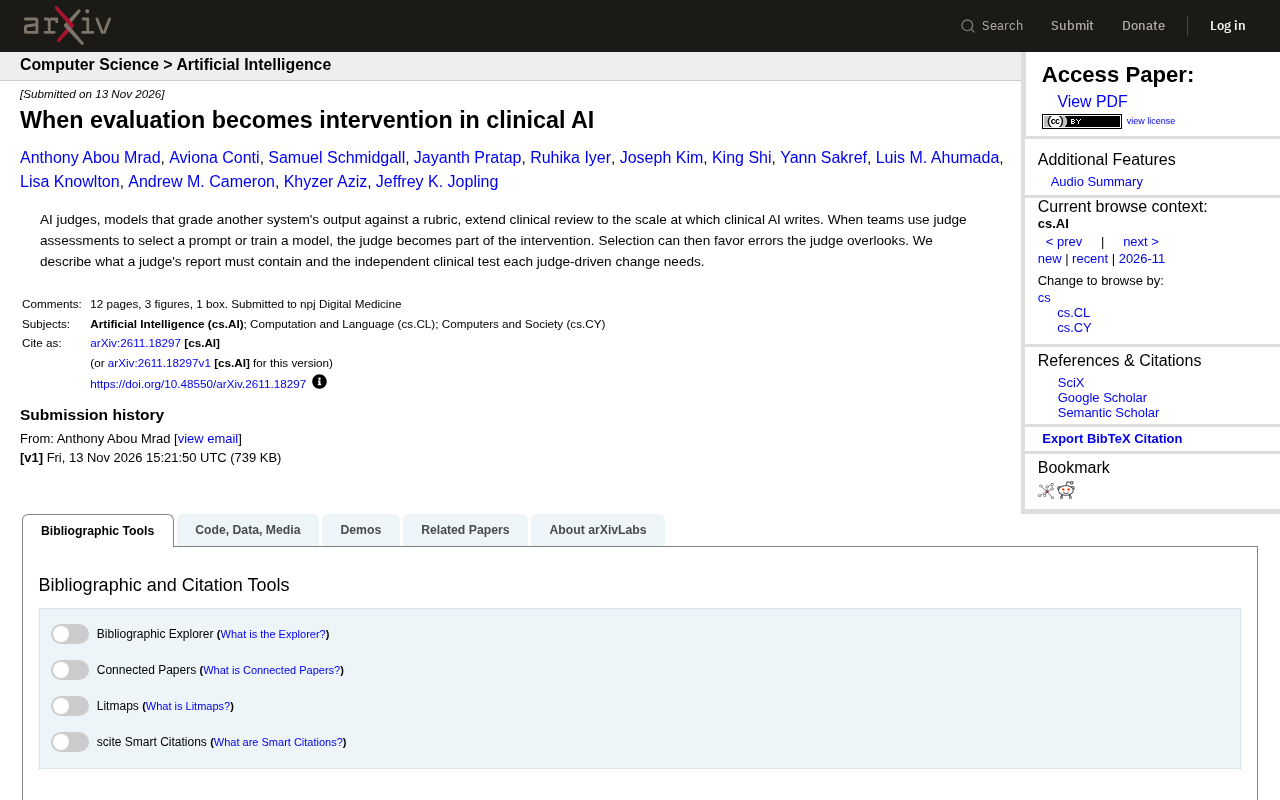
The article examines the role and risks of AI judges in clinical AI iteration. AI judges can scale review, but when teams use judge results to select prompts or train models, the judge is no longer neutral—it becomes part of the intervention. Selection mechanisms favor error types the judge can recognize, while overlooked errors may be preserved or amplified. The article argues that judge reports must expose scoring dimensions, handling of ambiguous cases, and inspection boundaries so clinical teams can assess the evaluation's trustworthiness. The core recommendation: every judge-driven change needs accompanying independent clinical testing to break correlated bias and provide a genuine second line of defense.
The line between evaluation and intervention is blurring
In the iterative workflow of clinical AI, using an AI judge—a model that scores another system's outputs according to a rubric—to scale up clinical review has become a common practice. Its appeal is obvious: clinical AI generates content at a speed and scale far beyond human review capacity, and AI judges seem to fill that gap.
But the key issue is this: when teams use a judge's evaluation results to select prompts or train models, the judge is no longer a neutral external observer—it becomes part of the intervention itself. The selection mechanism naturally favors the types of errors the judge can recognize, while errors the judge overlooks may be preserved or even amplified during model iteration.
What a judge report should contain
For evaluation to genuinely serve clinical safety, the judge's output cannot be just a score or a pass/fail verdict. The original material explicitly states that a qualified judge report must contain enough information for the clinical team to determine whether the evaluation itself is trustworthy and where its boundaries lie.
At minimum, this means the report needs to expose the scoring dimensions the judge relies on, how it handles ambiguous cases, and which types of errors fall outside its scope of inspection. Without this information, teams are effectively using one black box to validate another—and the validation conclusions directly determine the direction of the product.
Every judge-driven change requires independent clinical testing
This is the most actionable claim in the original text: any change made based on AI judge evaluation results needs to be accompanied by an independent clinical test.
The reason is that correlated bias may exist between the judge and the model. If the judge itself is insensitive to certain types of clinical statements, then the high scores it gives cannot prove that the model is safe along that dimension. Only clinical validation independent of the judge can provide a genuine second line of defense. Treating judge evaluation as the sole release criterion is equivalent to concentrating both selection pressure and validation pressure into the same step.
Correlated bias refers to the judge and the model sharing the same type of blind spots or preferences, such that the judge's high scores cannot independently prove the model's safety. This correlation may arise from: the judge and model being based on similar pre-training data, the judge's scoring criteria and the model's training objectives being homologous, or the judge itself being tuned by the same team on the same batch of data. When the correlation between judge and model is high, the information value provided by judge evaluation drops substantially—it is more like confirming "whether the model matches the judge's preferences" rather than "whether the model is clinically safe." The value of independent clinical testing lies in breaking this correlation: it uses evaluators different from the judge (clinical experts), different evaluation dimensions (real case outcomes), and different data distributions, thereby providing a genuinely orthogonal validation signal. This is also why the original text emphasizes the word "independent"—not just any test will do; it must be a channel that does not pass through the judge.
How selection bias quietly enters the model
When evaluation results are used for prompt screening or model training, the bias propagation path is as follows: the judge systematically misses certain types of errors, these errors are not penalized among candidates, and therefore the selected solutions are more likely to carry such errors. After multiple rounds of iteration, the model converges toward the judge's preferences rather than toward real clinical needs.
The insidiousness of this bias lies in the fact that each step's evaluation report looks qualified; the problem only emerges at the aggregate level. For clinical settings, this means risks will not surface during testing but may only appear after deployment.
Selection bias here specifically refers to a bias introduced by the evaluation mechanism itself, rather than the bias caused by uneven sample selection in traditional statistics. Its core mechanism is: when an AI judge is used as the basis for screening candidate solutions (prompts, model versions, etc.), the screening criteria effectively define "what counts as good." The judge systematically missing certain types of errors means these errors are not penalized during screening, and thus are implicitly rewarded in the candidate pool. After multiple rounds of iteration, the model distribution converges toward the judge's decision boundary rather than toward real clinical needs. In machine learning, this is a variant of "reward hacking"—the optimization objective deviates from the true objective, and the deviation is invisible in single-step evaluation, only accumulating and manifesting at the aggregate level. For clinical AI, this bias is especially dangerous because the judge's missed detections tend to concentrate on low-frequency but high-risk clinical statements.
Practical recommendations
When introducing an AI judge, teams should position it as an auxiliary tool for expanding review coverage, not as a decision basis that replaces independent clinical validation. Specifically, judge reports need to be transparent enough to be audited by clinical experts, and every judge-driven product change should retain an independent validation channel that does not pass through the judge. Evaluation can be scaled, but the consequences of intervention must be borne by independent clinical evidence.
One-line Summary
AI judges scale clinical review, but once their evaluations drive model selection, the judge becomes part of the intervention and requires independent clinical testing as a safeguard.
Paragraph Summary
The article discusses the role and risks of AI judges in clinical AI iteration. AI judges can scale review, but when teams use judge results to select prompts or train models, the judge is no longer neutral—it becomes part of the intervention. The selection mechanism favors the types of errors the judge can recognize, and overlooked errors may be preserved or even amplified during iteration. The article argues that judge reports must expose scoring dimensions, handling of ambiguous cases, and inspection boundaries so clinical teams can assess the trustworthiness of the evaluation itself. The core actionable recommendation is: every judge-driven change needs accompanying independent clinical testing to break possible correlated bias between judge and model and provide a genuine second line of defense.
Related articles

Gemini 4 Hydrogen vs Sonnet Comparison Test: Uses Only 1% of Weekly Quota, Performance on Par
Hands-on test: Gemini 4 Hydrogen vs Sonnet on the same CRUD task—Hydrogen used only 1% weekly quota with comparable performance and better UI details, while Anthropic's model used 7%. Developer says daily tasks don't require expensive models.

Gemini 4 Neon Released: Beats Opus 5.5 on Multiple Benchmarks, Google Returns to the Top Tier
Google DeepMind releases Gemini 4 Neon: 61 on the Artificial Analysis intelligence index (3rd) and 1st on the coding index, beating Opus 5.5 on multiple benchmarks. $3/$15 per million tokens; available in the Gemini API and AI Studio.

Gemini 4 Neon Review: Benchmark Scores Rival Carbon, API Cost-Performance Analysis
Full review of Google Gemini 4 Neon: benchmark scores rival Carbon, API priced at 2x Hydrogen, yet Antigravity quota consumption is only 1x (vs Carbon's 3x). Real tests show it replaces 90% of Carbon use cases. Includes channel restrictions, ban risks, and combination strategy analysis.