When Internship Opportunities Cross Ethical Lines: The Dilemma Facing AI Researchers
How an ML PhD student can rationally weigh an internship when research value clashes with company ethics.
An EU-based ML PhD student faced a dilemma: a target company had an outstanding research team, but its product team used "exploiting user insecurities" as a marketing tactic — directly at odds with his values. The article uses this as a lens to examine the cultural divide between research and commercial teams common in the AI industry, and proposes three dimensions for evaluating such decisions: how directly your work connects to the controversial practices, the reversibility afforded by a time-limited internship, and the long-term impact on your professional reputation. The core conclusion: nearly no employer is perfect — what matters is knowing your own boundaries and keeping multiple options open so you can actually hold to them.
A Real Career Dilemma
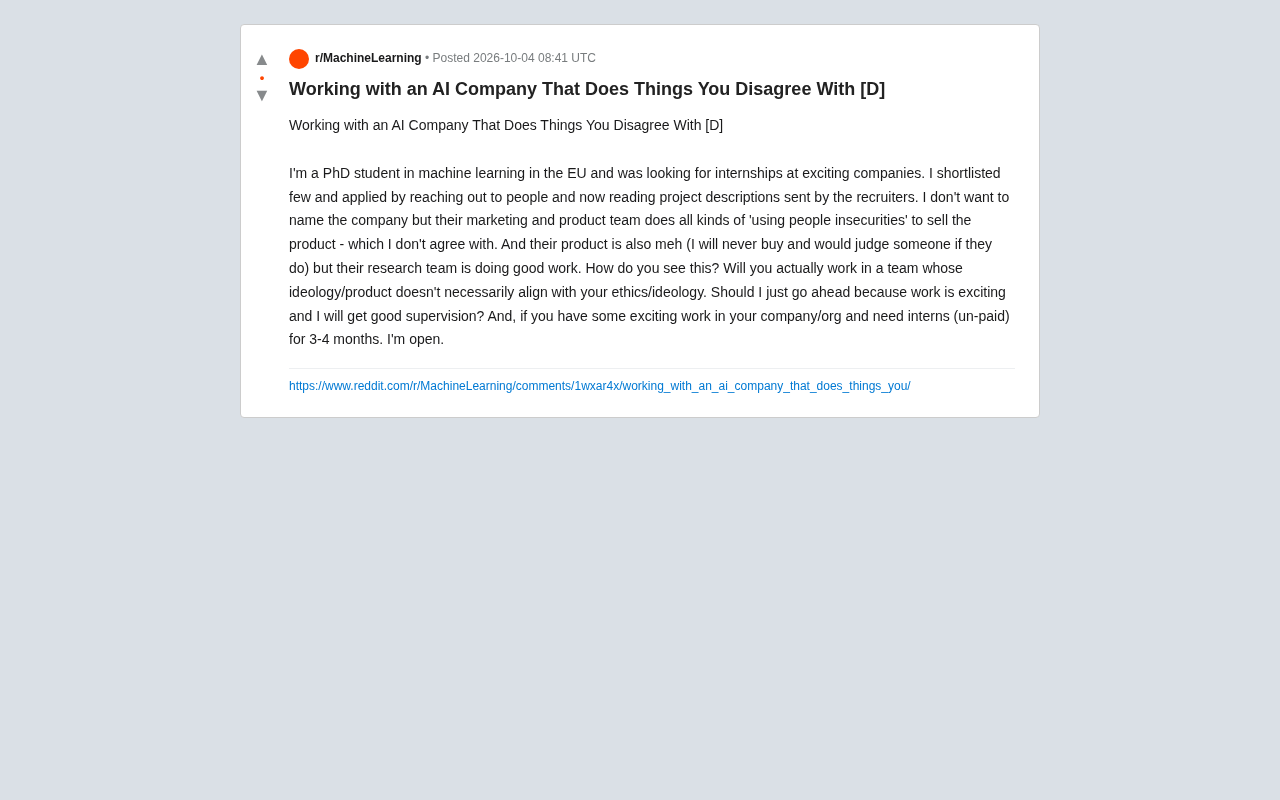
A machine learning PhD student studying in the EU recently posted a question on Reddit that resonated with many in the field. While searching for internships and vetting several promising companies, he discovered something troubling about one of them: the company's marketing and product teams heavily relied on "exploiting people's insecurities" to sell their products — a practice he fundamentally disagreed with.
What made it even more nuanced was that he didn't think much of the company's actual product either (describing it as "meh," adding that he'd never buy it himself and would even judge others who did). Yet the tension remained — the company's research team was doing genuinely impressive work. So the question landed squarely on the table: Would you join a company whose product philosophy and business ethics conflict with your personal values?
The Disconnect Between Research and Commercial Teams
This kind of dilemma is surprisingly common in the AI industry. A company's research division and its commercialization arm often operate under entirely different logics. Research teams pursue technical breakthroughs, paper output, and academic reputation, while product and marketing teams are accountable for revenue and growth — and the latter sometimes resort to the "selling anxiety" tactics the poster described.
For a PhD student, the core value of an internship lies in quality research mentorship, access to cutting-edge projects, and building an academic network. From that perspective, joining a strong research team can deliver real, tangible career benefits. The poster himself acknowledged that the role was "exciting" and came with solid mentorship.
The catch is that when a company's name appears on your résumé, the outside world won't draw fine distinctions between whether you were on the research team or the product team. That "guilt by association" is precisely where the ethical concern takes root.
This disconnect is especially pronounced at the boundary between academia and industry. AI research teams often emerge from academic culture, with their core KPIs centered on publishing at top conferences (NeurIPS, ICML, ICLR, etc.), releasing open-source models, and building technical influence. Meanwhile, the growth team at the same company operates under a completely different incentive structure — optimizing for conversion rates, retention, and paying user growth. The two teams may share a Slack workspace yet effectively live in parallel universes. This explains why you often see a company simultaneously publish an impressive technical report while drawing controversy for aggressive business practices — it's not a contradiction, but the inevitable result of two distinct subcultures coexisting. For interns or junior researchers, using LinkedIn, paper acknowledgments, or direct outreach to team members before joining is an effective way to assess the actual independence of the research team and reduce information asymmetry.
How to Weigh the Ethical Calculus
When facing this type of decision, it helps to evaluate it calmly across several dimensions:
Level of Involvement and Direct Contribution
The key question is: will your work directly enable the practices you object to? If you're on the research team working on foundational models or algorithm optimization with no connection to the controversial marketing, the ethical burden is relatively light. But if your research outputs will be directly used to reinforce a product mechanism that exploits users' insecurities, the situation is entirely different.
Time Investment and Reversibility
The poster mentioned this would be a 3–4 month internship. A short-term engagement with a clear exit point is fundamentally different in nature from signing a long-term employment contract. An internship is inherently a trial run and a learning experience — there's more room for error.
Long-Term Impact on Résumé and Reputation
In an industry as interconnected as AI, the institutions you've worked for become part of your personal brand. It's worth thinking ahead: a few years from now, will you be able to explain this decision comfortably?
In the AI field, the weight that "company brand prestige" versus "individual research contributions" carries on professional reputation varies by career stage. For PhD students, the academic community tends to evaluate people more through paper authorship, advisor endorsements, and conference presence than purely by employer name. In industry job-hopping contexts, however, the brand effect of a former employer gets amplified. It's also worth noting that AI ethics and Responsible AI are becoming increasingly explicit considerations at top institutions — academic, governmental, and big tech alike. In certain hiring contexts, having worked at a controversial company can genuinely prompt follow-up questions from interviewers, and candidates benefit from preparing a clear narrative framework in advance.
A Gray Area With No Standard Answer
It's worth acknowledging that in the real world, you'll almost never find a "perfectly clean" employer. Many large tech companies — and even nonprofits — have controversial practices somewhere in their operations. Setting an overly absolute ethical standard risks missing out on nearly every meaningful opportunity; yet abandoning principles entirely betrays one's own conscience.
A pragmatic middle ground is to clearly define where your line is. Some practices fall into the category of "I don't love it, but I can live with it" — others cross a threshold you're unwilling to compromise on. Whether anxiety-driven marketing belongs in the first category or the second is something only the poster can answer for himself.
It's also worth noting that at the end of his post, the poster openly mentioned that if any other organizations had exciting projects and needed (unpaid) interns, he was open to that too. This actually signals something positive — he's not stuck with just one path. He has options. And having alternatives is precisely what makes it possible to stand by your principles.
Practical Advice for Anyone in a Similar Position
If you're facing a similar choice, consider the following:
- Separate the product from the research: Assess whether your specific responsibilities are decoupled from the controversial business practices, rather than making a blanket judgment about the entire company.
- Have a direct conversation: Before the interview or before joining, ask candidly about team culture and actual work content to reduce information asymmetry.
- Set exit conditions: A short-term internship gives you a window to observe. If the actual work crosses your lines, cut your losses early.
- Expand your options: Like the poster did, actively seek out more opportunities so you're not held hostage by a single choice.
There's no universal answer to these questions. At its core, it's about finding a balance between career development, academic gains, and personal values. What truly matters isn't how anyone else would decide — it's whether you can take ownership of your decision and face it with a clear conscience.
Related articles

WorkBuddy Full Tutorial: Build an AI Office Automation Agent from Scratch
A complete WorkBuddy tutorial: installation, three working modes, multimodal picture book video practice, expert team agent building, and workflow configuration for low-cost AI office automation.

WorkBuddy Agent Complete Guide: From Beginner to Automation in 7 Days
Based on Bilibili's 256-episode WorkBuddy masterclass, this systematically breaks down Tencent's AI office workbench core capabilities: Agent principles, Skill encapsulation, cross-platform connectors, scheduled automation, knowledge bases, and zero-code development, with learning path recommendations.

8 AI Accounts, 7 Failed: An Honest Review of Using AI to Get Work Done
Only 1 of 8 AI-run Bilibili accounts succeeded. We break down the real difference between "performing AI" and "using AI to get work done."