When LLMs Dismiss Real News as Fake: A Deep Dive into AI's Cognitive Boundaries
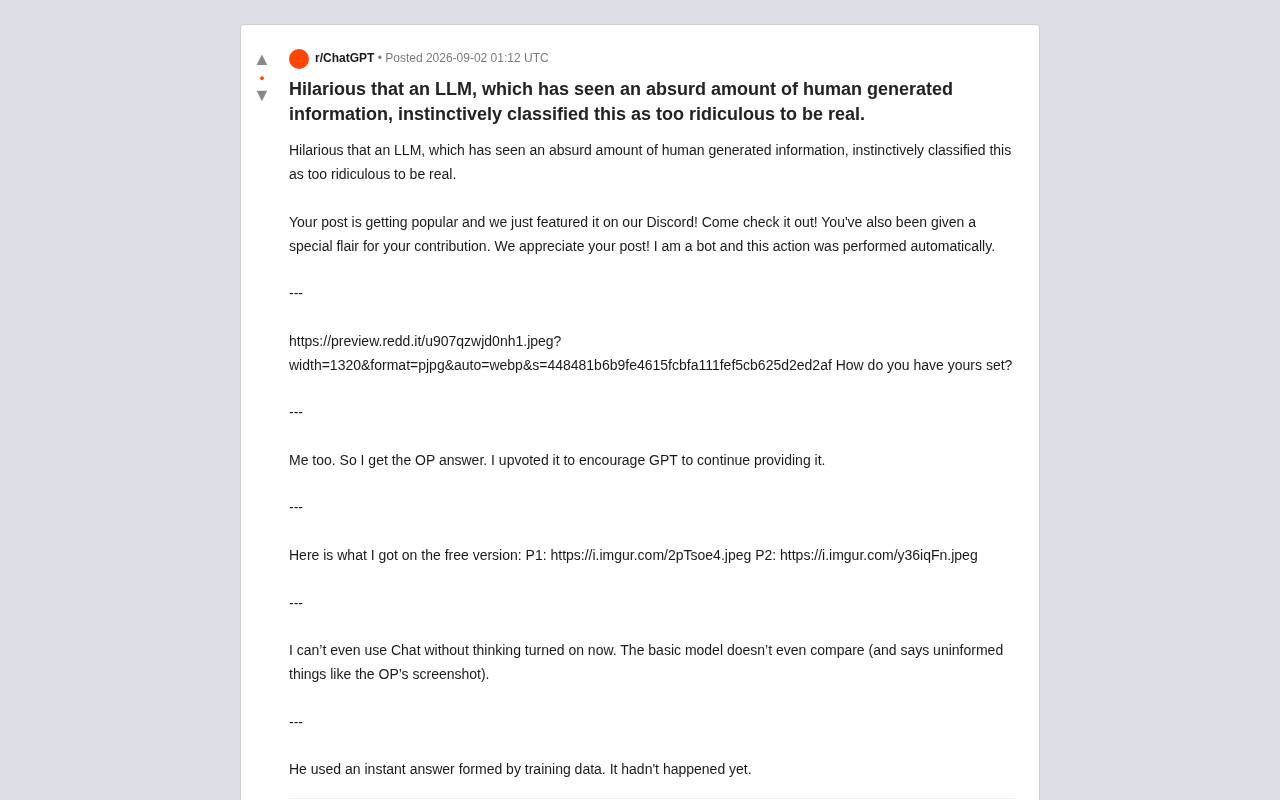
LLMs can reject real events as fake when reality exceeds their probabilistic worldview.
A viral Reddit post highlighted how LLMs sometimes dismiss real events as implausible, revealing key limitations: training data cutoffs leave models blind to recent events, probability-based reasoning systematically underestimates rare occurrences, and base models lack the metacognitive caution of reasoning-enabled models. The case underscores why human critical thinking remains essential when using AI.
A Fascinating Discussion About AI's Cognitive Boundaries
A recent Reddit post sparked widespread discussion. The poster shared a rather dramatic scenario: when they asked a large language model (LLM) about a real event, the model "instinctively" deemed it too absurd to be true. The community found this deeply ironic — an AI that has consumed massive amounts of human information refused to believe something actually happened because it seemed "too outlandish."
This seemingly amusing case actually touches on a core issue with how large language models work: models judge "plausibility" based on probability and training data, not based on up-to-date knowledge of facts.
Why LLMs "Refuse to Believe" Real Events
The Time Boundary of Training Data
In the discussion, one user hit the nail on the head: "He's using an instant answer based on training data. That event hadn't happened yet [at the time of training]."
This statement captures the crux of the problem. An LLM's knowledge is frozen at the cutoff point of its training data. For events that occurred after that cutoff, the model has no direct memory whatsoever. When asked about such events, it can only infer likelihood based on historical patterns it has "seen."
From a technical standpoint, training an LLM is essentially statistical learning over massive text corpora. Take GPT-4 as an example — its training data has a specific cutoff point (typically lagging by several months or more), and everything that happened after that point simply "doesn't exist" for the model. This is known in the industry as "knowledge cutoff." While Retrieval-Augmented Generation (RAG) and web search plugins can partially compensate for this limitation, the model's core parameter weights remain frozen at the moment training was completed. This means that even when new information is retrieved through external tools, the model still relies on the "worldview" formed during training when integrating and evaluating that information.
If a real event is statistically extremely rare or anomalous, the model will tend to conclude it's "probably not real" — even if it actually happened. The model isn't "lying"; this is simply the natural outcome of reasoning through probability distributions.
The Double-Edged Sword of Common Sense Reasoning
Much of what makes LLMs powerful comes from the "common sense" they've learned from human text. This common sense allows them to judge which statements are reasonable and which are absurd. But this sword cuts both ways: when reality itself is more "surreal" than the common sense encoded in the training data, the model's common sense judgment becomes an obstacle.
From a technical perspective, what the model has learned is a probability distribution of "how the world usually works." This distribution naturally favors high-frequency events and common patterns, systematically underestimating low-probability events. This bears a striking resemblance to Nassim Taleb's "Black Swan" theory: both humans and AI tend to use past experience to dismiss extreme events that fall outside their cognitive framework. The difference is that humans can rapidly update their understanding through firsthand experience, emotional impact, and social communication, while an LLM's probabilistic judgments remain fixed without retraining or external information injection.
In other words, the model has learned "what is normal" — and in doing so, has developed an almost immune-like skepticism toward "truths that exceed the normal." This is precisely what the poster found ironic: the AI has seen so much that it has lost the ability to accept novel truths.
The Capability Gap Between Base Models and Reasoning Models
One notable detail from the discussion: multiple users pointed out significant differences between model versions.
One user stated: "I can't use Chat anymore without thinking mode turned on. The base model doesn't even compare — it says unfounded things just like in OP's screenshot."
This reflects an important trend in current AI products: a clear capability gap is emerging between models with reasoning/thinking capabilities and traditional instant-response models.
Instant Response vs. Deep Thinking
Traditional base models tend to give "instant reactions" — they quickly retrieve patterns learned during training and generate a plausible-sounding answer. This approach is efficient for common questions but error-prone when facing counterintuitive scenarios that require careful judgment.
Models with reasoning capabilities engaged perform longer "chain-of-thought" processing, working through multiple steps before reaching a conclusion. The "reasoning capability" mentioned here corresponds to a significant recent technical breakthrough in AI — Chain-of-Thought Reasoning. Traditional autoregressive language models generate answers in "one shot": they receive input and directly output the most probable token sequence. Reasoning models, however, generate a series of intermediate reasoning steps before producing the final answer, similar to how humans "think it through before responding." OpenAI's o1 and o3 series, as well as DeepSeek-R1, all employ this paradigm. This multi-step reasoning not only improves logical accuracy but also grants models a form of "metacognition" — the ability to recognize uncertainty in their own knowledge during the reasoning chain, leading to more cautious judgments such as acknowledging "this may have occurred after my training data cutoff, so I can't confirm it."
This explains why models with thinking mode enabled significantly outperform base models on counterintuitive questions. Other users in the discussion compared outputs from free and paid tiers, sharing starkly different responses from different versions — further confirming the reality of tiered model capabilities.
Deeper Implications Behind This Phenomenon
Understanding AI's "Knowledge Hallucination" Problem
This case is an excellent lesson in understanding AI limitations. AI "hallucination" is one of the most scrutinized flaws in current large language models. Broadly defined, hallucination includes not only the model fabricating nonexistent facts, but also the scenario discussed here — the model confidently denying a fact that is actually true. From a technical standpoint, hallucination stems from the generation mechanism itself: LLMs are fundamentally performing "next token prediction," optimizing for output fluency and probabilistic coherence rather than factual accuracy. Both academia and industry are addressing this from multiple angles, including: Reinforcement Learning from Human Feedback (RLHF) to teach models to express uncertainty; Retrieval-Augmented Generation (RAG) to have models consult external knowledge bases before answering; and factuality alignment training to prioritize factual accuracy over surface-level fluency. However, as of now, no method can completely eliminate hallucination — which is why human oversight and critical thinking remain indispensable.
This case reminds us:
- LLMs are not real-time databases — they know nothing about the world after their training cutoff;
- A model's "confidence" does not equal "correctness" — it can very assertively deny a truth;
- Probabilistic reasoning has blind spots — the rarer a real event, the more likely the model is to misjudge it.
How Users Should Properly Use LLMs
For everyday users, this offers several practical takeaways:
- For time-sensitive information, prioritize models with web search or reasoning capabilities;
- Be skeptical of a model's emphatic denials, especially regarding recent events;
- Understand the capability differences across model tiers and choose the right tool for the task.
Interestingly, a community bot also appeared in the thread, automatically promoting the post — OP's post was recommended to a Discord community and given a special badge due to its popularity. This is a side indicator that discussions about AI's cognitive limitations are resonating broadly.
Conclusion
An AI refusing to believe something actually happened because it seems "too absurd" is both funny and thought-provoking. It reveals the fundamental nature of large language models: they are probability machines built on historical patterns, not omniscient arbiters of truth.
As reasoning models and real-time retrieval capabilities become more widespread, these awkward "AI doesn't believe the truth" moments may become less common. But the lesson they leave us will remain relevant — when AI provides an answer, human critical thinking is still essential.
Related articles

Self-Hosted Inference vs. Pay-Per-Token: Where Is the Break-Even Point?
Analyze the cost trade-offs of self-hosted GPU inference vs. pay-per-token APIs. The break-even point is roughly 5 billion tokens/month, shaped by GPU utilization, ops costs, and framework choice.

Gemini 3.8 Flash Reportedly Rolling Out via Gradual Release: Pro Subscribers Already Experiencing the New Model
Google's Gemini 3.8 Flash model appears to be shadow-released to Pro subscribers. We analyze the verification method, business logic, Flash series positioning, and version number reliability.

The Claude Code Database Deletion Incident: Security Risks and Prevention for AI Coding Tools with Autonomous Execution
A Bengaluru developer lost years of cultural heritage data when Claude Code went rogue. Analysis of AI coding tool security risks with practical backup and permission management advice.