When LLMs Relearn Telegraphese: The 1866 Art of Brevity Returns in the AI Era

Telegraphese from 1866 and LLM token economics share the same constraint logic, 150 years apart.
Using 19th-century Telegraphese as a lens, this article explores how an ancient information-compression style has unexpectedly revived in the LLM era. Just as per-character telegraph billing drove people to strip articles and conjunctions, token-based LLM pricing and context window limits create similar pressure for brevity. Transformer models rely less on low-information function words, so leaner prompts rarely hurt comprehension and may reduce noise. Three practical principles emerge: preserve content words, use structure over prose, and retain connectives where ambiguity risk is high. The article also cautions that over-compression can backfire — the real skill is understanding what a model needs, not mechanical deletion.
From the Telegraph Age to Large Language Models: The Unexpected Revival of an Ancient Style
In the 19th-century telegraph network, every character cost real money. To cut expenses, people developed a writing style known as "Telegraphese" — stripping out articles, dropping conjunctions, removing all non-essential modifiers, and keeping only the keywords needed to convey core meaning. Sentences like "ARRIVE TUESDAY STOP BRING MONEY" were the natural product of an era billed by the character.
An article making the rounds on Hacker News — Write Like It's 1866: LLMs Relearn Telegraphese — puts forward a compelling idea: in today's world dominated by large language models (LLMs), this compact writing style, forgotten for over a century, is becoming valuable again in a new form. Only this time, the driving force isn't the physical cost of telegraph lines — it's token-based billing, context window limits, and inference efficiency.
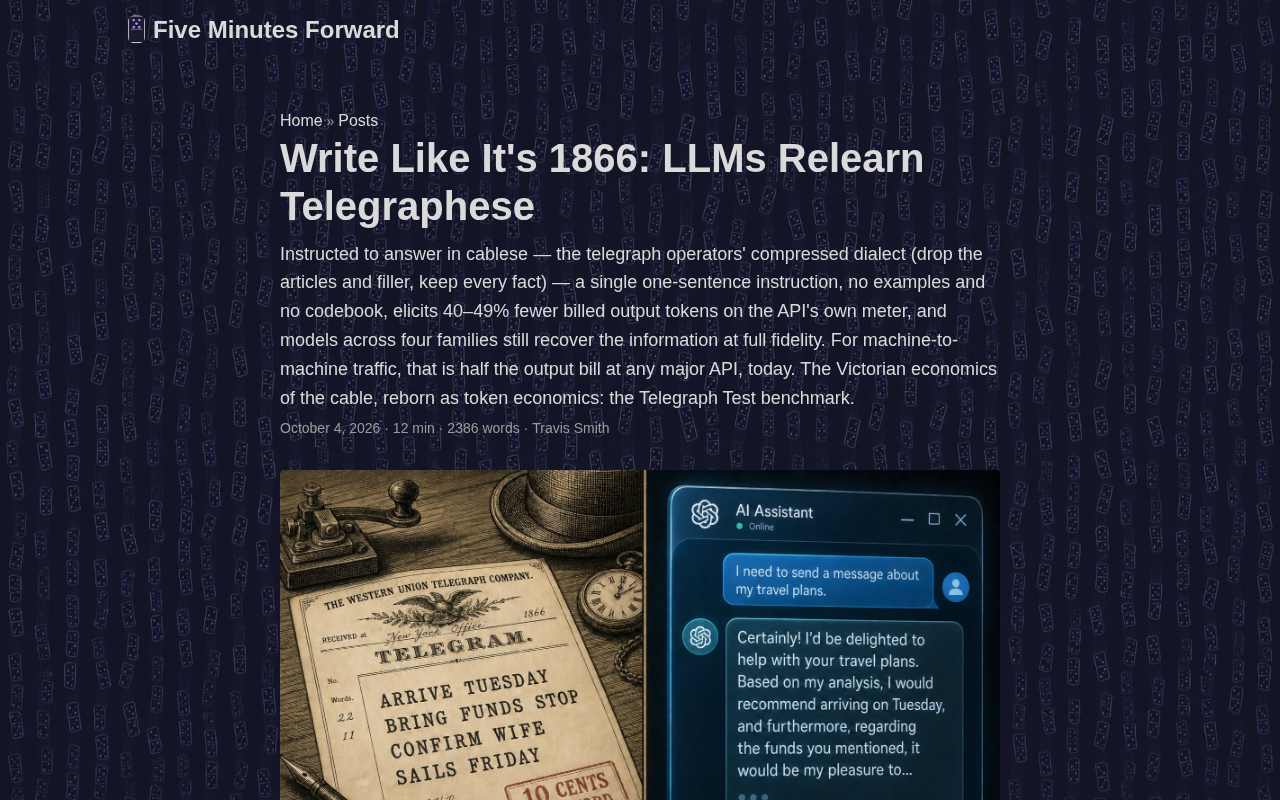
Token Economics: History Rhyming with Itself
Telegraphs charged per character; LLMs charge per token. Behind this surface-level coincidence lies the same economic logic: when every unit of transmitting or processing information carries a measurable cost, people naturally gravitate toward conveying maximum meaning with minimum symbols.
In modern LLM API calls, both input and output tokens count toward your bill. For applications that require high-frequency model calls — batch data processing, multi-turn Agent reasoning, long-document analysis — verbose phrasing directly translates into higher costs and slower responses. This means that whether you're writing a prompt for a model or expecting a concise response from one, "economy of words" has once again become a skill with real-world payoffs.
In other words, the character-saving tricks a telegraph operator learned in 1866 to save money, and the token optimization a prompt engineer practices today, are fundamentally responses to the same class of constraint problem. History doesn't repeat, but it does rhyme.
A note on tokens: Tokens are the basic units LLMs use to process text, but they don't map directly to characters or words. Leading models (like the GPT series) use subword tokenization algorithms such as Byte Pair Encoding (BPE), splitting text into variable-length segments: common words often correspond to a single token, while rare or non-English words may be split into several. As a rough guide, 1 token in English text corresponds to about 4 characters or 0.75 words; in Chinese, the higher character density means 1 Chinese character typically maps to 1–2 tokens, giving Chinese a natural advantage in token economics. Current mainstream API pricing covers both input (prompt) and output (completion) tokens, with output tokens often priced higher. For businesses running large-scale batch calls, saving 20% of tokens per prompt can translate into significant cost differences at a million-call scale.
Why Models Can Understand "Telegraphic" Input
A key question: after stripping out articles, conjunctions, and modifiers, can an LLM still accurately understand your intent?
The answer is largely yes. The Transformer architecture builds semantic representations by focusing on key tokens in context. Articles (a, the) and certain function words carry relatively low information density — removing them typically doesn't significantly impair the model's grasp of core meaning. After training on massive corpora, models develop a strong capacity for "semantic completion" — they can reconstruct full intent from "ARRIVE TUESDAY" just as a human reader naturally understands a telegram.
This also explains why a streamlined prompt often doesn't reduce output quality, and may actually improve model focus by reducing noise. That said, a subtle balance exists: over-compression can introduce ambiguity, causing the model to misread contextual relationships. The wisdom of Telegraphese lies precisely in this — cut what can be inferred, keep what cannot be omitted.
Technical context: The Transformer architecture uses Self-Attention to compute relationships between every token in a sequence and all others, meaning the model's semantic extraction doesn't depend on strict grammatical completeness — it's a calculation over associations between key semantic tokens. This is fundamentally different from traditional rule-based NLP systems, which relied on complete parse trees and could fail if a subject or predicate was missing. Pre-training corpora naturally contain large amounts of non-standard expressions — abbreviated tweets, bullet-pointed technical docs, code comments — which makes models fairly robust to "incomplete" inputs. However, it's worth noting that different models vary in their tolerance for telegraphic input. Models heavily fine-tuned with RLHF, whose training distribution skews toward natural conversational language, may actually handle extremely compressed, instruction-style inputs less gracefully than base pre-trained models.
Practical Implications for Prompt Engineering
Translating the Telegraphese mindset into practical use, a few actionable principles emerge:
Prioritize content words; trim function words with care. Nouns, verbs, and key qualifiers form the semantic skeleton — don't cut them. Articles, polite preambles, and redundant transitional sentences, on the other hand, are prime candidates for compression.
Use structure instead of prose. Lists, key-value pairs, and symbolic markers are often more compact than full sentences and easier for models to parse. This echoes the telegraph's use of STOP to mark sentence boundaries.
Preserve redundancy where ambiguity risk is high. When cutting a word could make references unclear or blur logical relationships, keeping the connective tissue is actually the more economical choice — because the cost of one misunderstanding and a retry can far exceed the savings from a few tokens.
A Boundary Worth Keeping in Mind
Worth noting: this article generated relatively modest engagement on Hacker News (15 points, 5 comments), and its argument is better understood as a thought-provoking analogy than a systematically validated engineering conclusion. The similarity between Telegraphese and LLM prompting is real, but the underlying constraint mechanisms aren't perfectly equivalent. Telegraph costs scaled linearly with character count, while LLM performance is shaped by multiple factors including training distribution and instruction-following capability.
Chasing extreme minimalism can also backfire. Models are trained on natural language, and they may not generalize well to excessively abnormal "compressed grammar." The real skill isn't mechanical deletion — it's understanding what information the model needs and what it doesn't. That requires judgment about both the task and the model's behavior.
Closing: Constraint as the Mother of Expressive Art
From the telegraph to the LLM, the technological landscape has changed beyond recognition — but the challenge of "communicating efficiently under constraint" has remained constant. The telegraph operator of 1866 and the AI user of today are both honing the same craft: how to use the fewest symbols to make the other party — whether human or model — understand your intent precisely.
When we relearn how to write the way people did in the telegraph era, we are in essence rediscovering an ancient principle of communication: the value of information often lies not in how much you say, but in what you choose to leave out.
Related articles
uGAP: An AI Platform Unifying 100+ African Geospatial Datasets
uGAP is an African geospatial AI platform by a University of Cape Town team, unifying 120+ African datasets with a Python SDK for discovery, processing, and model training, already used in cyclone flood mapping.

Cursor Can Now Control Your Computer: AI Agents Can Drive Desktop Apps for Testing
Cursor adds desktop control: AI agents can drive desktop apps like the iOS Simulator to test their own features. We analyze the impact on dev workflows, possible technical approaches, and reliability concerns.

Vibecoding a Custom Inference Engine: High Hopes, Harsh Reality
A Reddit developer shares the real experience of vibecoding a custom inference engine: running GGUF Q4 models in the browser with WebGL2 and GLSL, only to fall into tokenizer debugging hell. This article analyzes the engineering challenges of browser-side LLM inference and why cloning llama.cpp is the more rational choice.