When Optimal Transport Meets t-SNE: How OT-tSNE Eliminates Batch Effects

OT-tSNE replaces nearest-neighbor matching with global coupling from entropy-regularized optimal transport, improving single-cell cross-batch integration robustness.
The article introduces OT-tSNE, an integration and visualization method for single-cell batch effects. Traditional methods rely on cross-batch nearest-neighbor matching, which is local and error-prone under sparse overlap or distorted geometry. OT-tSNE uses global coupling affinities from entropy-regularized optimal transport embedded in t-SNE, balancing local structure preservation and cross-batch robustness. Synthetic experiments show nearest-neighbor methods degrade while OT remains robust; on seven real datasets, OT-tSNE achieves a Pareto-efficient trade-off between mixing and conservation. Computational cost and scalability remain concerns, and how correspondences are constructed may matter more than the downstream algorithm.
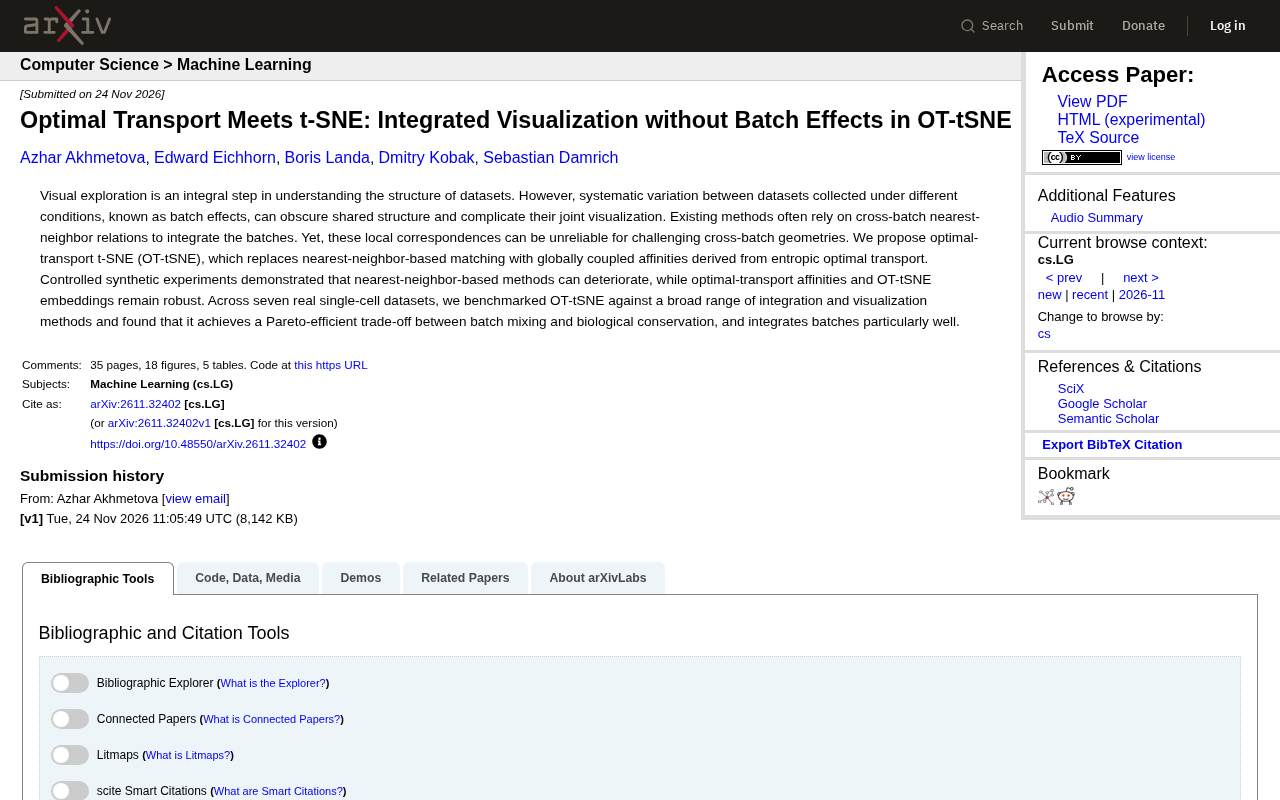
In single-cell data analysis, integrating datasets from different conditions or platforms is a common need. However, batch effects—systematic variation between batches—often obscure shared biological structure, making joint visualization difficult. A recent paper proposes OT-tSNE, which replaces traditional nearest-neighbor matching with Optimal Transport (OT), attempting to find a better balance between batch mixing and biological conservation.
Batch Effects and the Limitations of Existing Integration Methods
Batch effects are a long-standing problem in fields like single-cell sequencing. When data comes from different experimental batches, sequencing platforms, or processing conditions, technical differences introduce non-biological variation. If left unaddressed, this variation forms batch-separated clusters in dimensionality-reduction visualizations, obscuring the true cell-type structure.
Most existing integration methods rely on cross-batch nearest-neighbor relationships to align different batches. The idea is straightforward: if a cell in batch A finds a near neighbor in batch B, they are assumed to correspond to the same cell type, and representations are adjusted accordingly. But the paper points out that this kind of local correspondence may be unreliable under challenging cross-batch geometries—nearest-neighbor matching is essentially a local operation, and when overlap regions between batches are sparse or structurally distorted, matching easily goes wrong.
Entropy-regularized optimal transport: Optimal transport (OT) aims to move the mass of one distribution to another at minimum total cost. The classical form requires solving a linear program, which is computationally expensive. Entropy regularization adds an entropy term of the transport matrix to the objective, making the problem strictly convex and efficiently solvable via Sinkhorn iterations, while producing a smooth, dense coupling matrix. The regularization strength controls how "blurred" the coupling is: too large and it tends toward uniform, losing correspondence detail; too small and it approaches hard matching, causing numerical instability. OT-tSNE leverages this dense coupling matrix as the affinity between cross-batch cells, which is naturally global and smooth.
t-SNE and affinity embedding: t-SNE achieves dimensionality reduction with local structure preservation by constructing conditional probabilities in high-dimensional space (typically based on Gaussian kernels and nearest neighbors) and matching them with a t-distribution in low-dimensional space. Its input is essentially a similarity/affinity graph. OT-tSNE does not modify t-SNE's optimization framework; instead, it replaces how cross-batch affinities are constructed—using OT coupling instead of a nearest-neighbor graph—so t-SNE's gradient descent and visualization pipeline can be reused directly.
OT-tSNE's Core Idea: Global Coupling Replaces Local Matching
The key innovation of OT-tSNE is replacing nearest-neighbor-based matching with global coupling affinities derived from entropy-regularized optimal transport. Optimal transport provides a way to measure correspondence between two distributions from a global perspective, and entropy regularization makes the computation feasible and smooth.
Compared with nearest-neighbor "point-to-point" matching, optimal transport coupling is "distribution-to-distribution": it simultaneously considers transport costs between all points, yielding more robust cross-batch correspondences. The paper embeds this global coupling affinity into the t-SNE framework to form OT-tSNE, preserving t-SNE's strengths in local structure preservation while leveraging optimal transport to improve the robustness of cross-batch integration.
Pareto-efficient trade-off: In multi-objective optimization, a solution is on the Pareto frontier if no other solution can improve at least one objective without worsening any other. Single-cell integration often simultaneously pursues batch mixing (cells from different batches overlap sufficiently in low-dimensional space) and biological conservation (the same cell type clusters across batches while different types separate), and the two often trade off against each other. The paper describes OT-tSNE as Pareto-efficient: it lies on the frontier of mixing and conservation, meaning that at a given level of conservation it is hard to further improve mixing, and vice versa. This formulation better reflects the multi-objective nature of integration methods than a single score.
Experimental Validation: Synthetic Data and Real Single-Cell Data
Through controlled synthetic experiments, the paper demonstrates the degradation of nearest-neighbor methods: under certain geometric configurations, the performance of nearest-neighbor-based integration drops markedly, while optimal transport affinities and OT-tSNE embeddings remain robust.
On real data, the authors selected seven single-cell datasets and benchmarked OT-tSNE against multiple integration and visualization methods. Results show that OT-tSNE achieves a Pareto-efficient trade-off between batch mixing and biological conservation—that is, it achieves good batch integration without sacrificing biological structure. The paper particularly notes that OT-tSNE performs especially well in batch integration while maintaining competitive biological conservation.
Significance and Limitations
The value of OT-tSNE lies in pointing out a direction: in integration methods, how cross-batch correspondences are constructed may be more critical than the downstream dimensionality-reduction algorithm itself. Replacing local nearest neighbors with global optimal transport offers a more robust option for handling complex cross-batch geometries.
However, the computational cost of optimal transport is typically higher than nearest-neighbor search. Although entropy regularization alleviates the computational issue, scalability on large-scale datasets still deserves attention. The paper's benchmark covers seven real datasets, but more diverse data modalities and more extreme batch-effect scenarios remain to be further validated.
For researchers working on single-cell data integration and visualization, OT-tSNE offers a new tool worth trying, and it also reminds us to re-examine those local matching strategies that are treated as default options.
One-line Summary
OT-tSNE replaces nearest-neighbor matching with global coupling from entropy-regularized optimal transport, improving the robustness of single-cell cross-batch integration.
Paragraph Summary
The article introduces OT-tSNE, an integration and visualization method for single-cell batch effects. Traditional methods rely on cross-batch nearest-neighbor matching to align cells, but nearest neighbors are inherently local and prone to errors when overlap is sparse or geometry is distorted. OT-tSNE replaces nearest neighbors with global coupling affinities derived from entropy-regularized optimal transport and embeds them in the t-SNE framework, balancing local structure preservation with cross-batch robustness. Synthetic experiments show nearest-neighbor methods degrade under challenging geometries while OT methods remain robust; on seven real datasets, OT-tSNE achieves a Pareto-efficient trade-off between batch mixing and biological conservation. The article also notes that computational cost and large-scale scalability still require attention, and emphasizes that how cross-batch correspondences are constructed may be more critical than the downstream dimensionality-reduction algorithm.
Related articles

ChatGPT Plus Top-Up in China: Third-Party Website Recharge That Supports WeChat Pay and Alipay, No Overseas Card Needed
A Bilibili creator tests ChatGPT Plus top-up methods in China: comparing third-party website recharge, direct credit card, and mobile in-app purchase, with a full walkthrough of password-free WeChat/Alipay recharge and an analysis of Session credential and payment risk-control risks.

6GB Delivers Opus-Level Performance: Bonsai 2.5 27B Hands-On Test
Prism ML releases Ternary Bonsai 2.5 27B: ternary quantization brings it to just 5.9GB, runnable on a single consumer GPU while retaining 262k context and vision. Hands-on agentic benchmarks approach full-precision Qwen 3.8 27B, exceeding 150 tokens/s on a 4090, with impressive frontend and dashboard results, though game development and long tasks remain weak spots.

System Exchange Spawns an Offbeat Journey to the West: Why This Comedy Series Works
A Bilibili comedy short series reimagines Journey to the West with a system-exchange premise, as the protagonist challenges Sun Wukong, Erlang Shen, and other classics.