When the NSA Gets Involved: The AI Supply Chain Crisis Behind Open-Source CVEs and API Key Hijacking

PHP 9.2-score vulnerability and Railway/OpenCode breaches erupted the same day, with AI accelerating exploitation and API keys becoming black-market targets.
The article separates two types of same-day security events: public CVE disclosures such as the PHP core 9.2-score vulnerability, which prompted a rare FBI call to patch or shut down and saw ChainGuard break the disclosure embargo; and real breaches at Railway and OpenCode, where attackers stole API keys and compromised deployment environments. It notes that AI agents rapidly analyze patches and generate exploits, compressing the fragile window from fix to attack, while API key black market demand from access-restricted model distillation makes all key-hosting platforms targets. It also debunks the misleading "PHP runs 70% of websites" statistic, stressing real risk lies in unmaintained legacy sites, and offers a developer defense checklist.
When Patch Day Becomes a "Massacre Day"
Within a single day, severe vulnerabilities were disclosed in multiple open-source projects including Node, GitLab, PHP, Quick, and Light LLM. The FBI even took the rare step of tweeting an urgent call for organizations to patch or take systems offline immediately. At the same time, Railway and OpenCode suffered actual breaches: API keys were stolen and deployment environments were compromised. A YouTube tech creator said bluntly in a video that this was "one of the most unprecedented days in software history."
But what deserves more attention is that these two types of events have been widely discussed as if they were the same thing. A CVE is a public disclosure of a known vulnerability, while Railway and OpenCode are real attack incidents. Both are bad, but they are bad in completely different ways. This article attempts to separate the two threads and explain a structural risk that is taking shape: the acceleration of vulnerability exploitation by AI models, and the systemic threat that the API key black market poses to hosting platforms.
The CVE Side: Why the PHP Vulnerability Alarmed the FBI
PHP's 9.2-Score Vulnerability and "PHP to shell"
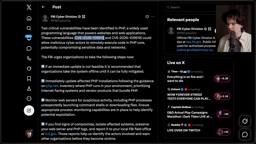
According to the FBI tweet cited in the video, PHP core contains a remotely exploitable memory vulnerability through which attackers can gain root access, commonly known as "PHP to shell." Both vulnerabilities have a CVSS score of 9.2. The FBI's advice was direct: upgrade immediately according to php.net guidance; if immediate updates are not possible, take systems offline; and prioritize inventorying internet-facing PHP instances.
What makes it trickier is that the PHP Foundation pointed out that ChainGuard released patched container images hours early, breaking the coordinated disclosure embargo. This means attackers could study the fix code while other distributions were still preparing updates. In an era when AI agents can rapidly analyze patches and generate exploits, every hour of the disclosure window becomes extremely expensive.
CVSS (Common Vulnerability Scoring System) is a widely adopted industry framework for quantifying vulnerability severity, maintained by FIRST, with scores ranging from 0 to 10. A score of 9.2 falls into the "critical" category, typically meaning the vulnerability is remotely exploitable, requires no user interaction, and can lead to privilege escalation or code execution. The higher the CVSS score, the more organizations should treat it as an urgent security incident rather than a routine version update. It is important to note that CVSS measures the technical severity of the vulnerability itself and does not directly reflect the actual risk in a specific environment—a 9.2-score vulnerability affecting only an isolated internal system may have a lower business impact than a 7.0-score vulnerability exposed to the public internet. That is why the FBI's advice specifically emphasizes "prioritizing inventorying internet-facing PHP instances"—this is precisely a risk management approach that combines generic scoring with asset exposure.
Coordinated Disclosure is a vulnerability disclosure norm long established by the security community: the discoverer first privately notifies the vendor, and both parties agree on an embargo period during which the vendor prepares a patch and distributions synchronize updates, with details made public only after the embargo ends. The embargo exists to give defenders a patching window and prevent attackers from mastering exploitation methods before a patch is available. ChainGuard's early release of patched images effectively leaked the key clue of "fix code" during the embargo—attackers can compare old and new code to locate the vulnerability and then reverse-engineer an exploit. In an era when AI agents can rapidly analyze patches, the cost of such early leaks is significantly amplified.
Models Are Compressing the "Vulnerability Window"
The video's author introduced a key concept: the fragile window. It is determined jointly by how obvious the vulnerability is, how fast patches are distributed, how difficult exploitation is, and what access attackers gain. In the past, discovering a patch, understanding the patch, writing an exploit, and distributing it before updates landed required substantial human effort. Now, agents can review commits one by one, identify security-relevant changes, and directly generate exploit code targeting older versions.
One piece of supporting evidence: these PHP vulnerabilities were not discovered by the most frontier models, but by models at the GPT 5.6 level. At the same time, the Wiz team independently discovered the same vulnerabilities. Cross-validation from multiple sources shows that vulnerability discovery capability is spreading rather than concentrating in a few security teams. This also weakens the traditional assumption that "private disclosure is sufficient to prevent mass exploitation."
AI agents here refer to model systems capable of autonomously executing multi-step tasks: they can read a code repository's commit history, identify security-relevant changes, understand patch logic, and generate exploit code targeting older versions. Compared with traditional "manual audit + hand-written exploit," the advantage of agents lies in tirelessly reviewing commits one by one, comparing differences across versions, and compressing the time from "patch to exploit" from days to hours or less. This is precisely the technical mechanism by which the "fragile window" is compressed.
It is worth distinguishing between the two stages of "vulnerability discovery" and "vulnerability exploitation." The discovery of PHP vulnerabilities by models at the GPT 5.6 level shows that models already have practical capabilities in code auditing and pattern recognition; agents generating exploit code further connects the chain from discovery to weaponization. The independent discovery by the Wiz team and the model discovery form cross-validation, meaning vulnerability discovery capability is spreading from a few security research teams to a broader set of participants—including potential attackers. This weakens the traditional assumption that "private disclosure is sufficient to prevent mass exploitation," because as the discovery barrier lowers, the probability that a vulnerability is independently found by multiple parties rises, and so does the risk that disclosure embargoes are broken.
70% of Websites Use PHP? This Number Needs to Cool Down
The video offers a strong rebuttal to the claim that "PHP runs 70% of websites": counting by number of URLs includes a large number of zero-traffic, unmaintained sites. The services that actually carry modern traffic—YouTube, GitHub, Twitter, Railway—mostly do not use PHP. The real distribution of risk is not in "PHP's share" but in "unmaintained legacy sites." Once these sites are compromised, the impact is on data preservation and botnets, not an immediate collapse of the mainstream internet.
The Attack Side: Why Railway and OpenCode Were Targeted
What Was Stolen Was Not Data, but API Keys
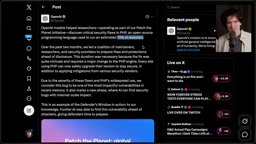
After OpenCode was breached, attackers obtained users' bring-your-own-key (BYOK) API keys for Anthropic, OpenAI, Gemini, and others. Developers reported that keys were consumed within minutes, with amounts ranging from hundreds to thousands of dollars, and some OpenAI accounts were suspended. OpenCode subsequently worked with model vendors to issue refunds, restore accounts, and automatically rotate keys.
Railway's incident was similar but more severe: attackers accessed encrypted environment variables and decrypted some of the contents, which may have included API keys and database credentials. At the same time, deployment services were unavailable for an extended period. The video's author was unable to redeploy from 1 a.m. to 5:30 p.m. and harshly criticized Railway's operational capabilities, explicitly stating that he would reconsider his hosting choices for critical software.
Why the Black Market Demands API Keys
A counterintuitive question: keys will be rotated quickly, so why steal them? The answer given in the video is model distillation. Teams that want to train models close to frontier capabilities but are restricted from accessing Anthropic and OpenAI need large amounts of high-quality reasoning data. Direct purchases get banned, and identity verification and usage thresholds are tightening, so "someone else's keys" become a low-cost, disposable channel for data generation.
This creates a downstream chain of effects: model vendors restrict sales → distillation demand shifts to the black market → hosting platforms become targets → ordinary developers' keys and bills get dragged in. The video's author concludes that every platform hosting API keys is now a target, because demand is large enough, resale is cheap enough, and accountability is difficult enough.
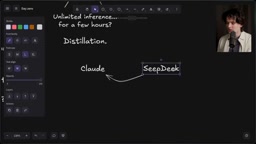
Model distillation is a technique for training a weaker model (the student) using the outputs of a strong model (the teacher): the student learns to imitate the teacher's reasoning process and response distribution, thereby achieving performance close to frontier capabilities at lower cost. The key raw material for distillation is large amounts of high-quality reasoning data—that is, the teacher model's detailed answers to various questions. For teams restricted by Anthropic and OpenAI in terms of access or usage thresholds, directly calling APIs to generate data will get them banned; buying "someone else's keys" allows them to obtain reasoning data at low cost and in a disposable way, swapping in a new key after one is banned.
BYOK (Bring Your Own Key) is a model used by developer tools such as OpenCode: users configure their own model vendor API keys into the tool, and the tool makes calls on their behalf. This model is user-friendly, but it also means keys are centrally stored in third-party platforms' environment variables; once a platform is breached, attackers can obtain large numbers of valid keys in bulk. In the Railway incident, encrypted environment variables were decrypted, similarly exposing the systemic risk of hosting platforms as "key aggregation points." The black market's demand for API keys is essentially demand for "disposable inference quota," which explains why keys are still worth stealing even though they are rotated quickly.
A Practical Defense Checklist for Developers
Faced with these two types of risk, action is more useful than anxiety. The following measures come from the video's recommendations and the weaknesses exposed by the incidents themselves:
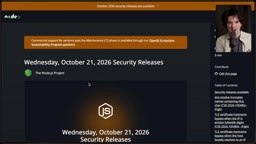
- Treat dependency updates as security incidents, not just version iterations. Security releases for projects such as Node, GitLab, and PHP should be prioritized in scheduling.
- Set up separate accounts, usage limits, and rapid rotation mechanisms for API keys. Do not put all keys in the environment variables of a single hosting platform.
- Monitor abnormal usage. Many victims of OpenCode and Railway only discovered the problem after their bills spiked.
- Inventory legacy site assets. Unmaintained PHP/WordPress instances should be taken offline or isolated rather than left to become attack stepping stones.
- Pay attention to the quality of disclosure embargo enforcement. The case of ChainGuard releasing images early shows that every link in the supply chain can leak patch information ahead of time.
Consensus and Disagreement Across Multiple Perspectives
Combining the video author, the FBI announcement, the PHP Foundation statement, and Wiz's independent discovery, several high-confidence judgments can be formed: the PHP vulnerabilities are severe and have already attracted attention in the wild; coordinated disclosure embargoes are easily broken; and AI agents significantly compress the time from patch to exploit.
The disagreement lies in the attribution of the Railway incident. The video's author attributes part of the prolonged deployment outage to the platform's operational capabilities rather than purely to the hacker attack; this judgment comes from a single source's personal experience and needs more independent evidence. Another point of controversy is the motivation behind Anthropic's sales restriction policy: the video's author believes it involves both security considerations and an element of protecting a monopoly, which is an opinion rather than a fact.
Regardless of stance, one conclusion is clear: API keys have become high-value assets in the AI supply chain, and the security boundary of hosting platforms is no longer just "protecting user data" but also "protecting users' inference quota from being abused." This crisis will not end soon, but at least it can start with rotating the first key.
One-line Summary
PHP's 9.2-score vulnerability and the Railway and OpenCode breaches erupted on the same day, with AI accelerating exploitation and API keys becoming black-market targets.
Paragraph Summary
The article breaks down two types of security incidents that occurred on the same day: one is the public disclosure of CVEs such as the 9.2-score vulnerability in PHP core, with the FBI rarely urging patching or shutdown and ChainGuard releasing images early to break the disclosure embargo; the other is the real breaches suffered by Railway and OpenCode, where attackers stole API keys and compromised deployment environments. The author points out that AI agents can rapidly analyze patches and generate exploit code, significantly compressing the fragile window from fix to attack; and the demand in the API key black market comes from model distillation parties restricted from access, making all platforms hosting keys targets. The article also refutes the misleading statistic that "PHP accounts for 70% of websites," emphasizing that the real risk is concentrated in unmaintained legacy sites, and provides a developer defense checklist.
Related articles

Free Unlimited Claude Code Solution: Agnes AI + CC Switch Setup Guide
No paid subscription needed — pair the free AI platform Agnes AI with the open-source tool CC Switch to provide a backend for Claude Code, enabling unlimited free calls to text, image, and video models. This guide covers the full setup, test results, and usage boundaries.

A Complete Zero-Cost Guide to Getting Started with Claude Code for Beginners in China
A beginner's guide to Claude Code for users in China: two installation methods (command line and IDE plugin), full configuration steps for replacing the official API with the free domestic LongCat model, and a hands-on demo of building a small tool with natural language, plus tips.

AI New Grad Resume Diagnosis: How to Stand Out for ML/CV Roles?
How can AI/ML new grads optimize their resumes to get interviews? Based on a real Reddit case, this article analyzes project selection, depth display, and structure for ML/CV roles, with actionable revision advice.