When Will Local Image Editing Models Catch Up to Nano Banana Pro?

Open-source image editing still lags behind Google's NBP due to the "collage effect," with hopes pinned on Krea 3.
A Reddit user's comparative test reveals a core tension in the AI image generation open-source ecosystem: while T2I has strong local solutions like Krea 2, no local model has emerged to rival Google's Nano Banana Pro (NBP) for image editing nearly a year after its release. NBP can reconstruct a subject's identity and 3D spatial presence from a single reference image — described as "instantly training a LoRA" — while open-source models like Qwen tend to paste subjects into new scenes, producing an obvious collage effect. Krea 2 excels at T2I and low-degradation LoRA training but can't bridge the editing gap. The community's hopes rest on the unreleased Krea 3, reflecting how image editing is becoming the next major battleground between open-source and cloud-based AI models.
In the AI image generation space, the open-source ecosystem for text-to-image (T2I) is already quite mature — but when it comes to image-to-image (I2I) and image editing, there's still a significant gap between local models and top-tier cloud-based solutions. A recent observation from a Reddit user captured a frustration shared by many creators: nearly a year after the release of Nano Banana Pro (NBP), the community still hasn't seen a local editing model that can genuinely compete with it.
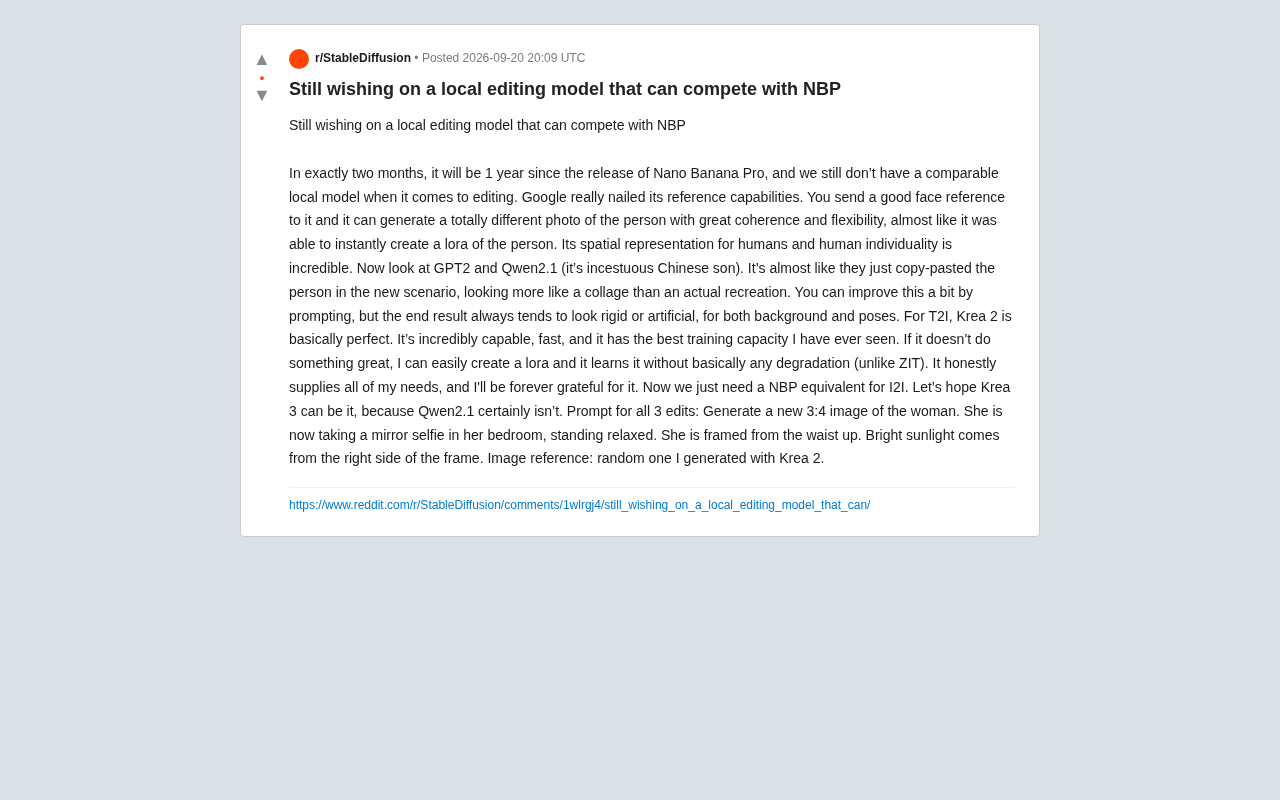
NBP's Reference Capability: Like Instantly Training a LoRA
This user had extremely high praise for Google's NBP, with the core strength being its handling of character reference images. According to the description, you only need to provide one decent-quality facial reference photo, and NBP can generate images of that person in completely different scenarios while maintaining impressive consistency and flexibility — "almost like it instantly trained a LoRA for that person."
That analogy is worth unpacking. In the open-source community, reliably reproducing a specific individual typically requires collecting multiple images and training a dedicated LoRA model — a time-consuming and labor-intensive process. NBP compresses that entire pipeline into a single-image inference step. The user specifically highlighted NBP's ability to reconstruct the spatial representation of the human body and the "individuality" of the subject — it understands not just the arrangement of facial features, but how that person exists as a unique individual in three-dimensional space.
LoRA (Low-Rank Adaptation) is a lightweight fine-tuning technique originally proposed by Microsoft Research and later widely adopted by the AI image generation community. Instead of modifying all weights of a pretrained model, it injects low-rank "delta matrices" alongside the original weight matrices, requiring only a tiny fraction of parameters to be trained — enough for the model to learn a specific style, person, or concept. In the image generation community, users typically need to collect 10–30 reference images of a specific subject from various angles and lighting conditions, then spend minutes to hours training before obtaining a LoRA file that can reliably reproduce that person's appearance. NBP achieving a similar effect from a single image at inference time implies some form of "instant identity binding" mechanism within the model — compressing knowledge that traditionally requires explicit training into a single forward pass. This is fundamentally different from LoRA fine-tuning and is closer to the few-shot in-context learning capabilities of multimodal large language models.
The Common Flaw in Open-Source Editing Models: Collage Rather Than Reconstruction
By contrast, the user was far more critical of current local alternatives — he mentioned "GPT2" and "Qwen2.1" (jokingly calling the latter the "inbred Chinese son" of the former). His core complaint: when these models perform edits, "it's almost like they copy-paste the person into the new scene," with results looking more like a collage than a genuine reimagining.
This "sticker effect" is a classic weakness of current open-source I2I models. While carefully crafted prompts can mitigate some of the problem, the final output tends to look stiff and artificial in both background and pose. The models lack a holistic understanding of the scene and can't naturally "integrate" the subject into a new environment — coherence in lighting, perspective, and posture all fall short.
To ensure a fair comparison, the user applied the exact same prompt to all three models: "Generate a new 3:4 image of the woman taking a mirror selfie in a bedroom, relaxed stance, framed from the waist up, bright sunlight coming in from the right side of the frame." The reference image was a random photo he had generated with Krea 2. Based on his feedback, local models still lag noticeably behind NBP on editing tasks that require recomposing and relighting a scene.
Image-to-image (I2I) editing is technically far more complex than text-to-image generation because the model must simultaneously satisfy two competing objectives: faithfully preserving identity information from the reference image (ID preservation) and appropriately adapting to the lighting, perspective, and pose constraints of the new scene. The "collage effect" in current open-source models is essentially the result of these two goals being out of balance — models over-rely on pixel-level features from the reference image, pasting the subject's outline and texture nearly as-is onto the new background, while lacking implicit 3D spatial modeling to infer how the subject should deform under a new viewpoint, generate self-shadows, or interact with the environment's light sources. Cloud-based large models typically have billions to hundreds of billions of parameters and are trained on massive multi-view character datasets, enabling them to build deeper 3D prior knowledge. Local open-source models, constrained by parameter scale and limited training data diversity, often only learn shallow texture transfer and cannot achieve true scene reconstruction.
T2I Is Already There: Krea 2's Training Capability Gets High Praise
Interestingly, the same user was quite satisfied with the text-to-image side of things. He described Krea 2 as "basically perfect" — capable, fast, and with "the best training capability" he's ever seen.
His specific reasoning: when Krea 2 doesn't perform well on certain content, he can easily train a LoRA and the model shows almost no degradation — a clear improvement over what he described as "ZIT." For creators who rely heavily on custom training, "low degradation" is a critically important metric — it means you can teach the model new things without breaking its existing capabilities. He stated plainly that Krea 2 already meets all his T2I needs.
The "degradation" problem in LoRA training refers to performance decline in a base model's original capabilities after new concepts are injected — for example, after learning a particular facial feature, the model may begin forcing that feature into unrelated generation tasks, or its general handling of anatomy, lighting, and shading may weaken. Degradation is influenced by multiple factors including training steps, learning rate, dataset diversity, and the base model's architecture. Low degradation rate is an important metric for evaluating a base model's "trainability" — particularly crucial for professional workflows that rely on large numbers of custom LoRAs. Creators want each specialized LoRA to precisely control the target feature while minimizing impact on the model's overall capabilities, allowing multiple LoRAs to be stacked and combined without unpredictable interference.
The Missing Piece: A Local NBP
Taken together, this thread paints a clear picture of the current state: the open-source ecosystem has delivered satisfying results on T2I, but the real gap is in image-to-image and image editing. The user pins his hopes on the yet-to-be-released Krea 3, believing it could become the "local NBP" — while making it equally clear that Qwen2.1 is not the answer.
Underlying this request is a broader industry trend: image editing is becoming the next competitive frontier. Cloud-based models have established an advantage in character consistency and spatial understanding through larger parameter counts and training datasets. Whether the local open-source camp — having closed the gap in T2I — can achieve the same catch-up in editing capability will determine whether it can serve the complete professional creator workflow.
It's worth noting that these assessments reflect a single user's subjective experience, and the model names mentioned (such as "GPT2," "Qwen2.1," "Krea 2/3," and "ZIT") may be informal community shorthand or personal abbreviations. The conclusions should be taken as anecdotal. That said, the pain points described — the "collage effect" and insufficient character consistency in local editing models — are genuine shortcomings of the current open-source image ecosystem, and it's worth watching whether upcoming open-source models can make a breakthrough in this dimension.
Related articles

Amphibious Transforming Drone: Beyond 100x Power Savings, What Are the Real Needs?
Is the amphibious transforming drone just a gimmick? Starting from the 100x power difference of the M4 Morphobot, explore real application scenarios and thesis topic ideas, analyzing boundary conditions where pure drones and pure ground robots both fail.

Warhound Raises $200 Million: Genetically Engineered "War Dogs" Paired with Anduril Gear
Warhound raises $200M, backed by Ben Lamm and Palmer Luckey, to genetically engineer dogs for military and law enforcement use and equip them with Anduril gear. This article analyzes its technology direction, funding logic, and ethical controversy.

Claude API Comes to Google Cloud: IAM Integration and SDK Access Guide
Anthropic hosts the full Claude API on Google Cloud with IAM-controlled permissions and unified billing. This guide covers the Vertex AI and Anthropic-hosted entry points, IAM role configuration, and SDK access.