When You Give an AI Agent Internet Access, What Breaks First?

The same Agent with only an internet tool added—four rounds of comparison and a two-hour live exercise reveal that real-time data is a necessary condition, not judgment itself.
The article presents a controlled experiment by YouTube creator Siraj Raval: the same model and prompt, with only an Oxylabs internet tool in the difference, building two Agents and testing them through four rounds—prices, timeliness, housing, code—plus a two-hour live used-hardware exercise. The online Agent performed better at verifying real booking pages, time-sensitive information, dynamically rendered listings, and coding with the latest documentation, but the author stresses that internet access does not equal correctness: live pages may contain misleading prices, expired listings, or wrong product variants, so source verification and dual-source cross-checking are essential. Geolocation and JavaScript rendering are key capabilities of the internet tool, while the MCP server makes the coding Agent's documentation lookup process auditable. The ultimate conclusion: real-time data is a necessary condition, not judgment itself—Agents must be taught how to 'see' and how to verify.
When Agents Start to 'Act,' Outdated Information Is No Longer a Minor Annoyance
The same model, the same prompt, with only one internet tool in the difference—two AI Agents may give wildly different answers. YouTube creator Siraj Raval ran just such a controlled experiment: build the same Agent twice, one that "can't see" the live web and one that can fetch live web pages, then test them with four rounds of tasks plus one two-hour live exercise.
The premise of this experiment is clear: language models have a training cutoff, and Agents take action—they price products, find jobs, search for housing, and write code. For a chatbot, outdated information is at most irritating; for an Agent, it can carry direct economic cost, because Agents make decisions based on wrong information. In the creator's words, an Agent running on "last year's internet" is like an intern who just woke up from a coma but is strangely confident about everything.
Experiment Design: Only One Tool in the Difference
The entire build consists of just two files, with the core difference being a single internet tool. The experiment used the Oxylabs Web API: give it a URL, and it returns clean Markdown that the model can read; it supports JavaScript rendering, which is crucial for the many modern websites that load content dynamically; and it supports geolocation, allowing the Agent to fetch results from the perspective of a specified country. Oxylabs claims a network covering 195 countries with over 175 million residential proxies. (The video is sponsored by Oxylabs, but the creator states that the results are not embellished—if the blind-test Agent wins, it wins.)
In Cursor, the author also connected Oxylabs' MCP server, letting the coding Agent query the latest documentation directly. The MCP server is open source on GitHub and can be reviewed independently.
MCP (Model Context Protocol) is a standardized protocol proposed and open-sourced by Anthropic, designed to let large language models connect to external tools, data sources, and services in a unified way. In coding Agent scenarios, an MCP server can expose capabilities such as "query the latest documentation," "search the codebase," and "call APIs," and the model interacts with these servers through structured requests rather than relying on static knowledge memorized during training. Compared with writing separate integration code for each tool, MCP provides a reusable layer of abstraction: tool providers only need to implement an MCP server once, and any Agent that supports the protocol can call it directly. The author's connection of Oxylabs' MCP server in Cursor is precisely leveraging this mechanism to let the coding Agent pull the current version of a library's documentation in real time before writing code, thereby avoiding the documentation-debt problem of "the function name looks right, but it's actually deprecated." Because MCP servers are usually open source, their behavior can be audited, which is especially important for production environments that require a trustworthy toolchain.
Four Rounds of Comparison: Prices, Timeliness, Housing, Code
Round 1: Price-Type Questions
The experiment starts with price questions, which most easily expose outdated information: a specific flight from JFK to San Francisco, the current price and available purchase channels for a consumer electronics product, and the difference between monthly and annual billing for a software subscription. The criterion is not which answer sounds more confident, but opening the actual booking page to verify: does the price correspond to a flight that meets the requirements, is the product a new model rather than a refurbished one, and does the link actually allow you to place an order.
The author also ran an easily overlooked comparison: the same question, the same website, only switching the geographic perspective from the US to Germany, and the result may show different stores, currencies, inventory, and prices. This explains why geolocation has practical significance for Agents—the Agent needs to view the web from the perspective of the user's market.
Round 2: Time-Sensitive Information
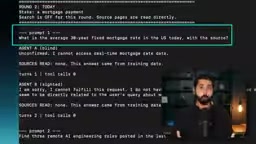
Mortgage rates and "salaried jobs posted in the last 24 hours" are the stars of this round. According to the verification process in the video, checking a mortgage rate involves only three things: the actual rate, the date, and whether it matches the loan type asked about; for a $500,000 loan, a small difference in rate noticeably affects the monthly payment.
Job search is harder: job boards are full of expired postings, duplicate listings, and pages without transparent salaries. It's not hard for the Agent to list three decent job titles; what's hard is that these jobs are actually open right now, were actually posted within the required time window, actually show a salary, and can actually be applied for.
Round 3: High-Value Scenarios Like Real Estate
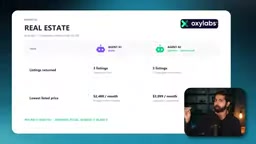
The task is to find currently available rentals in Brooklyn for no more than $3,200 per month. What's special about real estate search is that an apartment can genuinely exist and still be a completely useless result—it may have been rented last week, the price may be wrong, or the page may still be indexed but the unit is long gone. The author opens each listing to verify rather than counting it as a score just because the search result says it exists.
According to the example given in the video, the first month's rent plus an equal deposit for a $3,200 apartment creates potential financial exposure of up to $6,400—this is a risk illustration, not an actual loss in the experiment. Modern real estate sites rely heavily on JavaScript, so whether the tool can render the page and extract the body text is especially critical in this round.
JavaScript rendering refers to the process by which a browser executes page scripts and dynamically generates content. Modern real estate, e-commerce, and job sites rely heavily on front-end frameworks (such as React and Vue) to load data asynchronously on the client side; the raw HTML often contains only a skeleton, and key information such as listings, prices, and inventory is injected by JavaScript after the page loads. Traditional static scrapers can only get the initial HTML, so they miss this dynamic content or capture "loading" placeholders. Scraping tools that support JavaScript rendering (such as the capability claimed by the Oxylabs Web API in this article) simulate a browser executing scripts on the server side, wait for network requests to complete, and then convert the final rendered DOM into clean Markdown. This is crucial for Agents: if the scraping layer cannot get the real content, subsequent reasoning and judgment are built on an empty shell, and there is no way to tell whether a listing exists or whether the price is accurate.
Round 4: The Coding Agent's 'Documentation Debt'
This round is for everyone who writes software: have two Agents write a runnable script using a real software library, deliberately choosing a task that requires consulting the latest documentation. This is exactly where coding Agents are most frustrating—the code looks completely reasonable, the function names look plausible, the explanation sounds flawless, but the library has changed, and you are debugging code that was already outdated before it ever ran.
The blind-test Agent's code is run as-is, and the terminal output is the evidence; the online Agent queries the current documentation through the MCP server in Cursor before writing code. Whether it passes is decided by the terminal, not by the author.
Internet Access Does Not Equal Correctness: Judgment Is the Dividing Line
After four rounds, the author emphasizes a frequently overlooked conclusion: giving an Agent internet access does not automatically make it right. Live web pages may contain misleading prices, search results may point to the wrong product variant, listings may be expired, pages may show promotional prices that don't apply to your account, and the model may misinterpret perfectly accurate information.
To address this, the author added stricter accuracy checks: compare the online Agent's results item by item against the source, date, and specific product or service status, and require important conclusions to be cross-verified by two sources before being recommended. The goal is not to guarantee perfect answers, but to make the reasoning process auditable—if the Agent makes a mistake, it should be possible to distinguish whether it got bad information, misread correct information, or simply never checked a key link.

Dual-source cross-verification is an information verification strategy: for any key conclusion, require at least two mutually independent sources to provide consistent information before treating it as credible. In Agent scenarios, this means the model cannot draw conclusions based on a single search result or a single page; it should actively look for a second source for comparison. Judging independence itself also matters: if two sources are reposts of the same original data, or both come from aggregation pages on the same platform, then they do not constitute true cross-verification. The author requires the online Agent to cross-verify important conclusions with two sources before recommending them; the goal is not absolute correctness but making errors easier to detect—when two sources conflict, the Agent should flag uncertainty rather than force an answer. This strategy complements "requiring the Agent to show evidence" and together they form an auditable chain of reasoning.
Two-Hour Live Exercise: Can the 'Opportunities' in Used Hardware Be Trusted?
The final task is a real two-hour task: find used hardware currently listed below recent comparable sale prices, factor in platform fees and shipping, and list opportunity links that can actually be opened and purchased. The author let the online Agent run independently for two hours, observing API usage and request performance through the Oxylabs dashboard—for long-running Agents, avoiding a misconfigured loop that quietly burns through the budget is very practical. The Oxy Copilot in the dashboard can also describe the needed information in natural language and help generate scraping logic, reducing the time spent maintaining selectors.
The results table the Agent produced was not accepted directly. The author instead tried to disprove its strongest opportunities: open the original link to confirm it is still for sale, compare recent sales of the same model, and deduct fees and shipping. The gap between listing price and sale price does not equal profit—the condition may differ, the capacity may differ, the device may be damaged or locked, or it may already be sold. Profit exists only after the transaction is actually completed and costs are accounted for; what the Agent can do is surface opportunities, and whether an opportunity holds up is another question.
Residential proxy networks refer to proxy pools made up of real home broadband user devices, with traffic forwarded through these residential IPs so that the target website sees requests coming from ordinary consumers rather than data centers. Compared with data center proxies, residential proxies are harder for websites' anti-scraping mechanisms to identify and block, so they are often used for large-scale, geographically distributed web scraping. Geolocation capability depends on this: by selecting a residential exit IP in a specific country, the Agent can access websites from the perspective of a local user and obtain that market's stores, currency, inventory, and prices. Oxylabs claims its network covers 195 countries with over 175 million residential proxies. It is worth noting that the scale and compliance of proxy networks vary by provider; when using them, pay attention to whether their sources are legal, whether they comply with the target website's terms of service, and how to monitor usage through a dashboard during long-running Agent tasks to avoid runaway request loops consuming the budget.
Three Takeaways
First, when an Agent's work depends on current information, give it a channel to access current data. Second, require it to show evidence, not to be more confident. Third, you don't have to start over—sometimes the most meaningful change is simply adding one more tool. The author has also open-sourced the code for both Agents so readers can reproduce this comparison on their own Agents.
The most valuable part of this experiment is not the scoreboard but the boundary it draws: real-time data is a necessary condition, not judgment itself. You still need to teach the Agent how to "see," and how to verify what it sees.
Related articles
 Tech Frontiers
Gemini Omni 1.2 Flash: AI Video Moves Toward Draft-Style Editing
Google's Gemini Omni 1.2 Flash update enables conversational, draft-style editing of the same video—swap scenes while keeping products, adjust lighting while keeping characters. Clips up to 15s, 720p costs 30% less than the previous Flash—ideal for e-commerce ads, previs, and short-asset production.

Codex Tutorial: One-Command Install and Run Your First Task
Codex tutorial: one-command install and run your first task. Covers the four Codex forms, sandbox and approval guardrails, AGENTS.md and MCP configs, cloud network policy, and the iron rule of human review—everything you need to get started with this autonomous coding agent.
 Tech Frontiers
Localix: An Open-Source Agentic Development Environment with Multi-Model and Local AI Integration
Localix is an MIT open-source Agentic Development Environment (ADE) supporting seamless Claude Code plugin loading, multi-model cloud and local execution, Mini Apps extensions, and agent context management—an open AI collaboration workbench for developers.