Where Does the Value of a Debugging Session Go? The Problem of Preserving AI Agent Troubleshooting Records

The reasoning chain in an AI Agent debugging session is more valuable than the fix — but it almost always disappears when the session ends.
An OOM crash during a training job raises a long-overlooked engineering question: the real value isn't the one-line config change — it's the Agent's full reasoning chain: which hypotheses it ruled out, which commands it ran, and what clues led to the root cause. Git is the wrong place for this, yet almost no tool provides a proper home for it. The article maps out three possible destinations — attaching summaries to runs in W&B, writing them into PR descriptions, or letting them vanish in the terminal — and examines the core tension between knowledge preservation and information noise: auto-generated summaries only work if they're concise, triggered on demand, and searchable. Otherwise, they become just more background static that everyone ignores.
Thirty Minutes of Work — Discarded After a One-Line Fix
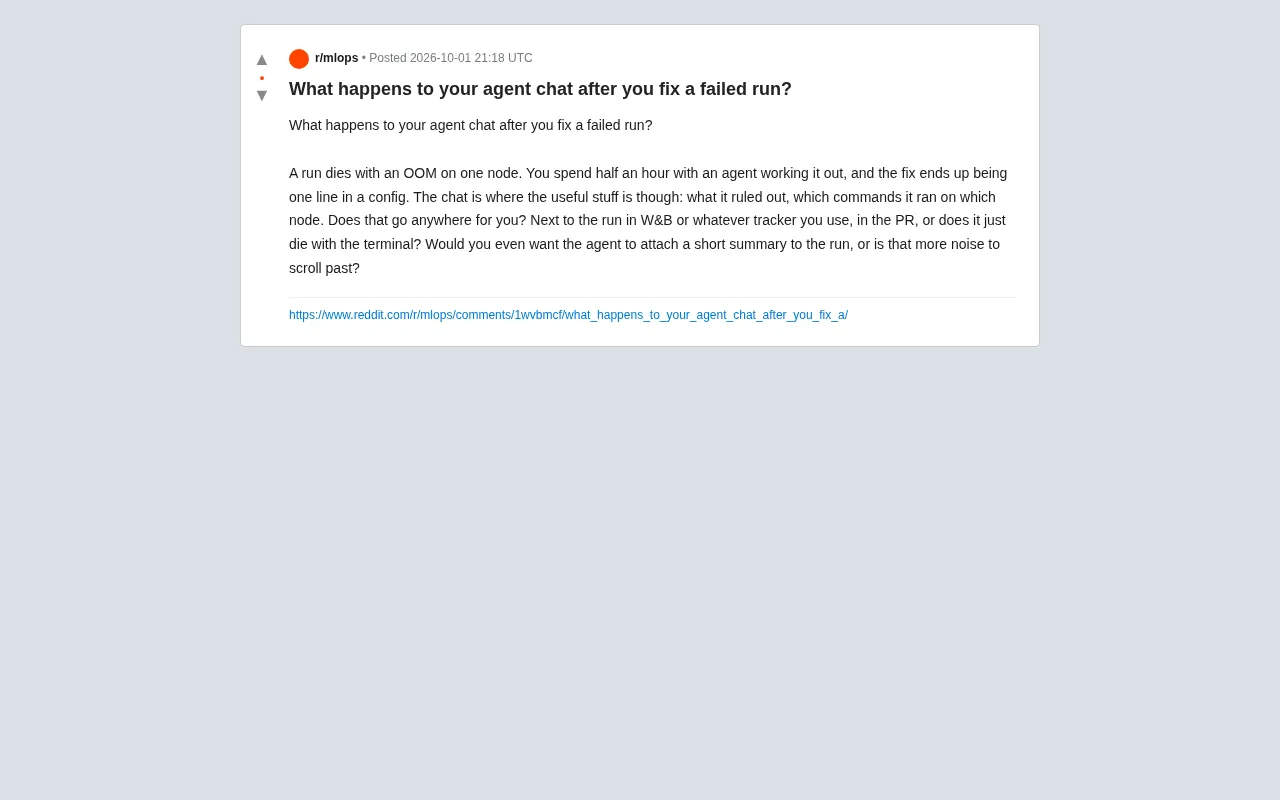
A discussion from the machine learning engineering community on Reddit hit a nerve for a lot of practitioners: a training job crashes due to OOM (out-of-memory) on a specific node. You spend half an hour troubleshooting alongside an AI Agent, and eventually the fix comes down to changing a single line in a config file.
Here's the problem — the truly valuable stuff was buried in that conversation the whole time: which possibilities the Agent ruled out, which commands it ran on which nodes, and what clues it followed to pinpoint the root cause step by step. And all of that typically vanishes the moment you close the terminal window.
The Conversation Is the Asset — Not the One-Line Change
At its core, this discussion surfaces a long-overlooked point: the chain of reasoning during a debugging session has more reuse value than the final fix itself.
Dropping a one-line config change into a Git commit is easy enough — but it can't answer "why this line." When the same OOM reappears on another node three months later, or when a teammate encounters similar symptoms, that one-line diff provides almost zero context. By contrast, if you could preserve:
- The initial directions the Agent suspected (e.g., batch size, data loading, gradient accumulation)
- Which diagnostic commands it ran on which nodes
- Which hypotheses were disproved by the data and systematically eliminated
...that's transferable engineering knowledge. In other words, the thought process behind troubleshooting is a form of tacit asset — and the current toolchain provides almost no place for it to live.
Where Should These Records Go?
The original poster laid out a few concrete destinations, each mapping to a key node in real-world workflows:
Stored Alongside the Run in an Experiment Tracking Tool
Attaching an Agent troubleshooting summary to the corresponding run — in W&B (Weights & Biases) or another tracker — has an obvious advantage: the knowledge is bound to the specific task it solved. The next time someone looks at that failed run, the full story behind the fix is right there.
W&B (Weights & Biases) is a mainstream experiment tracking platform in ML engineering, used to log metadata such as hyperparameters, metric curves, and system resource usage for each training run. Similar tools include MLflow, Neptune, and Comet ML. The core value of these platforms is extending the "reproducibility" of model training beyond the code layer to the experimental context layer — you don't just see the final accuracy of a run; you can trace back to its configuration and environment at the time. Attaching an Agent troubleshooting summary to a run effectively brings "why this run failed and how it was fixed" into the same queryable context system, upgrading experiment records from pure metric logs into a knowledge base that captures engineering decisions.
Written Into the PR (Pull Request)
If the fix eventually lands as a code change, including the troubleshooting summary in the PR description gives reviewers and future maintainers a clear picture of the actual motivation behind the change. It gives that one-line diff an auditable decision trail.
Or It Just Disappears Into the Terminal
This is the most common outcome in practice. The session ends, the window closes, and thirty minutes of collaborative reasoning is zeroed out. The next time someone steps in the same trap, they start over from scratch.
The Real Tension: Knowledge Preservation vs. Information Noise
The most valuable aspect of this discussion is that it doesn't treat the answer as obvious. The author follows up with a pointed counter-question:
Would you want the Agent to automatically attach a short summary to the run? Or would that just be more noise you have to scroll past?
This is the unavoidable core tension in automated knowledge capture. Auto-generated summaries sound appealing in theory — but if every run gets tagged with a verbose, low-signal-to-noise summary, it quickly becomes background static that everyone ignores, much like automated logs nobody reads.
The key to a genuinely useful implementation may not lie in whether to preserve records, but in:
- Whether summaries are concise enough — capturing only the root cause, the ruled-out hypotheses, and the final fix, rather than replaying the entire conversation
- Whether they're triggered on demand — generated only when a failed run has been manually resolved, for example, rather than flooding every session
- Whether they're searchable — so the knowledge can be actively surfaced when similar symptoms appear in the future, rather than passively buried
This tension is not new to software engineering. Automated code comments, IDE smart suggestions, and CI/CD pipeline build logs have all faced the same dilemma: the higher the information density a tool generates, the higher the cognitive filtering cost for engineers — eventually leading to "alert fatigue," where people habitually ignore all automatically produced content, even when it occasionally contains genuinely important signals. Signal-to-noise management is therefore a core engineering challenge in AI-assisted tool design, not merely a UX detail. The value of a summary doesn't depend on whether it exists — it depends on when it appears, how dense it is, and whether it's directly tied to an engineer's decision-making actions.
Implications for Engineering Teams
This is an open-ended question, but it reflects a genuinely important challenge for teams where AI Agents are now deeply embedded in development and operations: when your collaborator shifts from a human to an Agent, the way you document the collaboration process needs to be redesigned too.
In the past, the knowledge from pair programming was passed along through conversation and documentation. Today, a large portion of troubleshooting happens in private sessions between engineers and Agents. Without a layer designed to capture that output, these high-value reasoning processes will systematically disappear. For teams that care about engineering efficiency, the question is worth asking now: after you fix the bug, where does your Agent session actually go?
(This article is based on a Reddit community discussion and draws from a single source. The views expressed reflect open-ended questions rather than definitive conclusions.)
Related articles

Amphibious Transforming Drone: Beyond 100x Power Savings, What Are the Real Needs?
Is the amphibious transforming drone just a gimmick? Starting from the 100x power difference of the M4 Morphobot, explore real application scenarios and thesis topic ideas, analyzing boundary conditions where pure drones and pure ground robots both fail.

Warhound Raises $200 Million: Genetically Engineered "War Dogs" Paired with Anduril Gear
Warhound raises $200M, backed by Ben Lamm and Palmer Luckey, to genetically engineer dogs for military and law enforcement use and equip them with Anduril gear. This article analyzes its technology direction, funding logic, and ethical controversy.

Claude API Comes to Google Cloud: IAM Integration and SDK Access Guide
Anthropic hosts the full Claude API on Google Cloud with IAM-controlled permissions and unified billing. This guide covers the Vertex AI and Anthropic-hosted entry points, IAM role configuration, and SDK access.