Which Multi-Agent Platform Wins? A Small Team's Battle Scars and Selection Considerations

Small teams keep failing with multi-agent platforms; selection hinges on fit, observability, and progressive rollout.
The article uses the experience of an operations lead at a 27-person startup who tried two multi-agent solutions in four months and failed both times to analyze the common obstacles small teams face: underestimated business abstraction costs, insufficient agent collaboration reliability, and invisible rises in maintenance costs. It argues that selection should focus on fit with existing workflows, observability and human intervention capabilities, and support for a progressive rollout starting from a single high-frequency task. The conclusion: multi-agent platforms are better positioned as an enhancement layer for process automation, not a replacement for core operational judgment, and real community feedback about "it's been a few weeks and it hasn't fallen apart yet" is more valuable than demos.
The Multi-Agent Platform Dilemma for Small Teams: Why Did Both Attempts Fail?
An operations lead at a 27-person startup tried two multiagent solutions over four months, hoping to automate repetitive work — and both fizzled out within weeks. He posted on Reddit asking what solutions other teams ultimately chose. This isn't an isolated case: multi-agent platforms often look impressive in demos, but they frequently "stall out" when it comes to actually integrating into the daily operations of small teams.
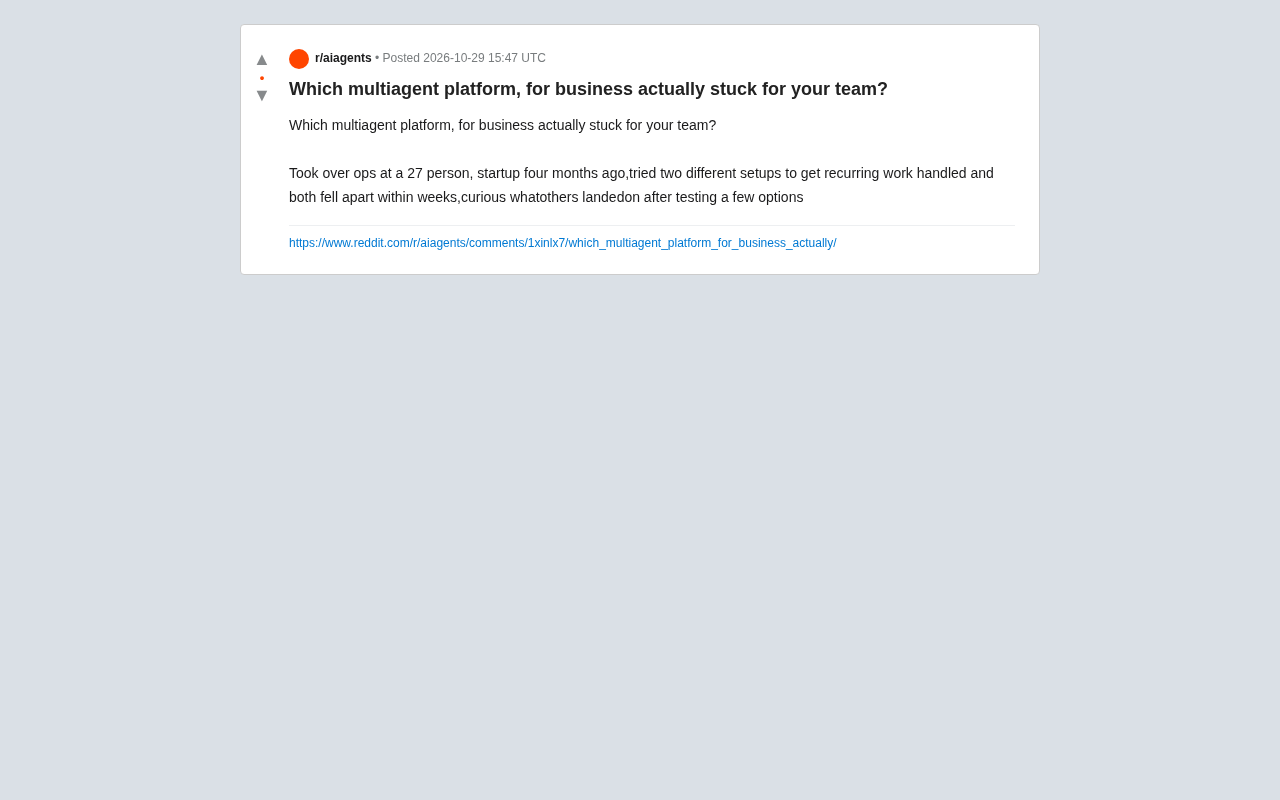
The post resonated because it struck a common pain point: choosing a multi-agent platform isn't about the length of the feature list — it's about whether it can consistently deliver in real business scenarios. When a team has only a couple dozen people and no dedicated AI engineers, ease of use, stability, and depth of integration with existing tools matter far more than "how many agent collaboration modes are supported."
Why Do Multi-Agent Solutions Fall Apart "Within Weeks"?
Based on the post, both attempts failed quickly, and there are likely several common underlying causes.
1. The cost of business abstraction is underestimated
Multi-agent platforms require users to break down repetitive work into clear steps, roles, and handoff rules. For small teams, this amounts to a lightweight business process reengineering effort. If the platform doesn't provide enough industry templates or guided configuration, operations staff can easily run out of patience at the "design the agent workflow" stage.
Business Process Reengineering (BPR) is a management concept introduced by Michael Hammer in the 1990s, referring to the fundamental rethinking and radical redesign of an enterprise's core processes, rather than incremental patching of existing workflows. Multi-agent platforms require operations staff to decompose repetitive work into steps, roles, and handoff rules — essentially a miniature process reengineering effort: tacit knowledge must first be made explicit. For example, a task like "organize customer feedback" requires clarifying who collects, who categorizes, who writes summaries, and how exceptions are escalated. Small teams often lack a dedicated process analyst, so this work falls on the operations lead — and if the platform doesn't offer industry templates or guided configuration, the abstraction cost quickly exceeds the benefits of automation.
2. Collaboration reliability is insufficient
The core value of multi-agent systems lies in division of labor and collaboration, but once task handoffs, state synchronization, and exception handling between agents become unstable, you get the problem of "one link gets stuck and the whole pipeline halts." Small teams have no redundant manpower for manual fallback, and a single failure can cause the team to lose trust in the platform.
Multi-agent orchestration refers to an upper-layer scheduling mechanism responsible for task dispatch, state tracking, and fault recovery — rather than letting agents converse freely. Common patterns include centralized scheduling (an orchestrator invokes agents in sequence or based on conditions) and decentralized negotiation (agents communicate directly with each other). The former is easier to observe and control for reliability but less flexible; the latter looks "intelligent" in demos but in practice is prone to message loss, circular invocations, and state inconsistency. If a small team chooses a platform with a high degree of decentralization and no clear orchestration layer, it becomes very difficult to pinpoint "where it got stuck" — this is the technical root of collaboration reliability problems.
3. Maintenance costs rise invisibly
Launching the platform is just the beginning. Changes to business rules, integration of new tools, and adjustments to agent prompts all require ongoing investment. If the platform's interface and debugging tools aren't friendly enough for non-technical users, maintenance work falls back onto the few technically savvy people — defeating the original purpose of "automating repetitive work."
What Should Small Teams Really Focus On When Choosing?
Drawing on similar discussions in the community, there are several dimensions worth examining during selection, rather than being led by vendors' feature lists.
Fit with existing workflows
Can the platform directly connect to the collaboration tools, data sources, and business systems the team already uses? The smoother the integration, the easier it is for agents to "embed" into existing processes — rather than requiring the team to change its work habits to accommodate the platform.
Observability and human intervention capabilities
A good multi-agent platform should let operations staff clearly see what each agent is doing and where it's stuck, and be able to pause, correct, and restart processes at any time. "Black-box automation" lacking transparency is hard to earn long-term trust in small teams.
Observability originates from distributed systems operations, originally referring to inferring a system's internal state through logs, metrics, and tracing. In multi-agent scenarios, it corresponds to three things: whether each agent's inputs and outputs are traceable, whether the handoff chain of tasks between roles is complete, and whether the context at the time of failure can be reproduced. Dashboards and success-rate numbers alone aren't enough — operations staff need to see the reasoning behind "why this step was judged complete"; otherwise, manual intervention is guesswork, and trust is hard to establish.
Progressive rollout path
Starting with a single high-frequency, clearly bounded repetitive task as a pilot, then gradually expanding after validating platform reliability, is more prudent than rolling out multiple agent collaboration scenarios all at once. Both attempts in the post may have over-pursued "getting it right in one step," which only accelerated failure.
The Realistic Positioning of Multi-Agent Platforms
Multi-agent platforms are not a panacea. For a startup of 27 people, they are better suited as an enhancement layer for process automation, rather than a replacement for core operational judgment. When choosing, rather than looking for the "strongest" platform, look for the one that "best matches the current team's technical capabilities and business rhythm" — a solution that's quick to learn, runs stably, and is easy to adjust often goes further than the most feature-rich one.
The operations lead's question was essentially a search for answers validated by real teams. This is precisely where the value of community experience lies: beyond feature demos, those plain, unglamorous feedback notes about "it's been a few weeks and it hasn't fallen apart yet" are the most valuable signals for small teams making their selection.
Additional Background
Version management of prompt engineering is an often-overlooked maintenance cost. An agent's behavior is jointly determined by system prompts, tool descriptions, and a few examples; when business rules change, multiple prompts often need to be updated in sync. If the platform doesn't support prompt versioning, A/B comparison, and regression testing, operations staff can only adjust by feel, making it hard to trace the effects of changes. The "configuration as code" practice familiar to engineering teams is still immature in most multi-agent platforms aimed at business users — this is the structural reason maintenance work tends to flow back to technical staff.
One-line Summary
Small teams' multi-agent platforms keep failing; the key to selection lies in fit, observability, and progressive rollout.
Paragraph Summary
Using the experience of an operations lead at a 27-person startup who tried two multi-agent solutions within four months and failed both times as a starting point, the article analyzes the common obstacles small teams face in deploying multi-agent platforms: underestimated business abstraction costs, insufficient agent collaboration reliability, and invisible rises in maintenance costs. The article argues that selection should not be driven by vendors' feature lists, but should focus on the platform's fit with existing workflows, observability and human intervention capabilities, and whether it supports a progressive rollout path starting from a single high-frequency task. The conclusion is that multi-agent platforms are better suited as an enhancement layer for process automation rather than a replacement for core operational judgment, and that real community feedback about "it's been a few weeks and it hasn't fallen apart yet" is more valuable for reference than demos.
Related articles

T3 Code: The Open-Source AI Coding Assistant's Comeback Story
T3 Code is an open-source AI coding assistant that unifies subscriptions like Codex and Claude, with powerful remote control and parallel task management.

Never Elected, Yet Ruled New York for 30 Years: The Ultimate Case Study in the Mechanics of Power
Robert Caro's biographies reveal how unelected Robert Moses ruled New York for 30 years through legal drafting and public authorities, and how Lyndon Johnson built leverage as a "powerless" Senate Majority Leader. Unpacking the underlying logic of accumulating and sustaining power.

The CPython 3.10 Recursion Trap and Synthetic Recovery in TokenGuard, an LLM Circuit Breaker
TokenGuard's author recounts a recursion crash caused by OrderedDict.pop in CPython 3.10 and introduces v0.3.0's Loop Nudge synthetic recovery, inline DLP scanning, and other new LLM agent circuit-breaker capabilities.