Whimscope Micro-Adventure App Deep Dive: Reigniting Daily Exploration Through Four-Dimensional Matching

Whimscope uses four-dimensional matching to spark daily micro-adventures and reignite your curiosity about life.
Whimscope is a newly launched lifestyle app that addresses the 'motivation gap'—helping users who don't know what to do rather than managing existing plans. Its core innovation is a four-dimensional matching system (time, energy, mood, budget) that recommends contextually appropriate micro-adventures. With a deliberate 'no nagging' philosophy and a journal feature for building narrative identity, it takes a restrained, psychologically-informed approach to product design that stands apart from gamified competitors.
In an era where lifestyle apps are becoming increasingly homogeneous, an application called Whimscope has chosen a distinctly different path. It doesn't do habit tracking, doesn't offer to-do lists, and won't bombard you with push notifications reminding you to "go exercise." Instead, it attempts to solve a more fundamental and often overlooked problem: How do you get people interested in life again?
Recently, Whimscope officially concluded its beta phase and launched on both the App Store and Google Play, gaining attention on Product Hunt. While its current vote count stands at just 4 with a ranking of 16th—clearly in its early stages—the product philosophy it represents deserves deeper exploration.
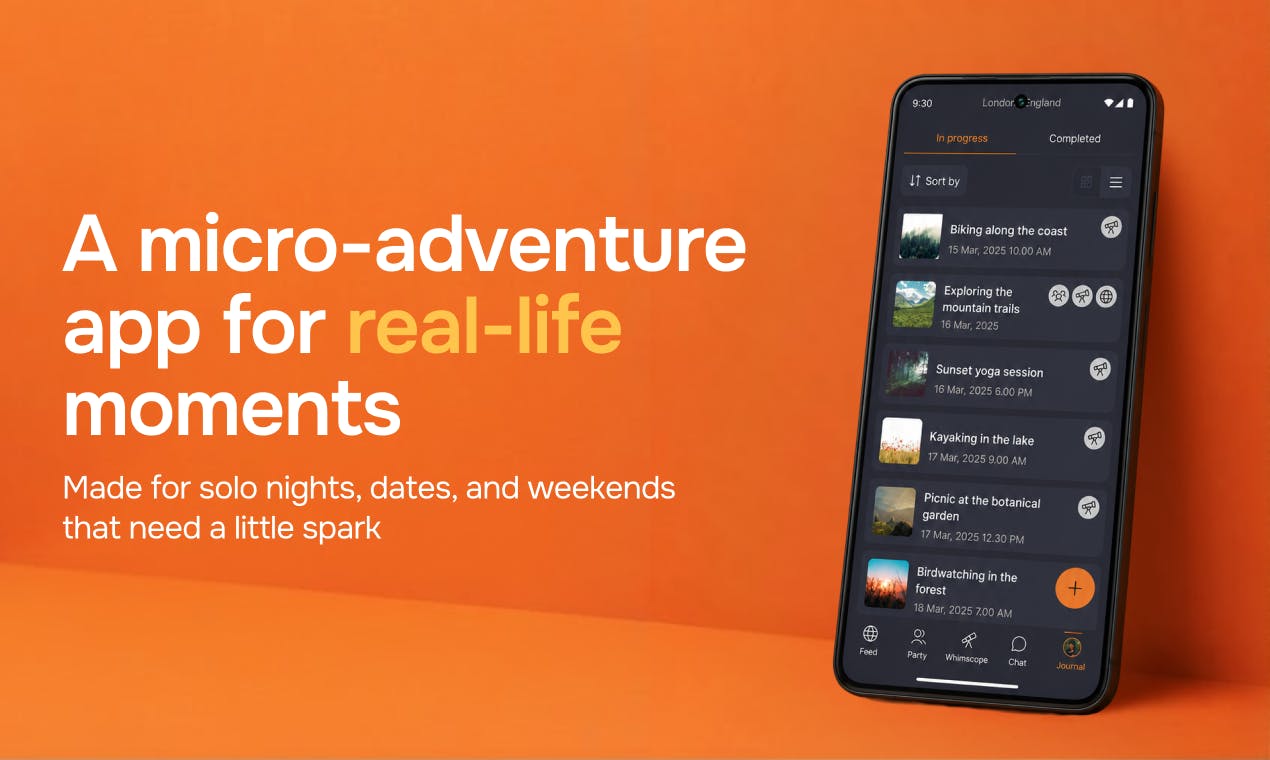
From "Managing Existing Plans" to "Sparking New Desires"
Whimscope's core positioning can be summed up in one official statement:
"Most similar apps help you organize things you've already planned to do, while Whimscope helps you want to do something in the first place."
This is a subtle but crucial distinction. The vast majority of lifestyle and productivity tools on the market are fundamentally execution-layer products—they assume users already know what they want to do and just need a tool to record, schedule, and remind them. Calendars, to-do lists, and habit-tracking apps all operate this way.
However, in reality, many people don't face the problem of "too many plans, too little execution," but rather a sense of emptiness from "not knowing what to do." The two hours after work, a weekend afternoon—the time clearly exists, yet often slips away while scrolling through phones. Whimscope targets precisely this motivation gap: it doesn't assume you have plans already, but proactively provides inspiration.
This design approach has deep theoretical support in psychology. Self-Determination Theory posits that human intrinsic motivation stems from three basic psychological needs: Autonomy, Competence, and Relatedness. When daily life becomes highly routinized, these three needs often go unmet, and people fall into what psychologists call "Hedonic Adaptation"—gradually becoming numb to repetitive daily stimuli. Traditional productivity tools strengthen execution capability but fail to address the source of motivation. By providing novel, freely choosable exploration opportunities, Whimscope attempts to reactivate the intrinsic motivation system—a practical application of behavioral science at the product design level.
The "Micro-Adventure" Concept: Low-Barrier Daily Exploration
Whimscope's core concept is the "micro-adventure"—not the kind of trip that requires taking time off work and booking flights, but small explorations embedded in everyday life. It might be visiting a café you've never been to, trying a new route during a walk in a nearby park, or doing something creative at home on your own. This "low-barrier, high-frequency" exploration positioning distinguishes it from traditional travel planning tools.
The concept of "micro-adventure" was first systematically proposed by British explorer Alastair Humphreys in 2014. After being named National Geographic's Adventurer of the Year, he began advocating the idea that adventure doesn't have to mean crossing Antarctica or summiting Everest—it can be an overnight camp in your backyard or cycling down a country lane you've never explored. This concept gained broader resonance in the post-pandemic era—when international travel was restricted, people began rediscovering the possibilities in their immediate surroundings. From a product design perspective, the core appeal of micro-adventures lies in combining "novelty" with "accessibility," lowering the psychological resistance to action (what behavioral economics calls "activation costs") while preserving the dopamine reward of exploration.
The Four-Dimensional Matching System: Time, Energy, Mood, and Budget
Whimscope's most ingenious product design element is its intelligent recommendation mechanism. Rather than randomly throwing out a bunch of ideas, it performs precise matching across four dimensions:
- Time: How much free time do you have right now?
- Energy: Do you want to get moving, or just relax?
- Mood: What kind of activity suits your current emotional state?
- Budget: How much are you willing to spend?
The value of this four-dimensional model is that it contextualizes the abstract concept of "inspiration." Many recommendation products fail because they're disconnected from the user's actual current state—recommending a two-hour activity to someone with only 20 minutes free, or suggesting high-intensity exercise to someone who just wants quiet rest, creates an experience gap. Through upfront state matching, Whimscope aims to make every suggestion feel "just right."
From a technical standpoint, this system falls under the category of "Context-Aware Recommendation." Traditional recommendation systems (like the collaborative filtering algorithms used by Netflix or Spotify) primarily predict based on user historical behavior, while context-aware recommendations additionally incorporate the user's current state variables—time, location, mood, device type, etc. This technical direction has been researched in academia for over a decade, but successful applications in consumer products remain rare. The main challenges are: acquiring real-time state data depends on either user manual input (adding usage friction) or sensor inference (raising privacy concerns), and the weight combinations between contextual dimensions require extensive A/B testing to optimize. Whimscope's choice to have users manually input four dimensions is a pragmatic balance between accuracy and privacy.
From Inspiration to Memory: A Complete Experience Loop
In terms of user flow, Whimscope has designed a clear experience loop:
- Discover (Look through the lens): Browse inspiration through the app's "lens"
- Save: Bookmark ideas that interest you
- Plan: Complete them solo, or invite friends to join
- Journal: After completion, record the experience in your journal
You might not have noticed that final "journal" step. It makes Whimscope more than just an inspiration generator—it becomes a container for accumulated experiences. Over time, users can look back on the micro-adventures they've completed, forming a personalized collection of life memories—which, on an emotional level, may offer more long-term stickiness than mere recommendations.
There's a deeper psychological mechanism behind this feature: Narrative Identity. Psychologist Dan McAdams's research shows that people construct their sense of self-identity by organizing life experiences into coherent stories. When users record completed micro-adventures in Whimscope, they're actually weaving a self-narrative of "I am someone who stays curious about life." Once formed, this narrative produces a positive identity confirmation effect—people tend to act in ways consistent with their self-narrative, creating a virtuous cycle. This also explains why a journal feature may have better long-term retention effects than push notifications: it appeals to identity rather than external prodding.
The "No Nagging" Product Philosophy: A Restrained Counter-Trend Design
The team specifically emphasizes: "It's not a habit tracker, and it won't nag you."
This statement may sound simple, but it represents a deliberate product stance. In recent years, numerous apps have relied on push notifications, streak tracking, and achievement badges to maintain user engagement, but this "gamified coercion" has also created widespread notification fatigue and psychological burden. Whimscope takes the opposite approach, adopting a lighter, more respectful-of-user-autonomy posture that aligns with current digital wellness trends.
Whimscope's philosophy is part of the broader "de-gamification" design movement in recent years. Since gamification became a product design trend in the early 2010s, points, badges, and leaderboards (the PBL trio) have been widely applied across applications. However, research shows that extrinsic rewards can "crowd out" intrinsic motivation (the psychological "overjustification effect"), causing users to completely abandon behaviors once external rewards stop. Apple's introduction of Focus Mode in iOS 15 and Google's Digital Wellbeing suite both reflect the industry's rethinking of notification overload. The success of apps like Calm and Forest also proves that restrained design is commercially viable for certain user segments. However, such products typically require longer word-of-mouth accumulation periods, with flatter early growth curves.
From a business perspective, this restraint is a double-edged sword: it better aligns with users' pursuit of "digital wellness," but also sacrifices the most common user retention levers. For a product still in its early stages, how to maintain long-term usage without disturbing users will be a core proposition that needs continuous validation.
Overall Assessment: Clear Direction, Still Awaiting Market Validation
Whimscope's product thinking is undoubtedly clear and insightful. In an era where people are increasingly "fed" by algorithmic feeds and life becomes routinized, an app that proactively helps you "want to explore again" addresses a genuine emotional need.
However, as a product that has just emerged from beta, it faces several practical challenges:
- Richness and localization of the inspiration library: Whether micro-adventure suggestions are diverse enough and relevant to different cities and cultures directly determines experience quality
- Matching algorithm accuracy: The four-dimensional matching sounds elegant, but whether actual recommendations truly "get you" requires substantial usage data to refine
- The retention challenge: Having voluntarily abandoned nagging mechanisms, how to get users to habitually open the app is key to long-term survival
Among these, the localization issue deserves particular attention. For content recommendation products like Whimscope, the "Cold Start Problem" is a core challenge at both the technical and operational levels. When user behavioral data is insufficient, the system struggles to provide precise personalized recommendations. More challenging still, a micro-adventure suggestion suited for London users (like "try a food you've never eaten at Borough Market") is meaningless for users in Tokyo or Shanghai. This requires the product team to build a massive inspiration database categorized by geographic location and cultural context, or introduce UGC (User-Generated Content) mechanisms for the community to contribute localized content. While the latter offers better scalability, it introduces new content quality control issues—a classic tension that all products transitioning from tool to platform must face.
Whimscope is currently available on both the App Store and Google Play. For those who often feel life lacks freshness yet are tired of being constantly reminded by various apps, it offers a gentle and interesting alternative. Whether it can grow from early niche attention into a more influential product remains a question that only the market and time can answer.
Related articles

Gaussian Process Bandit Optimization: Exploration Strategies and Inference Regret Guarantees
Cumulative regret guarantees in Bayesian optimization fail to reflect final recommendation quality. This article examines a new study that provides inference regret guarantees for Gaussian process bandit optimization through exploration query strategies and fill distance analysis, validated on hyperparameter optimization and control tasks.
The Most Detailed Codex Guide on Bilibili: From Installation to Real-World Practice
The most detailed Codex guide on Bilibili: from app store installation to daily work mode configuration, with a real coffee shop project demonstrating file organization, data extraction, dashboard creation, and other practical tasks. Learn to use Plan Mode and desktop pets to leverage Codex efficiently.

Appearance Compensation in Volume Rendering: Why RGB Accuracy Cannot Guarantee Density Correctness
Volume rendering research reveals that volumetric data perfectly reproducing external RGB views may still contain density errors: appearance compensation can double central density and keep external rays unchanged even when L2 error exceeds 14.52%. Density recovery depends on appearance capacity, spatial resolution, and measurement design.