Who Defines Beauty in the Age of Machines? Reflections Sparked by a Single Tweet

As AI learns and amplifies human aesthetics, "who defines beauty" becomes the most urgent philosophical question of the algorithmic age.
A tweet about how mathematicians perceive beauty sparked a deeper debate about aesthetic agency in the AI era. Mathematics has long treated "elegance" as a genuine evaluative standard, with simplicity and unity seen as guides toward truth. Yet as generative AI mass-produces aesthetically compliant content, a paradox emerges: machines "learn beauty" by statistically mapping human preferences, while simultaneously reshaping human perception through recommendation algorithms and generation tools. The article distinguishes two forms of power — the subjective capacity to feel beauty (still belonging to conscious humans) and the practical power to define aesthetic standards (quietly migrating toward platforms and algorithmic systems). In an age when algorithms increasingly govern content ecosystems, maintaining independent aesthetic judgment is more urgent than ever.
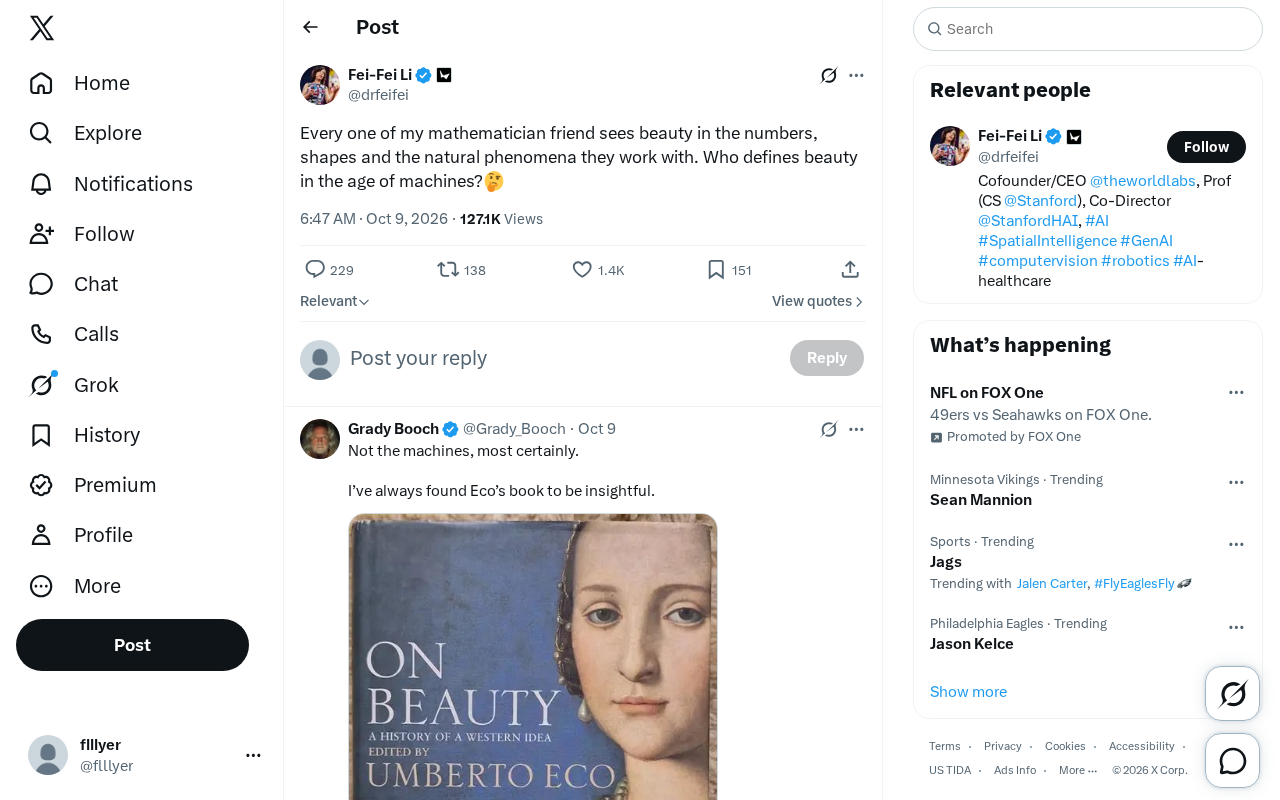
A brief tweet recently sparked a discussion about the relationship between aesthetics, mathematics, and artificial intelligence: "Every mathematician friend I have can see beauty in the numbers, shapes, and natural phenomena they study. So in the age of machines, who gets to define beauty?"
The question sounds simple, yet it cuts to the heart of an ancient and fundamental human question — where does beauty come from, and who sets the standard for judging it? As machines increasingly participate in creation, calculation, and even "appreciation," this question takes on an urgent new dimension.
Mathematical Beauty: A Widely Shared Intuition
A mathematician's sense of "beauty" is not mere romantic rhetoric. Within the mathematical community, "elegance" is a genuine criterion for evaluating a proof or formula. Euler's identity e^(iπ)+1=0 is celebrated time and again precisely because it connects five of the most fundamental mathematical constants in an extraordinarily compact form.
This aesthetic sense is typically tied to simplicity, symmetry, and unexpected unity. The physicist Dirac even argued that the beauty of an equation matters more than its agreement with experiment. In other words, within mathematics and theoretical science, beauty is not just subjective decoration — it often serves as a guide toward truth.
The "numbers, shapes, and natural phenomena" the tweet author references point directly to this long-cultivated human aesthetic intuition — the sense of order we repeatedly confirm in the Fibonacci sequence, the golden ratio, and fractal structures.
The concept of "elegance" in mathematical aesthetics has concrete, operational dimensions: minimizing the number of proof steps, the universality of a method (whether an argument can be extended to broader cases), and a sense of "surprise" — the way a conclusion emerges from its premises in an unexpected manner. G.H. Hardy systematically articulated this feeling in A Mathematician's Apology, arguing that mathematical beauty is structurally identical to artistic beauty — both are, at their core, "the beauty of pattern." Notably, these aesthetic standards are not universal across all cultures. Different mathematical traditions — such as the Western axiomatic tradition versus classical Chinese algorithmic traditions — apply different criteria for what constitutes "good mathematics," demonstrating that even mathematical beauty is not entirely free from cultural context.
How Has Aesthetic Judgment Shifted Since Machines Entered the Picture?
Now that generative AI can create images, compose music, and generate mathematical conjectures, the question of "who defines beauty" has grown considerably harder to answer.
On one hand, AI does not "understand" beauty. Through training on vast quantities of human-created work, it learns the statistical distribution of human aesthetic preferences. When a model generates a "beautiful" image, it is effectively reproducing aesthetic patterns that humans have already validated. From this perspective, machines remain amplifiers of human aesthetics, not definers of them.
On the other hand, AI has begun to shape human aesthetics in return. Recommendation algorithms continuously reinforce certain visual styles, and image generation tools push particular aesthetics into the mainstream. As more and more people view, create, and consume content through AI tools, aesthetic standards are quietly being steered by technological systems.
A genuine tension exists here: machines learn from human aesthetics, but their outputs are simultaneously retraining the human eye.
The technical foundation of generative AI consists of deep learning systems — most notably large language models and diffusion models. Diffusion models learn from tens of billions of human-labeled or human-curated images, compressing "beauty" into a probability distribution across a high-dimensional space. When a user enters a prompt, the model samples from that distribution, and the resulting image is essentially a weighted average of the aesthetic preferences embedded in the training data. This mechanism carries a hidden consequence: niche aesthetics, non-mainstream cultural traditions, and aesthetic experiences that resist verbal description are already sparse in training data, making them highly vulnerable to being systematically overlooked or flattened by the model — creating pressure toward the homogenization of global aesthetics.
Is the Power to Define Beauty Still in Human Hands?
The central question posed by the tweet — "who defines beauty" — implicitly expresses a concern about agency.
From a philosophical standpoint, Kant argued that aesthetic judgment, while subjective, carries a claim to "universal communicability." The beauty that mathematicians experience feels more like a discovery than an invention. However powerful machines become, the subject who experiences beauty remains a human being. Machines can generate works that conform to aesthetic principles, but the act of being genuinely moved still belongs, for now, exclusively to conscious beings.
What deserves caution, however, is that the power to define beauty and the capacity to feel it are not the same thing. If technological platforms use algorithms to determine at scale which content gets seen and which styles get rewarded, then the de facto "setters of aesthetic standards" may be shifting away from individual aesthetic experience and toward engineering systems.
This is precisely why the value of this tweet lies not in providing an answer, but in raising a question that every creator, researcher, and everyday user ought to take seriously.
In Critique of Judgment, Kant distinguished three levels: the "agreeable" (pure personal sensory pleasure), the "beautiful" (aesthetic judgment with a claim to universality), and the "sublime" (the complex emotion aroused by the infinite or the overwhelming). He emphasized that the defining feature of aesthetic judgment is "purposiveness without purpose" — our perception of beauty serves no practical goal, which is precisely what distinguishes it from instrumental calculation. When machines generate content, they always operate with an explicit optimization target (such as user click-through rates or ratings). Within the Kantian framework, this means their outputs are fundamentally situated at the level of the "agreeable," not genuine "beauty" in the philosophical sense. This distinction offers a precise entry point for understanding whether machines can truly create beauty.
An Open Question Worth Asking, Again and Again
The question of aesthetics in the age of machines has no standard answer, but it forces us to reexamine several assumptions: Is beauty a uniquely human experience, or a pattern that computation can approximate? As machines participate in creation, will humans gradually cede their own aesthetic judgment?
The beauty mathematicians see in equations reminds us that beauty was once one of humanity's deepest ways of understanding the world. In an era when algorithms increasingly dominate content ecosystems, preserving an independent capacity to perceive and judge beauty may matter more than ever before.
Who defines beauty? The answer, perhaps, should still be: the person who consciously chooses to feel, to question, and to decide.
Related articles

uGAP: An AI Platform Unifying 100+ African Geospatial Datasets
uGAP is an African geospatial AI platform by a University of Cape Town team, unifying 120+ African datasets with a Python SDK for discovery, processing, and model training, already used in cyclone flood mapping.

Cursor Can Now Control Your Computer: AI Agents Can Drive Desktop Apps for Testing
Cursor adds desktop control: AI agents can drive desktop apps like the iOS Simulator to test their own features. We analyze the impact on dev workflows, possible technical approaches, and reliability concerns.

Vibecoding a Custom Inference Engine: High Hopes, Harsh Reality
A Reddit developer shares the real experience of vibecoding a custom inference engine: running GGUF Q4 models in the browser with WebGL2 and GLSL, only to fall into tokenizer debugging hell. This article analyzes the engineering challenges of browser-side LLM inference and why cloning llama.cpp is the more rational choice.