Whoop Launches a Social Network: Building a Humans-Only Community with 'Verified Heartbeat'

Whoop launches 'verified heartbeat' social network Whoop Humans, anchoring real human identity with physiological data.
Whoop has launched Whoop Humans, a social network letting members share wearable metrics, activities, and achievements in-app, with Stories-like Moments and comments. The platform claims to be 'fully human,' using a 'verified heartbeat' as an identity anchor: accounts are device-bound, so in theory every user is backed by continuous physiological signals. This is compelling amid bot-filled platforms but raises privacy trade-off questions—whether users will open real-time body data for social exposure. The move shifts wearable competition from hardware and algorithms to community and network effects; the high barrier brings trust advantages but a scale ceiling, with success hinging on whether members treat heart rate curves as a social language.
Whoop is no longer content with being just a wristband that tracks recovery and strain. It has just launched a social network called Whoop Humans, attempting to carve out a territory that belongs only to real humans—using the concept of a "verified heartbeat"—in a social media landscape flooded with bots, anonymous accounts, and algorithmic feeds.
From Data Dashboard to Social Plaza
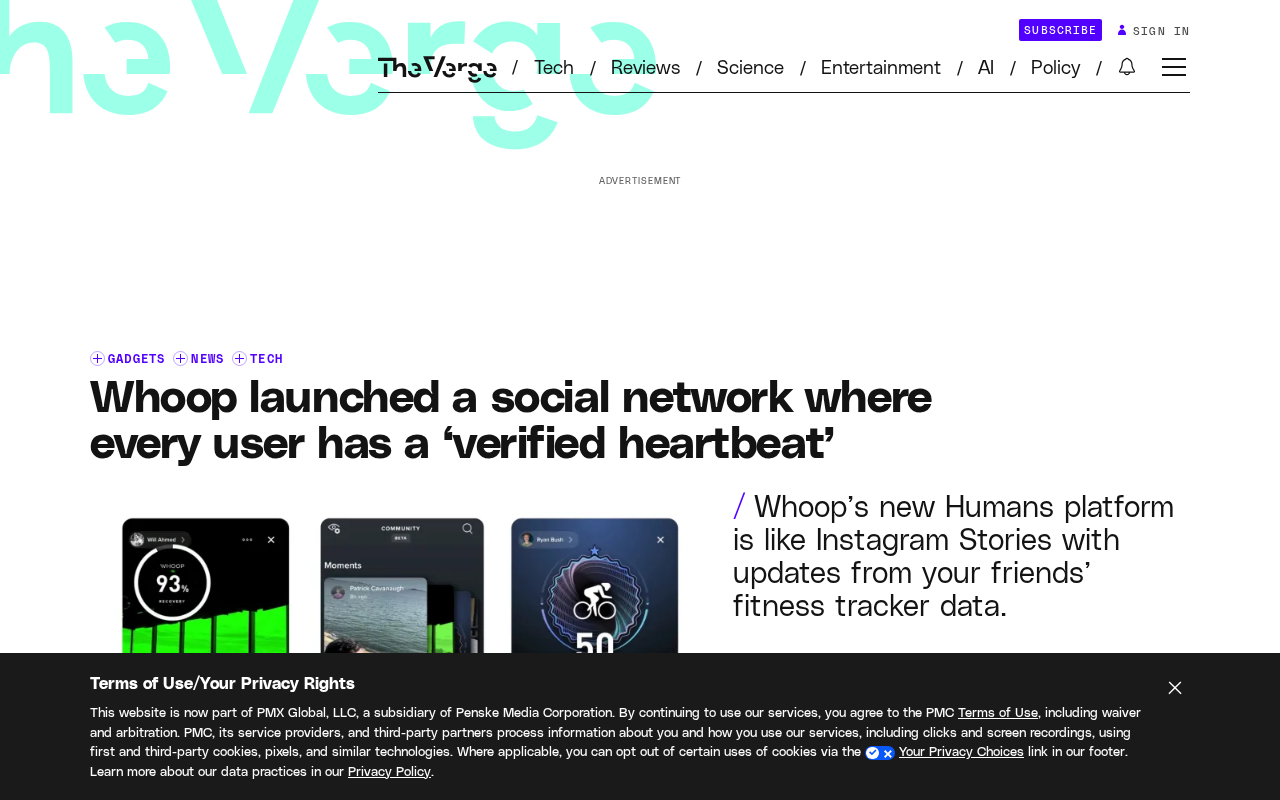
Starting Thursday, Whoop members can share data from their wearable devices directly within the app. Users can open up their metrics, activities, and achievements to other Whoop wearers. This effectively transforms what was once a private health dashboard into a public profile that can be viewed, liked, and commented on.
Beyond hardcore data displays, Whoop Humans also introduces a Stories-like "Moments" feature, allowing users to post updates with photos and text captions. Other members can comment on and interact with posts. This combination isn't novel, but it shifts the anchor of social interaction from "what you say" to "what your body data says."
The "Fully Human" Selling Point and Its Controversy
Whoop claims this platform is "fully human." What underpins this claim is the core concept in the title—every user has a "verified heartbeat." Since the platform is tied to wearable devices, in theory every account is backed by a real wearer's physiological signals continuously generating data, constituting a biometric-level identity anchor.
In an era where AI-generated content is rampant and bot accounts flood social platforms, this approach of "proving you're human with physiological data" is quite compelling. However, it also raises a sharp question: when social identity is tied to heart rate, recovery scores, and sleep quality, are users willing to surrender real-time body data for social exposure? Whoop has not yet detailed the granularity of data-sharing controls—which metrics members can choose to make public and which to keep private. How this mechanism works in practice will determine whether the "verified heartbeat" is a privacy compromise or a controllable social currency.
"Verified heartbeat" is essentially an extension of biometric authentication thinking. Traditional social platform account verification relies on phone numbers, emails, or third-party logins, which can only prove "there's a reachable entry point" but cannot prove a real person is behind it. In contrast, signals continuously collected by wearables—heart rate, heart rate variability (HRV), skin conductance—have liveness characteristics: they fluctuate in real time with a person's activity, emotions, and circadian rhythms, making them difficult to fake long-term with scripts or recorded data. Whoop's logic is that since the device is bound to the body long-term, the physiological data stream associated with the account constitutes a continuous proof of "I am present." However, this mechanism is not foolproof—data can be "farmed" through shared devices or artificially induced activity, and its credibility depends on the continuity of device wear and the rigor of anti-cheat strategies.
Potential Impact of Socializing Health Data
The emergence of Whoop Humans pushes competition in the wearable industry from hardware and algorithms toward community and network effects. When a user's friends are all sharing recovery scores and training records on Whoop, the cost of switching devices is no longer just the hardware price—it's the entire social graph.
On the other hand, placing health data in social contexts may spawn new behavioral patterns. Public recovery scores and activity achievements can serve as positive motivation but may also generate comparison anxiety. Whether Whoop's emphasized "humans-only" community can find a balance between motivation and pressure depends on the product's trade-offs in visibility design.
Network effects are key to understanding the business intent behind Whoop Humans. When a product's value increases with the number of users, users become "locked in" to the ecosystem. For wearables, hardware switching costs were originally low, but once training records, historical trends, and social relationships are entrenched on a platform, migration means losing continuous data and social capital. Whoop's move essentially shifts the competitive dimension from sensor precision and recovery algorithms to community relationship chains. This parallels Strava's path in sports social networking: Strava's moat isn't hardware but segment leaderboards and mutual follows among cycling and running enthusiasts. The risk is that network effects need to reach a critical mass to self-reinforce, and Whoop's membership threshold may slow this process.
Can the Differentiated Approach Work?
Most existing social platforms rely on anonymity or weak identity verification to lower participation barriers. Whoop goes the opposite way, using biometric data to raise the entry barrier. The advantage of this approach lies in community quality and trust; the disadvantage is the scale ceiling—only Whoop members can enter, meaning it's a highly exclusive closed club.
Its real test isn't whether the features are complete, but whether members are willing to treat heart rate curves as a social language. If users simply treat it as yet another place to show off workout results, Whoop Humans may become a niche circle; but if "verified heartbeat" can establish a credible human identity layer, it may offer a reference model for socializing health data.
One-line Summary
Whoop launches "verified heartbeat" social network Whoop Humans, anchoring real human identity with physiological data.
Paragraph Summary
Whoop has launched the social network Whoop Humans, allowing members to share metrics, activities, and achievements collected by wearable devices within the app, with support for Stories-like Moments posts and comment interactions. The platform claims to be "fully human," using "verified heartbeat" as an identity anchor: accounts are bound to devices, and in theory every user is backed by continuously generated physiological signals. This approach is compelling amid rampant bot accounts, but it also raises privacy concerns—whether users are willing to open up real-time body data for social exposure. The article argues that this move pushes wearable competition from hardware and algorithms toward community and network effects; the high barrier brings trust advantages but also a scale ceiling, and success depends on whether members are willing to treat heart rate curves as a social language.
Related articles

From Pulpit to Senate: A Pastor-Senator on What Sin Is
A pastor-senator at Ebenezer Church reflects on how his Senate experience reshaped his understanding of sin and hubris, making his sermons more powerful—even likening Washington to Sodom and Gomorrah.

TechCrunch Mobility: The A/B Test Pitting Robots Against Humans
TechCrunch Mobility spotlights the future of transportation and AI's role, discussing A/B testing robots vs. humans in mobility scenarios, test design challenges, and industry implications.

Project Leonida: An Open-Source Attempt to Recompile Xbox GTA 6 for PC
Leonida is an open-source project attempting to recompile Xbox GTA 6 to run on PC. We analyze its technical approach, community controversy, and significance for the PC gaming ecosystem.