Why AI Coding Assistants Stop at the PR: The Missing Production Feedback Loop Is the Key Bottleneck

AI coding assistants lose all awareness after PR merge — the missing production feedback loop is the critical bottleneck.
AI coding tools like Copilot and Cursor excel at generating code and passing tests, but completely lose visibility once code hits production. This article examines why the production feedback loop is so hard to close — from data complexity and causal attribution challenges to fragmented toolchains — and explores emerging solutions including manual feedback, observability integration, and full-lifecycle closed-loop agents.
An Overlooked Blind Spot in AI-Assisted Coding
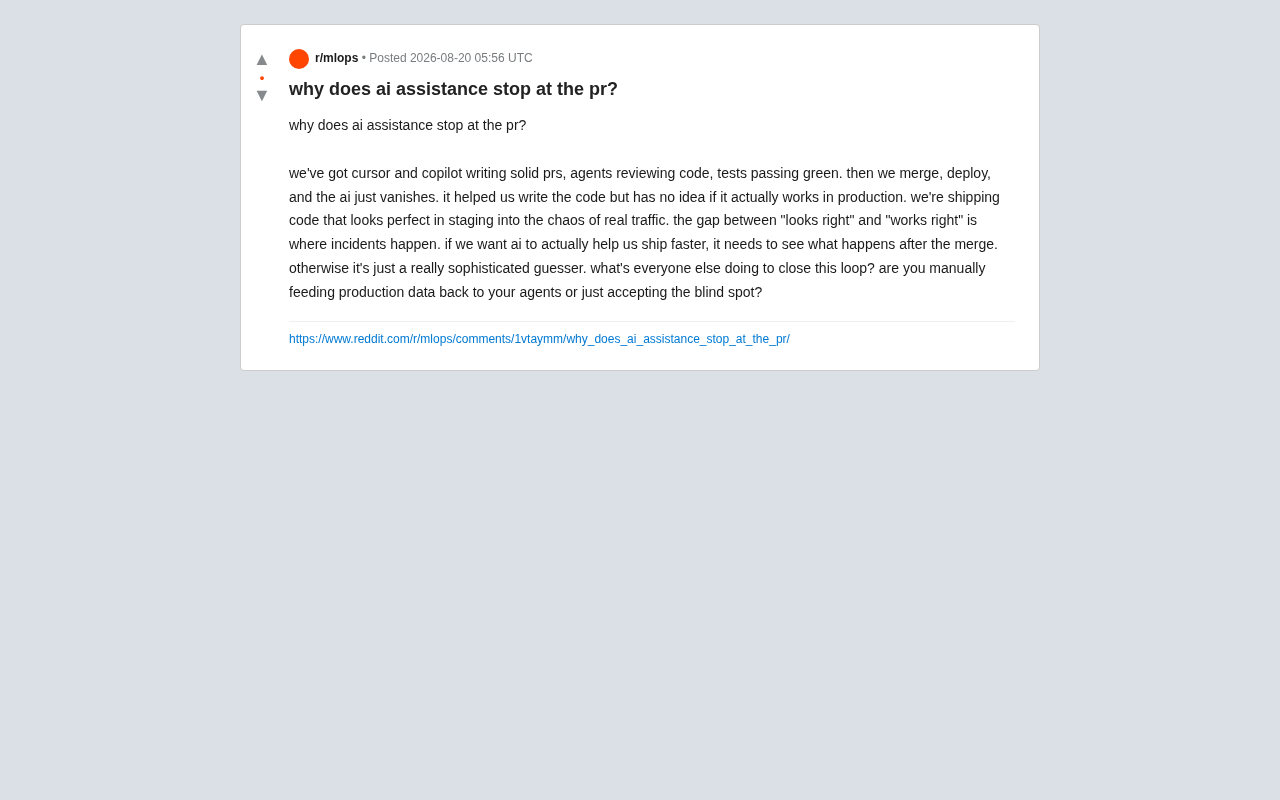
Today, AI coding tools have permeated multiple stages of software development. Cursor and Copilot can produce well-structured, logically sound Pull Requests (PRs), AI Agents can automatically review code, and tests pass with flying colors. Developers are enjoying unprecedented productivity gains. Yet, a Reddit developer raised a pointed question: Why does AI assistance always stop at the PR?
This developer described a real and widespread scenario: after code is merged and deployed, the AI simply "vanishes into thin air." It helped you write the code, but has absolutely no idea whether that code actually works in production. We push code that looks flawless in staging straight into the "chaotic battlefield" of real traffic, and the AI knows nothing about what happens next.
This isn't a minor tool flaw — it's a structural blind spot in the current paradigm of AI-assisted development.
The Chasm Between "Looks Right" and "Works Right"
One line from the original post hits the nail on the head: "The gap between 'looks right' and 'works right' is where incidents happen."
This statement precisely describes an age-old yet still thorny problem in software engineering. "Correct" during the coding phase typically means syntactically valid, logically consistent, and passing tests. But "correct" in production means withstanding real users' concurrent requests, malformed inputs, network jitter, dependency failures, and all kinds of edge cases that are nearly impossible to reproduce in testing.
The "Information Gap" of AI Coding Assistants
Current AI coding assistants fundamentally operate within a closed information environment. What they can see:
- The current state of the codebase
- The requirements you provide
- Test case execution results
- Discussions in code reviews
What they cannot see:
- Changes in error rates after deployment
- Fluctuations in API response times
- Actual user behavior paths
- Recurring exceptions in production logs
In other words, AI has all the context needed to "write code" but lacks the critical feedback to "verify whether the code actually works." The original poster put it bluntly: Without production feedback, AI is just a sophisticated guesser.
Why Is the Production Feedback Loop So Hard to Close?
To understand why this blind spot exists, we need to examine several technical and process-level obstacles.
1. Complexity and Sensitivity of Production Data
Observability data from production (logs, metrics, traces) is massive in volume and highly noisy. Effectively feeding this data to AI requires filtering, aggregation, and structuring. What's even trickier is that production data often contains user privacy information and commercially sensitive data, creating compliance risks if directly exposed to AI systems.
2. The Difficulty of Causal Attribution
Even if AI can see an error occurring in production, it's extremely difficult to automatically and precisely correlate that error to a specific code change. In a complex distributed system, a single failure may be the combined result of multiple services and multiple deployments. Establishing the causal chain of "code change → production behavior" is itself a high-difficulty engineering challenge.
3. The Fragmentation of Dev and Ops Toolchains
The tools for writing code (IDEs, Copilot), CI/CD pipelines, and monitoring/alerting systems (like Datadog, Prometheus, Sentry) are often isolated islands. AI coding assistants naturally operate on the development side, lacking a bridge to observability platforms on the operations side. This toolchain fragmentation is the direct technical cause of the missing feedback loop.
Closed-Loop Solutions the Community Is Exploring
The original poster closed with an open question: "What's everyone doing? Manually feeding production data back to agents, or just accepting the blind spot?"
Looking at industry practices, several typical approaches currently exist.
Manual Feedback: Crude but Effective
The most straightforward approach is for developers to manually paste error logs, stack traces, and monitoring dashboards into AI when encountering production issues, letting it help analyze and pinpoint problems. While primitive, this does let AI participate in the "post-deployment" phase. The downside is total dependence on human initiative, making it impossible to form a systematic, automated feedback loop.
Integrating Observability Data Sources
A more advanced approach is connecting AI Agents with observability platforms. In recent years, a wave of tools focusing on "AI + Observability" have emerged, attempting to let AI directly read production metrics and logs, proactively discover anomalies, and trace them back to relevant code. Some teams have begun building MCP (Model Context Protocol) servers that provide monitoring data as context to Agents, giving AI the ability to perceive the production environment.
From Code Generation to Closed-Loop Agents
The most forward-looking direction is building AI Agents that span the entire lifecycle of "write — deploy — monitor — fix." These Agents don't just generate code; they continuously observe system behavior after deployment and, upon detecting regressions or anomalies, proactively propose fixes or even trigger automatic rollbacks. This is essentially evolving AI from a "coding assistant" into an "ops collaborator."
Closing the Feedback Loop Is the Real Key to AI Acceleration
This discussion touches on a deeper proposition: If we want AI to truly help us ship software faster, it must be able to see what happens after the merge.
The value of software engineering lies not in "writing code" but in "delivering reliably running systems." Current AI tools optimize the former, but the latter is what truly determines business outcomes. An AI that can only see the PR but not production is fundamentally making decisions with incomplete information — its "intelligence" has a ceiling.
Closing this feedback loop means AI can:
- Learn from real production behavior, rather than judging solely by test cases
- Discover potential performance and stability risks before incidents occur
- Distill "post-deployment lessons" into experience for the next code generation cycle
Conclusion: The Core Challenge for Next-Generation AI Development Tools
The question raised by this Reddit developer may well be the core challenge that next-generation AI development tools need to solve. From Copilot to Cursor, we've addressed "how to make AI write better code." The next competitive frontier will shift to "how to make AI understand the fate of code in the real world."
Whoever can first close the complete loop from PR to production may define the next phase of AI-assisted development. Until then, the chasm between "looks right" and "works right" remains a blind spot that every engineering team must bridge with human effort.
Related articles

Chain of Thought Isn't Just for AI: How Humans Can Use CoT to Improve Thinking Quality
Chain of Thought isn't just a prompt trick for large models. Starting from a Hacker News discussion, this article analyzes why CoT works for human thinking too, breaks down actionable ways to transfer it, and highlights the key differences between human CoT and machine CoT.
Cloudflare Teams Up with OpenAI: Closi…
Cloudflare Teams Up with OpenAI: Closing the Loop from Vulnerability Discovery to Defense with AI
Cloudflare uses OpenAI Daybreak to investigate security vulnerabilities and generate reviewable remediation plans, while developers use Codex to boost coding efficiency and quality.

Orca Multi-Agent Orchestration in Practice: A Guide to Parallel Collaboration with Claude and Codex
Orca is Stable AI's free open-source agent workbench supporting 34 agents like Claude Code and Codex in parallel. Learn its Git worktree isolation, multi-model orchestration, and mobile management.