Why AI Customer Service Bots Keep Giving Wrong Advice: The Missing Feedback Loop Is the Root Cause

The root cause of AI customer service bots repeatedly giving wrong advice is the missing feedback path from outcomes back to recall.
The article argues that the root cause of customized AI customer service bots repeatedly giving wrong advice isn't insufficient model capability but the lack of a feedback loop from outcomes back to recall in the architecture. Each call ends before anyone knows whether the advice worked, leaving feedback nowhere to attach. Editing system prompts or merely storing correction notes can't solve it. Only by attaching call outcomes to specific notes and letting the recall mechanism weigh those outcomes can a loop be formed. Verdict signals can come from explicit ratings, user feedback, human intervention, ticket closure, and other sources. Scoring adjusts recall ranking, and failed notes should be kept with outcomes attached. The article also offers a minimal implementation based on SQLite and mnemoverse plus a control-group verification method.
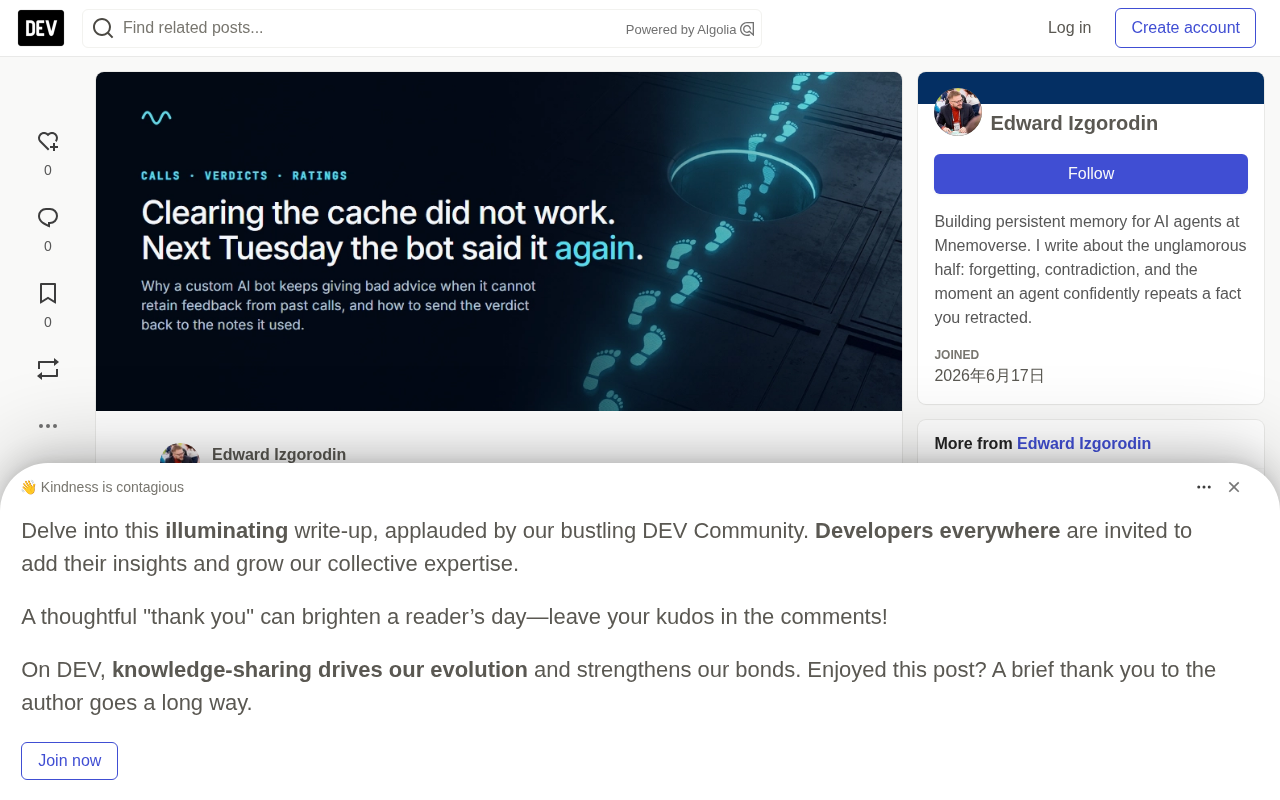
Your customer service bot tells a customer to clear the app cache to fix a sync error. The customer does it. It doesn't work. A human steps in and finds the real fix — reauthorizing the integration. The ticket closes. The following Tuesday, another customer reports the same error, and the bot confidently recommends clearing the cache again.
This scenario is not an isolated case. A large number of customized AI customer service bots share a common architectural flaw: every call ends before anyone knows whether the advice worked, and by the time feedback arrives, there's nowhere to attach it.
Why Bots Can't Learn From Their Own Calls
A typical customized bot is essentially a retrieval-augmented model call: system prompt, a search over help docs or stored notes, and the user's question. The verdict on last week's answer isn't in any of those places — it's in the customer's reply and the ticketing system.
Teams usually try three fixes in sequence.
Edit the system prompt. Add "don't suggest clearing cache for sync errors." The prompt is indeed the right place to store policy, but it scales like any hand-edited document: one line added per bad call, no one cleans it up, and important rules compete with outdated ones for the model's attention.
Store answers and corrections in memory. Corrections now survive across calls, but so does the cache advice. Similarity search ranks by closeness to the question, both notes match, both get returned, and the model picks one in context. A wrong note after ten failures is exactly as similar to the question as it was when it had never failed.
Attach outcomes to notes. When a call's outcome is known, record it on the note that shaped the answer. A failed note now carries its failure record, an effective note carries its success record, and a recall mechanism that weighs outcomes can tell them apart. Only this approach establishes a path from "what happened" back to "what gets recalled next time."
Retrieval-Augmented Generation (RAG) is a common architecture for customized customer service bots: before generating an answer, the system retrieves relevant snippets from external knowledge bases such as help docs and historical notes, then stuffs those snippets along with the user's question into the model context. This design lets the bot cite enterprise-private knowledge, but it also introduces the hidden hazard described in this article — the quality of retrieval results directly determines the quality of the answer. If the recall mechanism can't distinguish "advice that once led to failure" from "a genuinely effective solution," it returns both indiscriminately, and the model can only guess within the context. Traditional RAG only optimizes the "retrieve–generate" segment, lacking the "outcome–feedback–re-retrieve" loop, which is precisely the piece this article fills in.
What to Keep From Each Call
Answers are written during the call. Verdicts arrive after the call, sometimes days later, in a different process. So the call must leave behind something the verdict can find:
Call record: the information the bot retains from each call so that a later-arriving verdict can find what to judge — the question, the answer, and the IDs of the stored notes the answer relied on, under a key the verdict will carry.
IDs are per-note, not per-conversation. What failed is a piece of advice, not the entire exchange. If the model can state which recalled notes it relied on, keep those; otherwise keep all notes from the prompt and accept that they move together.
The key is something the verdict will carry: ticket ID, thread ID, session ID already sent by a feedback button. When a key covers multiple answers, the code keeps the latest.
Store call records in your own database, separate from the notes the bot recalls. If you write to the same memory, every recorded answer becomes just another candidate in the next recall — including the bad ones.
atom_id is the unique identifier of each note (atom) in a memory system, typically generated by the system at write time. It works like a database primary key, used to point precisely to a specific knowledge snippet. In this article's loop, atom_id is critical: when a verdict arrives, the system must know which notes to tag as "failed" or "succeeded." If the model doesn't explicitly declare which notes it relied on when answering, the only fallback is to treat every note recalled in that call as responsible, which leads to collateral damage. Keeping atom_id is equivalent to building a traceable file for each piece of advice, so that subsequent scoring, auditing, and manual correction can all pinpoint precisely.
Where Verdicts Come From
Explicit ratings are rare. Other outcomes are often already recorded somewhere, and wiring those sources in is more effective than waiting for a user to hit thumbs-down.
| Signal | Arrival time | What it means for the advice | What to send |
|---|---|---|---|
| Thumbs up or down on the answer | Seconds later, if at all | How the answer looked, usually before trying it | Positive or negative |
| User says it didn't work | Next message, or the next day | It was tried and it failed | Negative |
| Human steps in and resolves it another way | When the handoff closes | It failed, and this is the effective fix | Negative, plus the fix as a new note |
| The same user comes back with the same problem | Hours or days later | The first answer didn't hold up | Negative, with lower weight |
| Ticket closes and stays closed | After a silence period you choose | It probably worked | Positive, with lower weight |
| Nothing happens | Never | No information | Send nothing |
Two rows deserve particular attention. A handoff for reasons the bot was never supposed to handle — like a refund or an angry customer — says nothing about the advice itself. And silence, the most common case, is not a verdict.
The third row is the most valuable. Ratings can downweight failed advice, but only a note can supply effective advice, so the human's fix gets written into the memory the bot recalls.
What Scoring Changes and What It Doesn't
Scoring can't change an answer already given. It changes the ranking of what the next recall returns.
Keep failed notes rather than deleting them. Clearing the cache is correct for another kind of error, and a deleted note can't answer "why did the bot tell a customer to clear the cache in October?"
Scoring adjusts ranking, not truth. If a help doc is wrong, fix the doc. This loop doesn't depend on a specific product: a list of failed suggestions the bot checks can approximate it, storage you run yourself can carry outcome fields, and a hosted memory layer can handle the bookkeeping. What matters is the path from outcome back to recall.
valence here refers to the cumulative scoring direction of a note, usually a value ranging from -1 to +1: a negative value means the advice associated with that note has been proven ineffective multiple times, and a positive value means it has been effective multiple times. When ranking, the recall mechanism combines query similarity with valence, downweighting negative notes and upweighting positive ones. It's worth emphasizing that valence does not modify the text content of the note — it's just an attached statistical field. So even if a note is scored at -1, it can still be retrieved, just ranked lower, thereby preserving the historical evidence for "why the bot once gave this advice." This is precisely the technical basis for this article's emphasis on "keeping failed notes."
Minimal Code Implementation
The following uses mnemoverse 0.4.0; for Python SDK configuration, see its documentation. The model call is a placeholder, and call records are stored in SQLite.
import json
import sqlite3
from mnemoverse import MnemoClient

memory = MnemoClient()
DOMAIN = "bot:support"
db = sqlite3.connect("calls.db")
db.execute("CREATE TABLE IF NOT EXISTS calls "
           "(call_id TEXT PRIMARY KEY, question TEXT, answer TEXT, used TEXT, concepts TEXT)")

def answer(call_id, question):
    recalled = memory.read(question, domain=DOMAIN, top_k=5)
    reply, relied_on = bot.reply(question, recalled.items)
    used = [str(item.atom_id) for item in relied_on]
    db.execute("INSERT OR REPLACE INTO calls VALUES (?, ?, ?, ?, ?)",
               (call_id, question, reply, json.dumps(used), json.dumps(recalled.query_concepts)))
    db.commit()
    return reply

def on_verdict(call_id, outcome, fix=None):
    row = db.execute("SELECT question, used, concepts FROM calls WHERE call_id = ?",
                     (call_id,)).fetchone()
    if row is None:
        return
    question, used, concepts = row[0], json.loads(row[1]), json.loads(row[2])
    if used:
        result = memory.feedback(atom_ids=used, outcome=outcome,
                                 query_concepts=concepts, domain=DOMAIN)
    if fix:
        note = memory.write(f"Problem: {question}\nWhat worked: {fix}", domain=DOMAIN)
feedback uses the same domain as read; without it, the SDK sends "general". Writes that are too similar to recent memories in the same domain aren't stored, so the code checks stored.
The API documentation describes the effect in one sentence: "Scoring reorders what the next return gives back." The overview states what stays the same: "Feedback changes the order of the next read, not the stored text."
Verify With a Control Group
- Seed notes for two different problems, answer one question each via
answer(), and check that the two call records don't share IDs. Print thevalenceof the notes each call relied on, then stop the process. - In a new process, send a negative verdict only for the first call.
updated_countshould equal the number of IDs recorded for that call. If it's zero, check the IDs and the domain first. - Read both questions again and print the
valenceof the same notes. What you want to observe is the first call's notes moving toward -1. - Control group: the second call received no verdict, so its notes are the baseline for step 3. If their values changed while the first call's didn't, check the key the verdict was filed under. If both changed identically, step 3 didn't demonstrate the verdict's effect.
This loop also applies to coding agents, where verdicts come from builds or test runs, just with more boundary conditions for outcome memory.
Key Takeaways
The root cause of AI customer service bots repeatedly giving wrong advice isn't insufficient model capability but the lack of a feedback path from outcomes back to recall in the architecture. A real fix needs three elements: keeping a record of each call (question, answer, relied-on note IDs), capturing verdicts from multiple signal sources, and having the recall mechanism weigh those outcomes when ranking. Scoring adjusts ranking rather than deleting content; failed notes stay on file with their outcomes attached, available for later auditing and optimization.
One-line Summary
The root cause of AI customer service bots repeatedly giving wrong advice is the missing feedback path from outcomes back to recall; verdicts must be attached to notes.
Paragraph Summary
The article points out that the root cause of customized AI customer service bots repeatedly giving wrong advice isn't insufficient model capability but the lack of a feedback loop from outcomes back to recall in the architecture. Each call ends before anyone knows whether the advice worked, leaving feedback with nowhere to attach. Editing the system prompt or merely storing correction notes can't solve the problem — only attaching call outcomes to specific notes and having the recall mechanism weigh those outcomes during ranking can close the loop. Verdict signals can come from explicit ratings, user feedback, human intervention, ticket closure, and other sources. Scoring adjusts recall ranking; failed notes should be kept with their outcomes attached. The article also provides a minimal implementation based on SQLite and mnemoverse plus a control-group verification method.
Related articles

Automate Job Search with AI Agents and Residential Proxies for Precise Matching
Build an AI Agent with MCP and residential proxies to bypass recruitment site anti-scraping and geo-restrictions, scrape thousands of DevOps jobs, then have Claude score and rank each against your resume. Includes proxy comparison experiments, project structure, and cost analysis—filtering only, no auto-submission.

The AI Task Assistant That Knows When to Back Off: A Cure for Activation Struggles
One Small Step is an AI assistant for task initiation struggles, using agentic decisions for guilt-free reminders, timely retreat, and cross-platform task management. The developer shares real test results on 13 tasks and architectural trade-offs.

FastAPI: A High-Performance Python Framework and a Production-Ready API Development Powerhouse
FastAPI is a high-performance web framework based on Python type hints, supporting async and automatic OpenAPI docs. With over 100k GitHub stars, this article analyzes its core strengths, production readiness, and selection advice.