Why Are Democrats Pushing Childcare to the Center of the 2028 Election?

Democrats are pushing "universal childcare" as a 2028 election issue, but sharply disagree over what "universal" means.
The U.S. Democratic Party is making "universal childcare" a core issue of the 2028 presidential election, but the party is fundamentally split over what "universal" means: one camp wants completely free care fully funded by the government, while the other favors an "affordable" model with costs shared by parents, employers, and government. Representative Ro Khanna proposed an $80 billion-a-year free childcare plan allowing families to choose daycare, pay relatives for care, or receive $1,000 a month to care for children at home, further blurring the definition. Funding remains unresolved; polling shows only 21% of Americans support full government funding, while 40% prefer cost-sharing. Meanwhile, about 4.2 million young children with working parents have no available childcare option near home, a structural obstacle.
The U.S. Democratic Party is working to make "universal childcare" one of the central issues of the 2028 presidential election. According to Vox, several Democrats have begun rallying around this direction, but a fundamental disagreement is emerging: they do not agree on what "universal" actually means.
Two Paths: Free or Affordable?
Democrats are roughly divided into two camps. One camp argues that childcare should be completely free, fully funded by the government; the other favors an "affordable" model in which parents, employers, and the government share the cost.
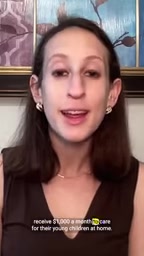
This divide is not merely a dispute over wording. California Representative Ro Khanna recently proposed an $80 billion-a-year plan that would provide free childcare to all children under six in the United States. Under the plan, families could choose a daycare center, pay a relative or neighbor to provide care, or receive $1,000 a month to care for a young child at home. The proposal pushed the "free" path to the forefront of policy debate, but it also made the definition of "universal" even blurrier—does getting paid to stay home count as "universal childcare"?
Who Pays? An Unresolved Question
Even within the "free" camp, there is no answer on funding. According to Lena Billick, a childcare researcher at the Roosevelt Institute interviewed by Vox, the framework of the discussion is shifting.
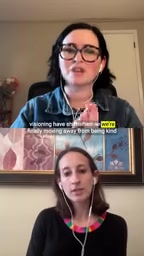
Billick said she welcomes the fact that "more and more people are moving away from the traditional market-based, means-tested status quo"—that is, the "7% of family income cap" approach under the Build Back Better framework. She believes many people in the field are moving beyond that model. More importantly, the parameters of the discussion have changed—"we are finally no longer fixated on means testing, and are finally starting to discuss whether implementing this kind of policy halfway might create more problems than solutions."
But where the money would come from has never had a clear answer.
Means-tested refers to government benefits or subsidies being distributed with a household income threshold—only families below a certain income level qualify, and higher-income households receive less. Medicaid, SNAP (food stamps), and the earned income portion of the child tax credit in the United States are all typical means-tested programs. The original intent of this design was to concentrate limited resources on the families who need them most, but in practice it has created several problems: complicated application processes, high administrative costs, a "cliff effect" in coverage (a slight increase above the threshold causes subsidies to disappear entirely), and a sense of "welfare stigma" among recipients. In left-leaning policy circles in recent years, a wave of reflection has emerged, arguing that means testing itself is the root cause of the welfare state's difficulty in expanding and in gaining political support from the middle class, and advocating instead for universal benefits.
The Build Back Better Act was a social spending package introduced by the Biden administration in 2021 that included childcare provisions. Its core idea was to cap family childcare spending at 7% of income, with the government subsidizing the excess, and to set minimum wage requirements for childcare workers. The bill failed to pass the Senate due to intra-party divisions, and its childcare provisions were shelved with it. This failure is an important backdrop to the current shift toward the "universalist camp" within the Democratic Party.
Public Opinion Does Not Support Completely Free
Voters' attitudes have also poured cold water on the "completely free" path. One poll showed that 40% of Americans believe parents and the government should share the cost, while only 21% believe the government should bear the full cost.
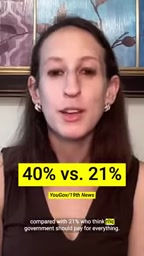
This means candidates who advocate completely free childcare may face electoral risk. Then again, the supply-side gap is equally enormous. According to one estimate, 4.2 million young children have working parents but no available childcare option within a reasonable distance of home. In other words, even if the government is willing to pay, insufficient supply of care services itself would greatly reduce the policy's effectiveness.
From Means Testing to Universality: A Paradigm Shift
The shift Billick describes is worth noting. The mainstream Democratic approach of the past—such as the 7% income cap in the Build Back Better Act—was essentially a means-testing mechanism: the government subsidizes low-income families while middle- and high-income families bear the cost themselves. A new generation of advocates argues that this approach is both complicated and prone to creating "welfare stigma," and that it cannot solve the structural problem of insufficient childcare supply.
They advocate an approach closer to the Nordic model: the government directly invests funds to build a universal childcare system while ensuring that childcare workers receive a living wage. But this shift also brings a new political dilemma—universality means much larger fiscal spending, and Congress could not even pass the limited subsidies under the Build Back Better framework.
The Nordic model usually refers to the combination of "high taxes—high welfare—high labor force participation" developed in countries such as Denmark, Sweden, and Norway. In childcare, these countries share common features: the government directly operates public childcare institutions, fees are standardized and far below market prices (often with caps set by household income but broad coverage), and public finance guarantees that childcare workers receive decent wages and professional status. As a result, women's labor force participation is significantly higher than the OECD average, and child poverty rates are also lower.
This model is often used as a reference by American progressives, but direct transplantation faces two major obstacles: first, Nordic countries generally have higher tax rates (VAT often exceeds 20%, and the top marginal income tax rate can exceed 50%), while tax-cut politics are deeply entrenched in the United States; second, the Nordic childcare system took decades to build before achieving adequate supply, while the current U.S. childcare supply itself has structural gaps. Therefore, "copying the Nordic model" in U.S. policy discussions is more of a directional reference than a workable operational blueprint.
The Real Test in 2028
As the 2028 election approaches, universal childcare will undoubtedly become a high-frequency issue. But the test facing Democrats is twofold: first, whether they can reach internal consensus on "what to promise families"—completely free or affordable cost-sharing? Covering children under six or a broader group? Second, whether they can find a viable funding source and delivery path.
Billick's concern is not unreasonable: doing only half may be worse than doing nothing. A "universal" system with incomplete coverage, unstable funding, and insufficient supply may instead intensify parents' dissatisfaction. For Democrats, childcare is both a powerful issue for mobilizing voters and a difficult problem that can easily divide the party.
The policy risk of a "half-measure" has a classic formulation in welfare state research: a universal policy with incomplete coverage, vague standards, and unstable funding may be less popular than a policy clearly targeted at low-income groups. The reason is that if middle-class families are promised "something for everyone" but find it difficult in practice to obtain services, their sense of relative deprivation may be stronger than that of groups never included in the welfare system; meanwhile, low-income families may not receive enough help because resources are diluted, creating a situation where "neither side is satisfied." This is exactly the scenario Billick worries about, and it is also the political arithmetic Democrats must confront when designing proposals.
One-line Summary
Democrats are pushing "universal childcare" as a 2028 election issue, but internally disagree sharply over what "universal" means.
Paragraph Summary
The U.S. Democratic Party is shaping "universal childcare" into a central issue of the 2028 presidential election, but there is a fundamental disagreement within the party over what "universal" means: one camp advocates completely free care fully funded by the government, while the other favors an "affordable" model in which parents, employers, and the government share costs. California Representative Ro Khanna proposed an $80 billion-a-year free childcare plan allowing families to choose daycare, pay relatives for care, or receive $1,000 a month to care for children at home, further blurring the definitional boundary. Funding remains unresolved; polling shows only 21% of Americans support the government bearing the full cost, while 40% prefer cost-sharing. Meanwhile, about 4.2 million young children with working parents have no available childcare option near home, and the supply gap constitutes a structural obstacle.
Related articles
uGAP: An AI Platform Unifying 100+ African Geospatial Datasets
uGAP is an African geospatial AI platform by a University of Cape Town team, unifying 120+ African datasets with a Python SDK for discovery, processing, and model training, already used in cyclone flood mapping.

Cursor Can Now Control Your Computer: AI Agents Can Drive Desktop Apps for Testing
Cursor adds desktop control: AI agents can drive desktop apps like the iOS Simulator to test their own features. We analyze the impact on dev workflows, possible technical approaches, and reliability concerns.

Vibecoding a Custom Inference Engine: High Hopes, Harsh Reality
A Reddit developer shares the real experience of vibecoding a custom inference engine: running GGUF Q4 models in the browser with WebGL2 and GLSL, only to fall into tokenizer debugging hell. This article analyzes the engineering challenges of browser-side LLM inference and why cloning llama.cpp is the more rational choice.