Why Are Local AI Models Free? The Business Logic Behind Open Source

Free local AI models are a deliberate business strategy — not charity — to capture developer ecosystems and influence.
This article addresses a common beginner question: why are local models like Llama and Qwen free? Publishers fall into three groups — large tech companies, research institutions, and independent developers — each with different motivations. The business logic is clear: open weights capture the developer ecosystem and set industry standards, while a "free model, paid service" dual-track model monetizes enterprise clients. Meta's decision to open-source Llama was partly aimed at preventing OpenAI and others from monopolizing AI infrastructure. The article also cautions beginners that "free" local AI isn't without costs: hidden hardware requirements, license restrictions, and a capability gap versus top closed-source models all apply.
A Beginner's Question: Why Would AI Companies Give Away Their Models?
Users new to local AI often have a simple but genuine question: models like Llama, Mistral, and Qwen can run right on your own computer — so why are the companies behind them willing to offer free downloads? After pouring enormous computing resources and R&D budgets into these systems, why not just charge for them? The question seems straightforward, but the answer touches on the competitive strategies and business model design of the entire AI industry.
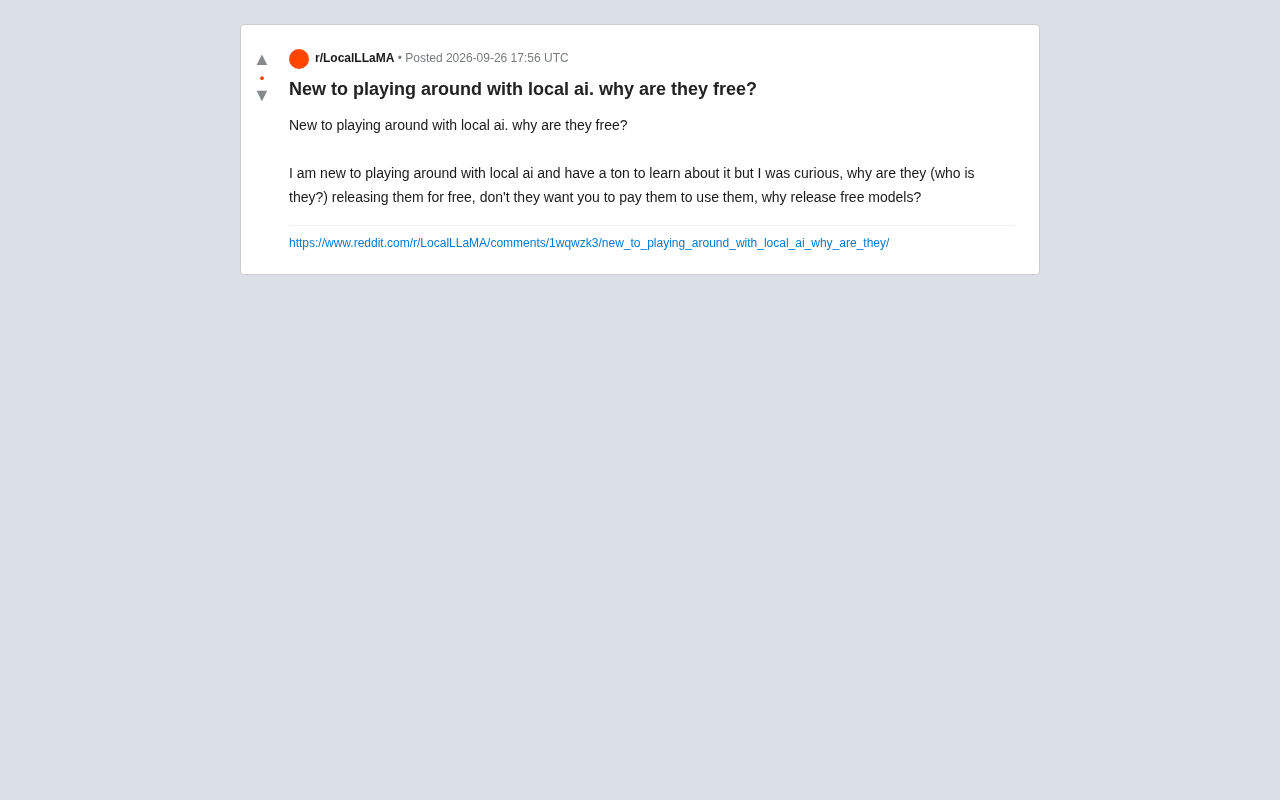
This Reddit post captures the mindset of many AI beginners — accustomed to the idea that "good things cost money," free and open source actually feels suspicious. To make sense of it, we first need to clarify who is releasing these models and what they're after.
So Who Exactly Are "They"?
When the poster asks "who is they," the answer is that publishers of free local models generally fall into a few categories:
Large Tech Companies
Meta (the Llama series), Alibaba (Qwen), Mistral AI, Google (Gemma), and others. These companies have deep pockets and significant compute resources. Opening up model weights is typically a strategic decision, not an act of charity.
Research Institutions and Universities
Many models originate from academic research. Public release is part of academic tradition, and it helps advance the field while boosting the citation impact of published papers.
Independent Developers and the Community
On platforms like Hugging Face, a large number of individuals and small teams take existing models, fine-tune them, and share the results for free — creating a vibrant open-source ecosystem.
Hugging Face deserves special mention here. It's currently the world's largest AI model hosting and collaboration platform — essentially the GitHub of AI — hosting over 700,000 public models. Anyone can freely upload, download, and share model weights. This platform is what makes "fine-tune and release for free" a sustainable feedback loop: beginners can download others' work, while more advanced users contribute their improvements back. Fine-tuning refers to taking an existing large model's weights and doing a second round of training on domain-specific data, making the model perform better on a particular task (such as code generation, roleplay, or a specific language) — without training from scratch. This dramatically lowers the barrier for individuals to participate in AI development.
The Business Logic Behind "Free"
Free doesn't mean unprofitable. In fact, releasing open models often serves longer-term commercial goals.
Capturing the Ecosystem and Developer Mindshare
When a model is made freely available, developers build tools, applications, and best practices around it. The more people use it, the more likely that model — and the company behind it — becomes the industry standard. One of Meta's core motivations for opening Llama was to prevent AI infrastructure from being monopolized by a handful of closed-source players like OpenAI. Rather than spending resources playing catch-up, open-sourcing pulls the entire ecosystem toward your platform.
"The Model Is Free; the Service Costs Money"
Many vendors operate on an "open weights, paid services" model. The model itself is free, but if you want a hosted API, enterprise-level support, larger-scale compute, or customization capabilities, you pay. Offering it free to individual users while monetizing commercial clients — these two paths aren't mutually exclusive.
The Value of Data and Feedback
When a massive number of users run the model in real-world scenarios, they surface bugs, generate feature requests, and contribute improvements. This feedback is enormously valuable for model iteration. In a sense, free users themselves are a resource.
Brand Building and Talent Attraction
Releasing a top-tier open model is the most direct way to demonstrate technical capability. It boosts a company's reputation and is a powerful tool for attracting elite AI talent — researchers tend to prefer working at places where they can publish their results openly.
"Free" Has Its Limits
It's worth reminding newcomers that "free" local AI isn't without costs or constraints:
- Compute costs shift to you: The model is free, but running a large model requires a decent GPU and plenty of RAM — hardware is a hidden cost.
- License restrictions: Many open models (like early versions of Llama) come with usage terms. For example, commercial applications exceeding a certain user scale may require additional licensing. Strictly speaking, these are "open weights" rather than fully free open source.
- Capability gap: Free local models generally still lag behind top closed-source models (like the flagship GPT series) in overall capability. Vendors keep their most powerful features in paid products.
What This Means for Beginners
For those just getting started, free local models are an excellent entry point: no cost, data stays local for better privacy, and you can experiment freely. Understanding why they're free also means understanding the competitive landscape of the industry — the battle between open source and closed source is one of the most important ongoing storylines in AI right now.
To put it simply: these companies aren't uninterested in making money. They've just chosen a path of "grow the ecosystem first, monetize later." The free access you enjoy is itself a product of that competition.
Background Note
"Open weights" and "open source" are two concepts that are easy to conflate but fundamentally different. True open source requires publishing training code, datasets, and model architecture, and permits use, modification, and redistribution in any form. "Open weights" means only the trained model parameter files are released — training data and the full pipeline typically remain a black box, and usage is often subject to license restrictions. Llama 2's license explicitly prohibits direct commercial use by products with more than 700 million monthly active users; Llama 3 relaxed this somewhat, but it still doesn't qualify as a standard OSI-certified open source license. Understanding this distinction is especially important for developers who plan to use local models in commercial projects — always read the applicable license terms carefully before proceeding.
Related articles

WebMCP: Every Website as Its Own MCP Server, So AI Agents No Longer Rely on Screenshots
WebMCP lets websites expose tools via the document.modelcontext API, becoming directly callable MCP servers. This article explains its architecture, the Claude Code remote-debugging demo, Chrome's current support stage, and its impact on the agent ecosystem.
MCP Protocol-Driven AI Testing Agent: …
MCP Protocol-Driven AI Testing Agent: Automated Execution, Diagnosis, and Reporting
Introduces an MCP protocol-based AI testing Agent: using FastMCP to expose PyTest execution tools, running Llama 3.2 3B locally with Ollama for failure diagnosis, automatically generating timestamped reports and comparing them with historical results to create a closed loop of test execution, root cause analysis, and fix tracking.

AI Agent Draws an Architectural Elevation in 15 Seconds — Open-Source Drawing Software Rewritten by AI
An AI Agent controls open-source drawing tool VectorCraft via MCP Server, executing 1,077 commands with zero errors to draw an architectural elevation in 15 seconds and export editable SVG/PDF.