Why Can't You Escape Those Unhinged Political Text Messages?
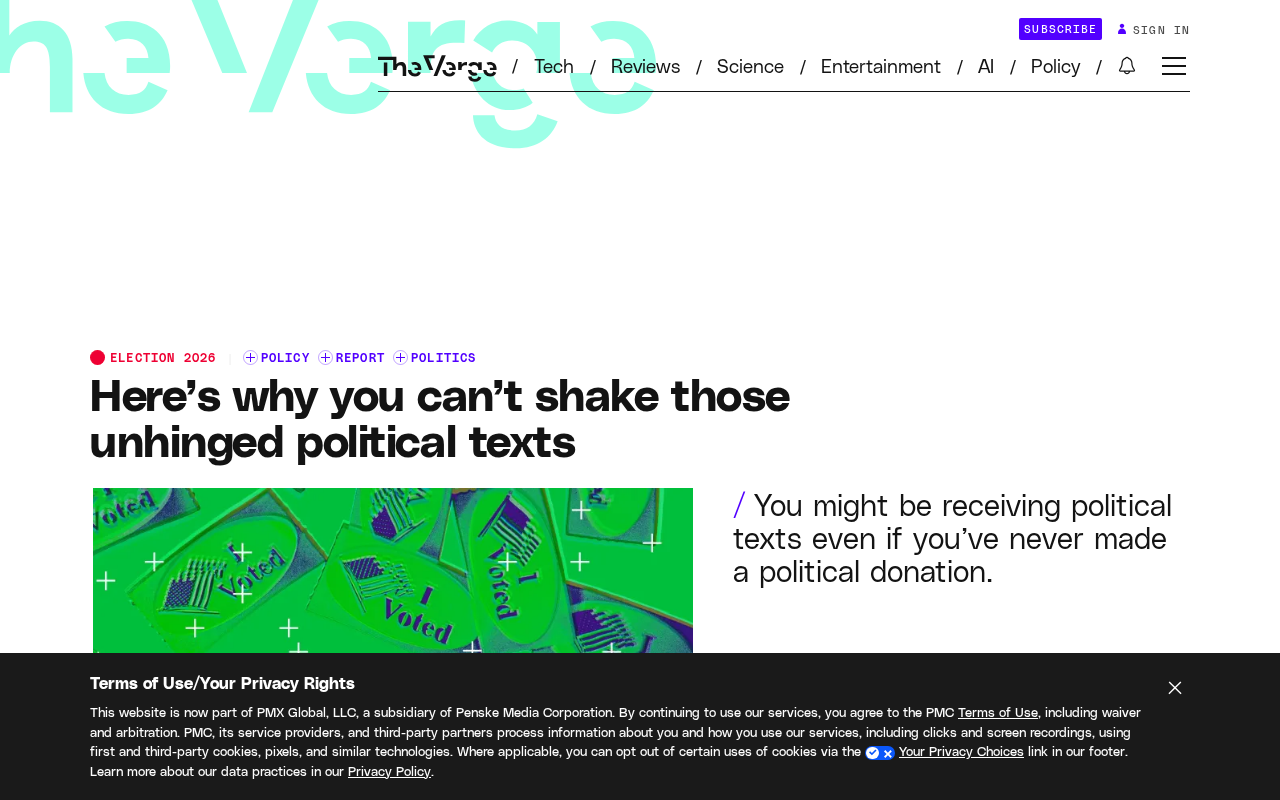
The unhinged tone of political texts is the product of A/B testing and conversion-rate conditioning, backed by list circulation and marketing incentives.
The article analyzes the phenomenon of rampant, unhinged political text messages in the US. These texts have high emotional intensity, low information density, and clear calls to action—donate or vote. Their unhinged style isn't strategist preference but the result of A/B testing and conversion metrics: the more emotionally stimulating the copy, the better it converts, so organizations keep amplifying it. Phone number lists circulate among campaign teams and committees; unsubscribing only blocks a single number; combined with high open rates and low costs, organizations have strong incentives to keep pushing. Political marketing service providers profit from sending volume, further driving frequency and intensity. The article notes this is a structural phenomenon of the attention economy penetrating political mobilization, and recipients should treat it as high-pressure marketing rather than credible information.
American voters' phones are flooded with unsettling political text messages—unhinged in tone, absurd in content, and astonishing in frequency. This is no accident, but the product of an entire system of political fundraising and mobilization.
What Do These "Crazy Rants" Actually Look Like
Several messages featured in the source material are quite representative: one pleads in the name of candidate James Talarico, begging the recipient, "Please please please, even just $1"; another uses polarizing language to ask, "Who's helping James Talarico campaign? Marxists"; yet another uses repeated "Wow! Wow! Wow!" to create urgency, claiming Mark Kelly has just released a "major announcement"; there's even a video featuring MLB analyst Ben Verlander urging voters to turn out on Election Day this Tuesday.
What these messages share: extremely high emotional intensity, extremely low information density, and an extremely clear call to action—donate money or vote. They read like scam texts, yet they come from legitimate political fundraising and mobilization operations.
Why Are These Messages So "Unhinged"
The unhinged tone of political text messages is essentially the result of being conditioned by data and algorithms. Fundraising teams continuously test different copy—whichever version has the highest open rate, click-through rate, and donation conversion gets amplified. And repeated testing demonstrates: copy that evokes panic, shame, moral coercion, and extreme contrasts often converts better than rational, measured versions.
This creates a feedback loop—the crazier it is, the more effective; the more effective, the crazier. The tone isn't a personal preference of the strategists; it's reverse-engineered by platform metrics. When a "please donate $1" text can generate real small-dollar donations, organizations have no reason to return to restrained, polite language.
A/B testing is the key technical context for understanding this phenomenon. A/B testing is a controlled experiment method: audiences are randomly divided into two or more groups, each shown different versions of copy, headlines, or calls to action, and then performance is compared across metrics like open rate, click-through rate, and donation conversion rate. Political fundraising teams typically run dozens or even hundreds of copy variants simultaneously, using real-time data from texting platforms and fundraising software to determine within hours or days which version converts best, then rapidly shift budget to the "winner." This rapid iteration and large sample testing mechanism means any phrasing that stimulates emotion and boosts conversion will be discovered and amplified, while measured, rational expressions are eliminated for mediocre performance. Over time, the tone of text messages systematically drifts toward emotional extremes, with strategists' personal style giving way to metric feedback.
Why You "Can't Escape" Them
The difficulty is that the dissemination chain of this information has almost no natural endpoint. Phone numbers can be repeatedly packaged, exchanged, and shared; small-dollar donor lists are treated as high-value assets, circulating among different campaign teams and committees. Once you've donated once, signed a petition, or registered voter information, you may be tagged as a "reachable potential donor" and enter more lists.
Unsubscribing is also merely a surface action. The STOP in a text usually only terminates pushes from one specific sending number, while the same organization may continue reaching you through multiple numbers and channels. Combined with the fact that text messages have far higher open rates than email and cost very little, political organizations have strong incentives to keep squeezing this channel.
The circulation of phone number lists is backed by a mature "donor profile" ecosystem. In American political fundraising, the names, phone numbers, zip codes, donation amounts, and frequencies of small-dollar donors are recorded in databases and circulated among different campaign teams, party committees, and advocacy organizations through data brokers, list rentals, or exchange agreements. Such lists are considered high-value assets because verified donors convert at much higher rates than cold numbers. Additionally, the cost of text outreach is extremely low—a single mass text typically costs only a few cents, while open rates far exceed email, yielding considerable ROI. Organizations therefore have persistent incentives to expand lists and increase sending frequency, and once recipients enter this ecosystem, it's very difficult to fully escape.
Who's Paying for This Content
This system persists because it genuinely delivers returns in fundraising and mobilization. Candidates need small-dollar donations to accumulate impressive totals, grassroots organizations need to get people to the polls, and text messaging is one of the lowest-cost, most directly measurable conversion tools. There are also numerous marketing service providers in between, profiting from sending volume or commissions, naturally inclined to increase sending frequency and copy intensity.
What's particularly amusing is the absurd mismatch in the source material—using an MLB baseball analyst to record an election video. This shows that the boundaries of political communication have long been blurred: anyone with an audience can be converted into a mobilization node. Whether the content is "professional" doesn't matter—reach and incitement are what count.
Political marketing service providers are an easily overlooked link in this industry chain. They provide mass texting platforms, list management, copy testing, and data analytics tools, typically charging by sending volume or taking a percentage of fundraising totals. Since revenue is directly tied to sending scale, service providers naturally have incentives to encourage clients to increase sending frequency and intensify copy's inflammatory nature, even offering "best practice" templates that standardize high-converting rhetoric. This means the unhinged tone isn't just the choice of campaign teams but the result of the entire commercial ecosystem's incentive structure—middlemen profit from the fundraising chain while bearing almost none of the costs of harassment or misinformation.
How Ordinary Recipients Should View This
Treating these texts as high-pressure marketing rather than credible information sources is the more reasonable stance. Their tone is deliberately exaggerated; the purpose isn't to convey facts but to provoke emotional reactions. Maintaining skepticism when receiving them and not being led by the rhetoric is more effective than unsubscribing one by one.
From a broader perspective, the unhinging of political text messages reflects a structural phenomenon: when communication channels are driven by real-time feedback metrics, public communication systematically drifts toward emotional extremes. This isn't an occasional lapse in any single election, but the inevitable result of the attention economy penetrating political mobilization.
Related articles

AI Can Read Neural Network Weights Directly: Do Models Already Exceed Expectations?
A Reddit developer experiment shows language models can directly read neural network weights and infer their function. Astra, Opus 5.5, and Muse Spark 1.3 all passed the test, sparking discussion on model generalization and training sources.

India's Microdrama Market Explodes: EloElo Secures $80M Investment from NBCUniversal
EloElo secures $80M from NBCUniversal to boost StoryTV, its microdrama platform with over 33M monthly active users, as India's microdrama market draws global capital.

Acoustic Detection of Multi-Rotor UAVs: Fusing Handcrafted Features with Pre-Trained Embeddings
Study reveals data leakage from random splits in UAV acoustic detection, proposes source-disjoint protocol with stacked ensemble of handcrafted features and YAMNet embeddings, achieving 95.29% accuracy for low-cost drone detection.