Why Chinese Open-Source Models Win Global Favor: The Three Logics Behind Open Weights
Chinese open-weight models win global developer goodwill through low prices, adequate capability, and controllability, but openness remains a business choice.
An OpenAI employee's post sparked discussion about global goodwill toward Chinese open-source models. The article notes that Chinese companies release model weights rather than complete open source—strictly open weights, with training code and data not necessarily disclosed. The goodwill stems from three factors: open models cost about one-quarter as much as closed-source ones due to hosting competition; the strongest open models catch up to closed-source models about four months later on average, though adoption is rising fast; and users gain control to run locally, audit internals, and fine-tune. The distillation controversy centers on the source of capability, but obtaining weights determines who holds control. Openness is a business choice: Alibaba monetizes via cloud, U.S. enterprise API spending remains concentrated in closed-source models, and license and safeguard-bypass boundaries are clear.
A post by OpenAI employee Room pushed the topic of "Chinese open-source models winning global favor" into the spotlight. He even went so far as to say that most people in the AI community in America side with China rather than with the companies that make money selling model usage rights. This goodwill is not unfounded, but reducing it to "free" underestimates the weight of open weights.
The Essence of Open Weights: What's Handed Over Is More Than Files
To understand what Chinese companies are doing, you first need to see clearly what "open source" really means here. What DeepSeekAd, Alibaba's Tongyi, Moonshot AI, and others release are trained model weights—the vast arrays of parameter numbers determined through training. Download the weights locally, pair them with a runtime and enough GPUs, and you can run the model. Strictly speaking, this is called "open weights," often simplified to "open source," but it does not necessarily disclose the training code, nor does it necessarily explain the training data. The Open Source Initiative's standard is stricter: complete open-source AI should disclose these as well.
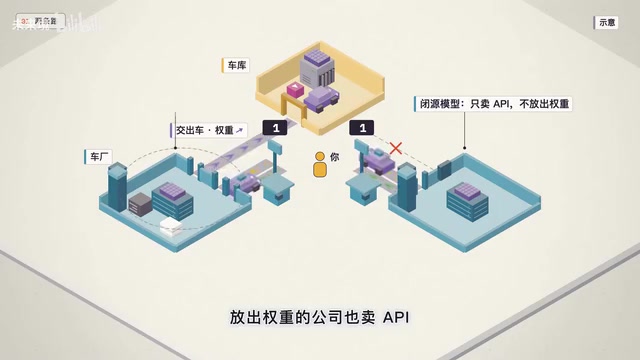
The other path is the API model: send a question to the model company, get an answer back, and the model always stays on their servers. Open weights are like a carmaker handing the car to you; an API is like a taxi company dispatching a ride per trip. Companies that only sell APIs without releasing weights are closed-source models; companies that release weights also sell APIs, but they additionally give you a downloadable copy of the weights. Both approaches can deliver equally good answers; the difference lies in who gets to decide how the model is used.
Model weights are the set of parameters a neural network learns during training, typically represented by tens of billions to hundreds of billions of floating-point numbers. The training process continuously adjusts these parameters through backpropagation, teaching the model to predict the next word across large amounts of text, eventually converging to a set of values capable of generating coherent answers. The weight file itself is static, but combined with model architecture code (such as the Transformer structure) and inference programs, the model's behavior can be reproduced locally. Open weights mean anyone can download, inspect, modify, and run these parameters on their own hardware, but the original training data, data cleaning pipelines, and training hyperparameters are not disclosed alongside them, which makes reproducing the training process nearly impossible and constitutes the key gap between open weights and complete open source.
Cheapness and Capability: The Two Most Direct Sources of Goodwill
A September survey by research firm ETR showed that 69% of enterprises already using open models cited cost savings as a reason. Why can openness drive prices down? The platform OpenRouter has estimated that the average list price for text generated by open models is about one-quarter that of closed-source models. The price gap mainly comes from competition among hosting providers—the same open model can be hosted by many providers, just as the same car model can be used by many fleets, so fares are naturally pushed down by competition. Low prices are to a large extent a byproduct of openness.
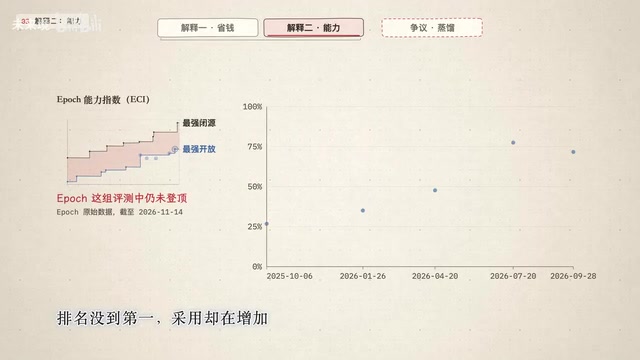
On the capability front, Chinese open models are catching up fast. Research institute Epoch AI synthesized a capability index from more than 50 benchmarks; as of late May, the strongest open models reached the level of the strongest closed-source models about four months later on average. As of November 14, the top five open models all come from Chinese companies, but in this evaluation set, this year's strongest open model still has not surpassed the strongest closed-source model of the same period. Rankings haven't reached first place, yet adoption is increasing: among the top fifty models by usage on OpenRouter, the share of text processed by open models from various countries rose from 27% last October to 72% in late September this year. For specific tasks, "good enough" capability is often more practical than ranking first.
The Distillation Controversy: Where Capability Comes From Is Not the Same as What Is Handed to Whom
Catching up so fast has also invited skepticism: were these Chinese models trained on answers from American models? So-called distillation means using a strong model's answers to train another model. The practice itself is conventional technology, but both Anthropic and OpenAI prohibit using answers to train competing models in their terms of service. Anthropic has twice accused Chinese companies of distilling Claude this year; its September report claimed that a party affiliated with Alibaba had more than 150 million conversations with Claude—these figures come from Anthropic's own investigation, the original evidence was not made public, and they have not been independently verified. Three U.S. safety agencies jointly named six Chinese companies in September, including DeepSeek, Alibaba, and Moonshot AI; the next day, China's Ministry of Commerce responded that distillation is very common in the industry and that American companies are no exception.
According to the analysis in the original Bilibili video, two questions need to be separated here: distillation can teach part of the capability, but it does not give you the original model's weights. Where capability comes from, and whether the model is handed to users, are two different things.

Knowledge distillation was first proposed by Hinton et al. in 2015, referring to training another smaller model (the student) on the output probability distribution of a large model (the teacher), so that the student approaches the teacher's performance with fewer parameters. In the era of large models, distillation has evolved into using generated text from strong models as training data to directly fine-tune or continue pre-training the target model. Technically, this can efficiently transfer style, reasoning patterns, and some knowledge, but it cannot replicate the teacher model's internal representations and complete capability boundaries, because the student can only observe signals at the output level. Terms of service prohibit distilling competing models; the core dispute lies in whether output data constitutes a protected use case and whether capability transfer amounts to misappropriation of intellectual property—this boundary is still legally unsettled.
The Transfer of Control: What Additional Choices Users Gain
With the weights in hand, what users gain is choice. When the model runs on their own machines, questions and data do not have to pass through the model company's servers; as long as it runs locally, the model can still run even if the model company shuts down its API. APIs are different—OpenAI once blocked API calls from regions including China, and whether older versions on the API remain available is up to the model company. Weights can continue to be used, but you must comply with the license released alongside them.
Control is also reflected in research freedom. With only an API, researchers mainly study models by asking questions and observing answers; with the weights, they can open the hood and inspect how it computes internally. Researcher Nathan Lambert found that about 30% of the machine learning paper samples he scanned mentioned this point. Singapore's national project Sea Lion uses Alibaba's Tongyi as its base and continues training in seven Southeast Asian languages—this is fine-tuning. But the car has been handed over; the manufacturing process is not necessarily public—DeepSeek's R1 released the weights but did not disclose the training data or training code.

Fine-tuning refers to continuing training on top of already pre-trained model weights using data from a specific domain or task, so that the model adapts to new scenarios. Compared with training from scratch, fine-tuning requires only a small amount of data and compute, because the model already possesses general language capability. The Sea Lion project starts from Tongyi weights and continues training on corpora in seven Southeast Asian languages, which is a typical fine-tuning: it retains the original architecture and most parameters, adjusting only some layers or all parameters to adapt to the new language distribution. Open weights make fine-tuning possible because users have the complete parameter files; the API model usually offers only limited fine-tuning interfaces, and the trained model remains on the provider's servers, where users cannot download or audit it.
Giving Away Weights for Free: How Do Companies Make Money?
Alibaba co-founder Joe Tsai has said that Tongyi releases open weights and Alibaba makes money from its cloud business—users train and run models on Alibaba's servers, and Alibaba charges for that. A report by venture firm Menlo Ventures points out that many of the open models used by U.S. enterprises are run by hosting providers; the same open weights can be moved to another host, or users can consider running them themselves. Migration has costs, but when switching hosts you don't have to switch the model along with it, so users don't have to depend on a single company and thus gain bargaining power.
The boundaries of openness are equally clear. Menlo Ventures estimates that Anthropic and OpenAI together account for 86% of U.S. enterprise spending on large-model APIs; the money is still mostly spent on closed-source models. Licenses also impose limits: flagship models such as Tongyi and Moonshot AI's Kimi stipulate that companies with revenue above a certain scale must obtain additional authorization to resell services; whether the next version will remain open is also not up to users. U.S. evaluation body CAISI also points out that when some open models are run by users themselves, the safeguards preventing dangerous answers can be bypassed.
The goodwill Room speaks of ultimately comes from three things: cheapness, adequate capability, and users having more say in how the model is used. For developers building products in the AI community, being able to inspect the internals and being less affected by supply shutdowns are concrete benefits. Open weights are not charity but a business choice that partially transfers control in exchange for an ecosystem position—this goodwill is the echo of that choice.
One-line Summary
Chinese open-weight models win global developer goodwill through low prices, adequate capability, and controllability, but openness remains a business choice.
Paragraph Summary
A post by OpenAI employee Room sparked discussion about global goodwill toward Chinese open-source models. The article points out that what Chinese companies release are model weights rather than complete open source; strictly speaking, this is open weights, and training code and data are not necessarily disclosed. The goodwill mainly comes from three aspects: open models cost about one-quarter as much as closed-source models, with low prices driven by competition among hosting providers; on capability, the strongest open models catch up to closed-source models about four months later on average, but adoption is rising rapidly; and users gain control, being able to run locally, audit internals, and fine-tune. The distillation controversy focuses on the source of capability, but whether one obtains the weights determines who holds control. Openness is a business choice: Alibaba monetizes through cloud services, U.S. enterprise API spending remains highly concentrated in closed-source models, and boundaries such as licenses and safeguard bypasses are equally clear.
Related articles

The Bottleneck of AI Programming Isn't Generation: Why Software Factories Collapse
After AI coding tools went mainstream, PR review quality dropped and incidents rose. The speaker argues the bottleneck isn't code generation but models' inability to sustain maintainability.
Gemini 4 Neon Hands-On: 10 Hours to Achieve What Opus Couldn't in Days, 20x Faster Warm Start
Google's surprise Gemini 4 Neon release made critic Theo change his tune: 10 hours to finish what Astra couldn't in ten days, 20x faster warm start, coherence beating Opus.

Gemini 4 Neon Hands-On: Which $20 AI Subscription Should You Choose?
Bilibili creator tests Gemini 4 Neon: composite intelligence index 61, beating Claude Opus 5.5, with API 25% cheaper. With a $20 budget, how to choose between Google AI Pro, Claude Pro, and ChatGPT Plus? Includes three must-know pitfalls and recommendations by user type.