Why Claude Code Ditched RAG for Grep: The Engineering Logic Behind the Decision

Claude Code ditched RAG for Grep-based Agentic Search — here's the engineering logic behind why.
Claude Code switched from RAG vector retrieval to Agentic Search using Grep, driven by three core problems: RAG's retrieval black box is undiagnosable by the model, errors multiply across pipeline stages, and vector indexes can't keep pace with fast-changing codebases. The right approach separates scenarios — exact matching uses Grep, semantic exploration uses vectors — with the model driving retrieval decisions rather than a fixed pipeline.
Starting with an Interview Question
"Why did Claude Code abandon RAG in favor of native Grep search — do you think that's a reasonable call?" This seemingly tricky interview question isn't testing which side you take, but rather how deeply you understand the RAG (Retrieval-Augmented Generation) paradigm and whether you have real-world engineering judgment from shipping LLM products.
RAG was introduced by Facebook AI Research in 2020 as an architectural pattern that decouples external knowledge retrieval from language model generation: a retrieval system first pulls relevant chunks from a knowledge base, then injects those chunks as context into the prompt to guide the model's response. It became widely adopted because it addresses two core limitations of LLMs — the knowledge cutoff problem and hallucinations — since the model doesn't need to "memorize" all knowledge; it only needs to reason over the given context. A standard RAG pipeline typically involves seven stages: document preprocessing, text chunking, embedding vectorization, vector database storage, approximate nearest neighbor (ANN) retrieval, optional reranking, and final generation.
If you just say "RAG doesn't work well," the interviewer will immediately push back: "Where exactly does it fall short? Be specific." That's where many candidates stumble — they have a vague impression but no root-cause analysis. This article breaks it down across four dimensions: fact alignment, root-cause analysis, scenario segmentation, and architectural philosophy.
Getting the Facts Straight
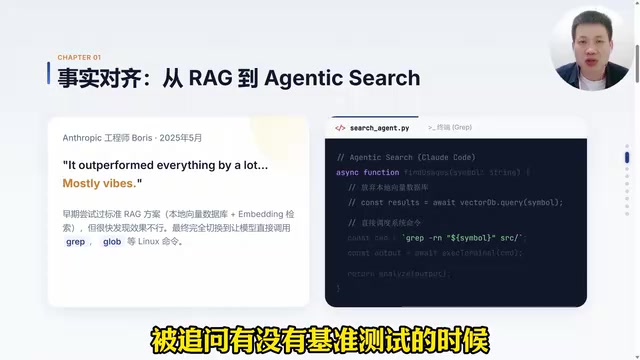
Anthropics engineer Boris mentioned in the Latent Space blog that Claude Code did indeed experiment with the standard RAG approach early on — a local vector database paired with embedding-based retrieval — but found it unsatisfactory and eventually switched to Agentic Search.
Agentic Search is part of the broader AI Agent paradigm. In this paradigm, the model is no longer a passive reasoner waiting for inputs; it actively plans and invokes external tools to complete tasks. Claude Code implements this through Tool Use / Function Calling: the model outputs structured tool-call requests, the host environment executes the actual shell commands, and the results are returned to the model for continued reasoning. This "observe-think-act" loop (the ReAct framework) gives the model an adaptive retrieval strategy: when facing ambiguity, it can first explore the directory structure, then narrow down to precise searches — the entire process driven by the model's reasoning chain, not a pre-fixed pipeline.
In practice, Agentic Search means letting the model invoke Linux commands like grep and find to search code in real time, rather than relying on a pre-built vector index. Boris's exact words were: "It outperformed everything by a lot."
One detail worth noting: when pressed on whether there was benchmark data to back this up, Boris admitted the conclusion was mostly based on "gut feel" from extensive real-world use. This matters — it means the finding comes from engineering intuition, not rigorous benchmarks. Pointing this out in an interview actually demonstrates greater professionalism.
Where RAG Actually Fails in Code Contexts
Many assume RAG failed because "embeddings don't work on code." That's a misconception. Embedding maps text into a high-dimensional dense vector space where semantically similar text sits closer together. Leading code embedding models (such as OpenAI's text-embedding-ada-002 and Microsoft's CodeBERT), pretrained on large-scale code corpora, can capture function-level semantic relationships. Even when getUserById and deleteUserById share a large number of tokens, embeddings can still capture their semantic differences. The real problems run deeper — and there are three of them.
Undiagnosability: The Model Can't See Inside the Retrieval Black Box
RAG essentially wraps an independent retrieval system around the model. When retrieval results are wrong, the LLM has no way to tell — is the external retrieval system at fault, or is the underlying data just like that? The model can't diagnose errors in the RAG pipeline, so it ends up having to access the raw data itself to verify. If the model has to look at the actual code anyway, why add an opaque retrieval layer in front of it?
The Multiplication Effect: Errors Compound Across Stages
Document splitting, embedding generation, vector retrieval, reranking, final generation — even if every stage of this pipeline scores 95 out of 100, multiply them together and overall accuracy drops below 60. It's worth noting that vector retrieval typically relies on databases like FAISS, Pinecone, or Weaviate, using approximate nearest neighbor algorithms such as HNSW (Hierarchical Navigable Small World) or IVF (Inverted File Index). ANN algorithms inherently trade recall for speed — an unavoidable precision loss that makes RAG structurally disadvantaged in exact-match scenarios. Debugging failures is even worse: you can't tell whether the chunking was bad, the embedding quality was poor, or the query reformulation drifted. By contrast, when Grep fails, there's exactly one reason: the keyword didn't match. That determinism is enormously valuable from an engineering standpoint.

Index Staleness: Code Changes Fast, Indexes Can't Keep Up
Code repositories evolve rapidly. An index built in the morning may already be stale by the afternoon, causing continuous drift between the index and the actual codebase. You're stuck choosing between frequently rebuilding the index (at significant compute cost) or tolerating stale indexes that produce incorrect retrieval results. Grep, on the other hand, always searches in real time — you always get the current state of the code, with zero synchronization issues.
Dropping RAG Doesn't Mean Dropping Knowledge Bases
A critical clarification is needed here: Claude Code abandoning RAG doesn't mean knowledge bases are useless — it means knowledge bases shouldn't be used the way traditional RAG uses them. Different scenarios have clear boundaries.
Grep and command-line tools excel at precise matching — searching code, searching logs. Function names, variable names, and error codes are themselves the best retrieval keywords. But business documents like employee handbooks, contract terms, and policy manuals genuinely need an external knowledge base.

The real issue isn't "should we have a knowledge base" but "how should we use it." Traditional RAG works like this: user asks a question, the system retrieves chunks from the vector store, then stuffs those chunks into the prompt for the model to answer — this completely bypasses the model's own judgment. A better approach is to let the model decide what to look up, when to look it up, and how to use what it finds. The knowledge base still exists, but control over retrieval belongs to the model, not to a fixed external retrieval pipeline.
This is the core philosophy of Agentic Search: let the model drive retrieval, not let retrieval drive the model.
Going Deeper: Architectural Philosophy and Engineering Trade-offs
Anthropics internal principle is sometimes described as "Everything is a model" — let the model itself drive decisions rather than building a complex engineering pipeline around it.
From an operations perspective, a RAG solution requires maintaining the state of an entire indexing system: the index gets stuck, the cache gets corrupted, data goes stale — all of this operational burden falls on the engineering team. Grep runs entirely locally: zero configuration, zero indexing, zero maintenance. Users can clone a repo and start working immediately.
There's also a security consideration that often gets overlooked: storing code as embeddings in a vector database creates information leakage risk from the vector representations themselves. Multiple academic papers published in 2023 (including research from MIT and Cornell teams) demonstrated that through reverse engineering of embedding vectors, attackers can reconstruct original text content with considerable accuracy — a class of attacks known as "Embedding Inversion Attacks." The mechanism involves training a dedicated decoder model that maps target embedding vectors back to approximate original token sequences. For enterprise codebases, embeddings implicitly encode highly sensitive information: function logic, API key naming conventions, business domain vocabulary, and more. Even if the vector database has access controls, once the vector files are leaked, the original code content faces a real risk of reconstruction. For code — a core business asset — this risk is unacceptable.
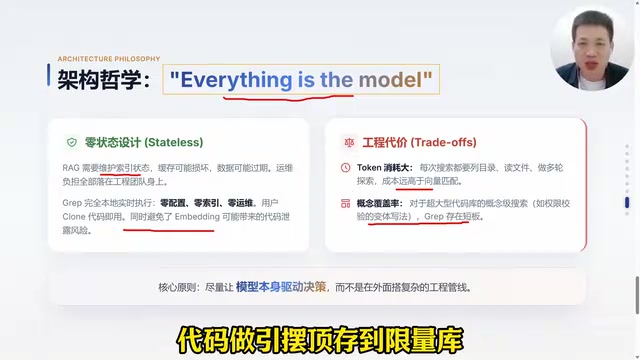
Of course, the Grep approach has clear costs. The biggest issue is token consumption — each real-time search involves listing directories, reading files, and multiple rounds of exploration, consuming far more tokens than a single vector retrieval call. With Claude 3.5 Sonnet, for example, a code exploration task might involve dozens of tool calls, each returning file contents ranging from hundreds to thousands of tokens, stacking on top of multi-turn conversation history — total token consumption for a single task can be 5–10x that of a traditional RAG approach. That said, as model context windows continue to expand (Claude 3 series supports 200K tokens) and inference costs continue to fall, this disadvantage is becoming increasingly marginal. Additionally, for very large codebases, Grep does have gaps in conceptual-level search: if you want to find "all logic related to permission checks," Grep may not cover every variation of how that logic is written.
The Right Conclusion: Separate the Scenarios, Not a Binary Choice
The correct takeaway isn't "RAG is obsolete" — it's that the scenarios have been separated:
- Exact matching → Grep: function names, error codes, log search;
- Conceptual exploration → vector retrieval: fuzzy semantics, cross-file associations;
- Knowledge bases can still exist, but the model should decide when and how to query them — not a pre-fixed pipeline.
Coming back to the original interview question: if you can clearly articulate all three layers — the foundational issue of undiagnosability, the scenario-level distinction of precise boundaries, and the architectural principle of stateless design — with sound reasoning and clear scope, it'll be hard for the interviewer not to give you top marks.
Here's an open question worth thinking about: if your system needs both exact matching and semantic search, how would you design a retrieval router that lets the model decide when to use Grep and when to use the vector store?
Key Takeaways
Related articles
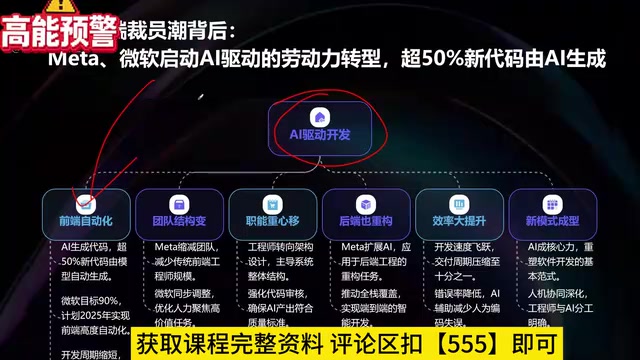
What Is Vibe Coding? The AI Programming Skill Every Developer Needs
What is Vibe Coding? Learn how AI programming is reshaping dev teams, why traditional programmers face displacement, and why Cursor & Claude Code matter.
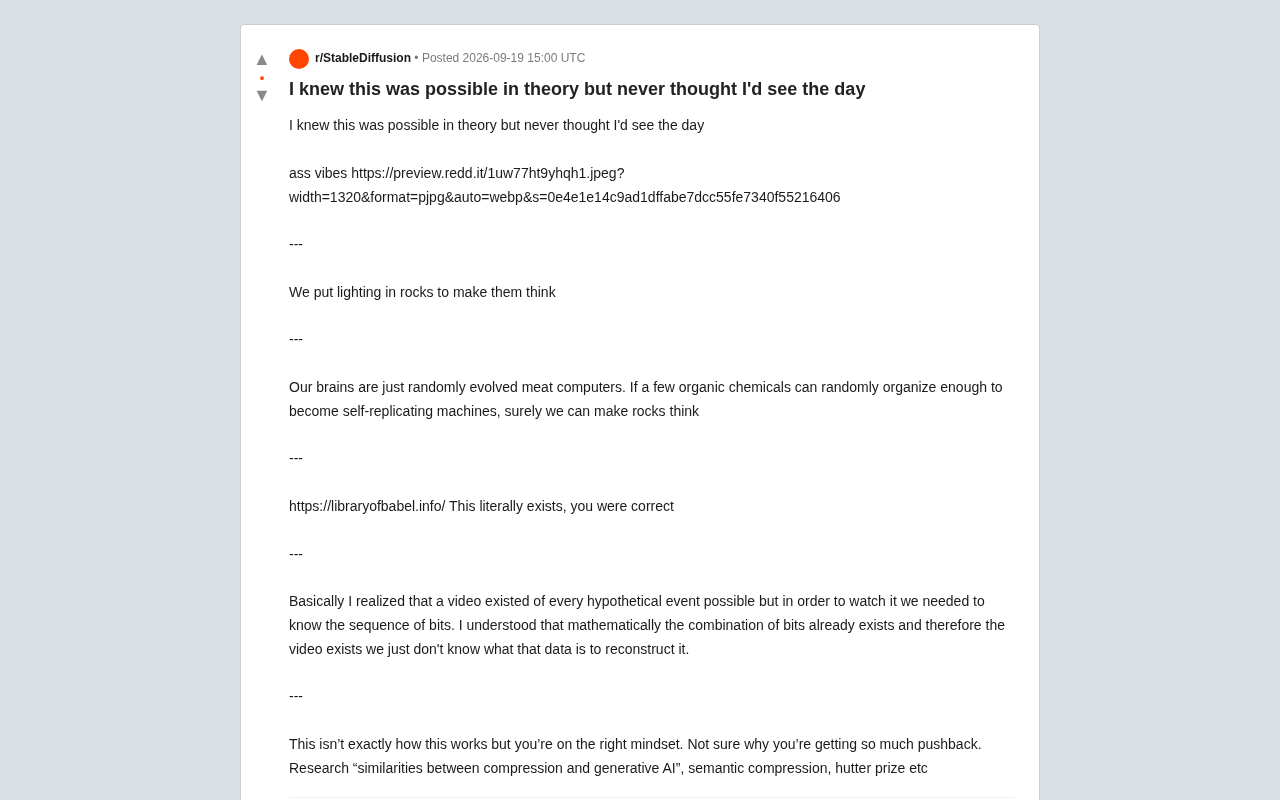
Making Rocks Think: A Philosophical Exploration of Generative AI and Information Compression
From a viral Reddit post to deep AI theory: why compression equals understanding, the Library of Babel thought experiment, semantic compression, and the Hutter Prize.
Irregular Warns: Four AI Lab Security Breaches Traced to the Same Root Cause
Irregular reveals four AI lab security breaches share a single root cause, exposing systemic risks from technology stack homogeneity across the AI industry.