Why Did example.com Get a Redesign? An Official IANA Email Reveals the Story

IANA redesigned example.com as routine maintenance and proactively emailed users, sparking discussion about public infrastructure stability.
example.com is a reserved domain maintained by IANA under RFC 2606 and RFC 6761, dedicated to documentation, teaching, and testing — a quietly relied-upon public resource in internet infrastructure. After its page content recently changed, IANA promptly sent an official email explaining it as routine maintenance and modernization. Though minor, the event drew attention on Hacker News and highlighted an important engineering principle: countless documents, tutorials, and automated scripts have implicit dependencies on example.com's specific implementation, meaning any change can cause unexpected breakage. IANA's transparent communication reflects responsible stewardship of public internet resources and reminds developers to avoid over-assuming stability in infrastructure details.
The example.com Redesign Caught the Tech Community's Attention
example.com is one of the most unique domains on the internet. Maintained by IANA (Internet Assigned Numbers Authority), it is reserved exclusively for documentation, testing, and educational purposes. Anyone can reference it in code, tutorials, or technical documentation without worrying about infringing on a real website's rights. Because of this, what appears to be an unremarkable domain is actually a widely relied-upon public resource within internet infrastructure.
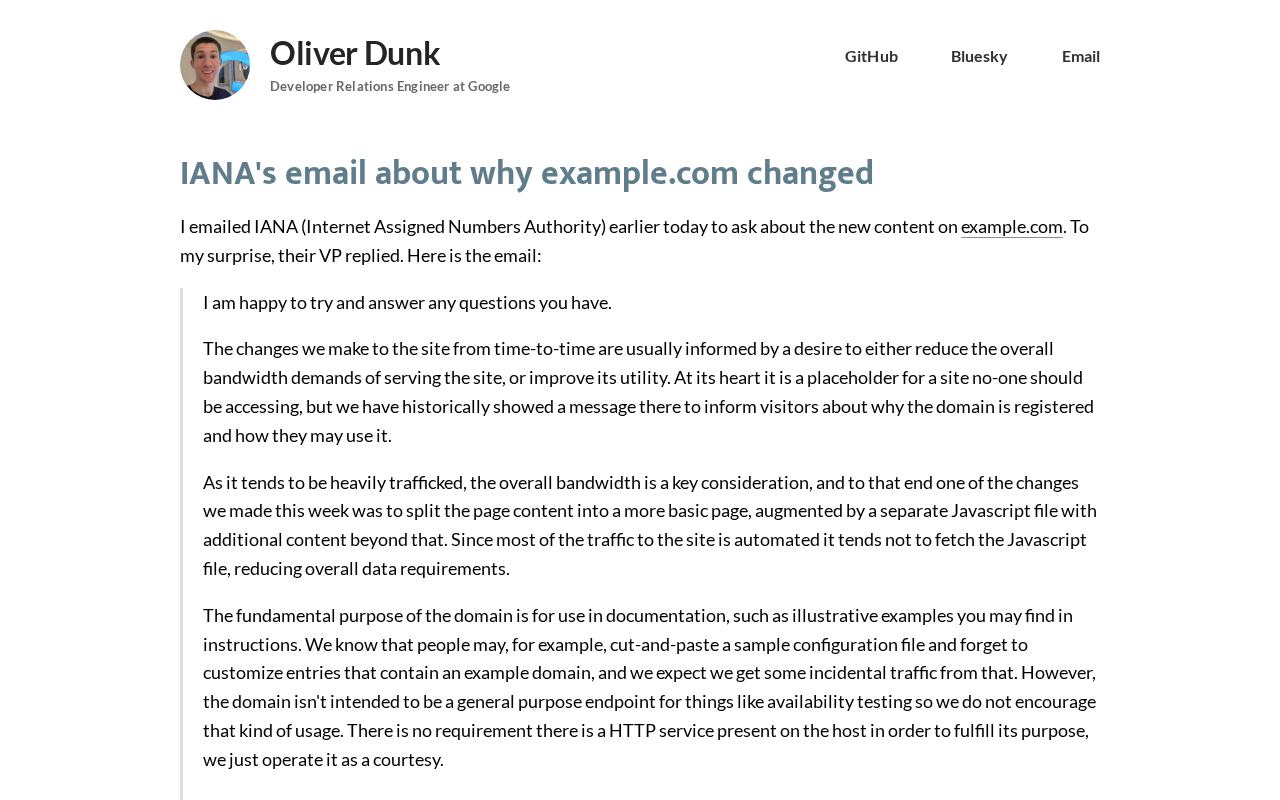
Recently, users in the technical community noticed that the content on example.com had changed, and someone shared an official IANA explanatory email about the matter on Hacker News. While the discussion wasn't a massive explosion of activity (28 upvotes, 2 comments), the topic sparked the curiosity of many developers and network professionals — why would a reference domain considered "eternally unchanged" ever be modified?
The Special Status of example.com
To understand the significance of this redesign, it helps to know the background of example.com. Per RFC 2606 and RFC 6761, example.com, example.net, example.org, and the .example top-level domain are all reserved for documentation and example use, and will never be assigned to any real commercial or personal purpose.
This means that whether you're writing API documentation, drafting an RFC, or creating a beginner's tutorial, developers can safely use these domains as placeholders. Their existence eliminates the awkward — and legally risky — situation of casually writing a domain name that happens to point to a real website. As the administrator of these reserved domains, IANA bears the responsibility of maintaining their stability.
RFC 2606 was published in 1999 by the IETF, originally reserving example.com, example.net, example.org, and top-level domains like .example, .test, and .localhost. RFC 6761, published in 2013, further expanded and formalized the handling rules for "special-use domain names," explicitly requiring DNS resolvers, registrars, and applications to adopt specific default behaviors for these domains. Together, the two RFCs form the legal and technical foundation for example domains. It's worth noting that IANA actually hosts a web service at example.com, making it accessible in a browser and returning an informational page rather than simply being a "nonexistent" domain — a design choice specifically intended to give beginners a real but safe target to practice HTTP requests against.
What the IANA Email Revealed About the Redesign
According to the IANA official email shared by the community, the changes to example.com were part of routine maintenance and modernization. Although the purpose of a reserved domain is fixed, the webpage that hosts it still requires ongoing technical upkeep over time — such as updating page structure, adjusting explanatory text, or adapting to backend service changes.
For users who rely on this domain for automated testing or screenshot examples, any change to page content can have unexpected consequences. This is precisely why IANA chose to proactively send an explanatory email rather than making silent changes — transparent communication is an essential part of maintaining trust in public infrastructure.
Why This Small Event Deserves Attention
On the surface, a page redesign for an example domain might seem trivial. But it reflects a core principle in internet infrastructure operations: stability and predictability. Countless documents, tutorials, and automated scripts quietly depend on the existence and behavior of example.com, and any change must be handled carefully and communicated promptly.
The maintenance of this kind of "invisible infrastructure" often goes unnoticed by the general public, yet it is the cornerstone of the smooth functioning of the entire internet ecosystem. IANA's proactive explanation of the redesign is a demonstration of that responsibility. For developers, it's also a reminder: even the most "taken-for-granted" resources should not be over-relied upon for their specific implementation details.
The concept of "invisible infrastructure" is widely discussed in software engineering. Many automated test suites make real HTTP requests to example.com to verify that their network stack, DNS resolution, or TLS handshake is functioning correctly. Some instructional screenshots, API documentation, and even compliance examples directly embed specific HTML structures from that page. Once a page's fields or layout change, scripts relying on CSS selectors or regex matching may fail silently. This "over-reliance on implementation details" is a classic anti-pattern in distributed systems and public API design, described precisely by Hyrum's Law: with a sufficient number of users of an interface, all observable behaviors of that system — whether intended or not — will be depended upon by someone. The example.com redesign is a real-world case of this law playing out at the infrastructure level.
Summary
The example.com redesign was a routine maintenance update, but IANA's willingness to publicly explain it reflects a responsible attitude toward public internet resources. For technical professionals, this is both an interesting piece of internet trivia and a practical lesson about infrastructure dependencies and stability.
Note: Due to limited source material, this article is primarily based on the publicly available technical background of
example.comand community discussion. For specific details of the IANA email, please refer to the official original communication.
Related articles

Amphibious Transforming Drone: Beyond 100x Power Savings, What Are the Real Needs?
Is the amphibious transforming drone just a gimmick? Starting from the 100x power difference of the M4 Morphobot, explore real application scenarios and thesis topic ideas, analyzing boundary conditions where pure drones and pure ground robots both fail.

Warhound Raises $200 Million: Genetically Engineered "War Dogs" Paired with Anduril Gear
Warhound raises $200M, backed by Ben Lamm and Palmer Luckey, to genetically engineer dogs for military and law enforcement use and equip them with Anduril gear. This article analyzes its technology direction, funding logic, and ethical controversy.

Claude API Comes to Google Cloud: IAM Integration and SDK Access Guide
Anthropic hosts the full Claude API on Google Cloud with IAM-controlled permissions and unified billing. This guide covers the Vertex AI and Anthropic-hosted entry points, IAM role configuration, and SDK access.