Why Did Ollama Rise So Fast? Decoding the Success of a Local LLM Tool

Decoding how Ollama rose to become the default tool for running LLMs locally.
Ollama grew from a niche open-source project into developers' default choice for local LLMs. This article breaks down the logic behind its rise across three dimensions—an out-of-the-box experience, leveraging llama.cpp, and the dual dividend of timing and ecosystem—and what it teaches AI tool developers.
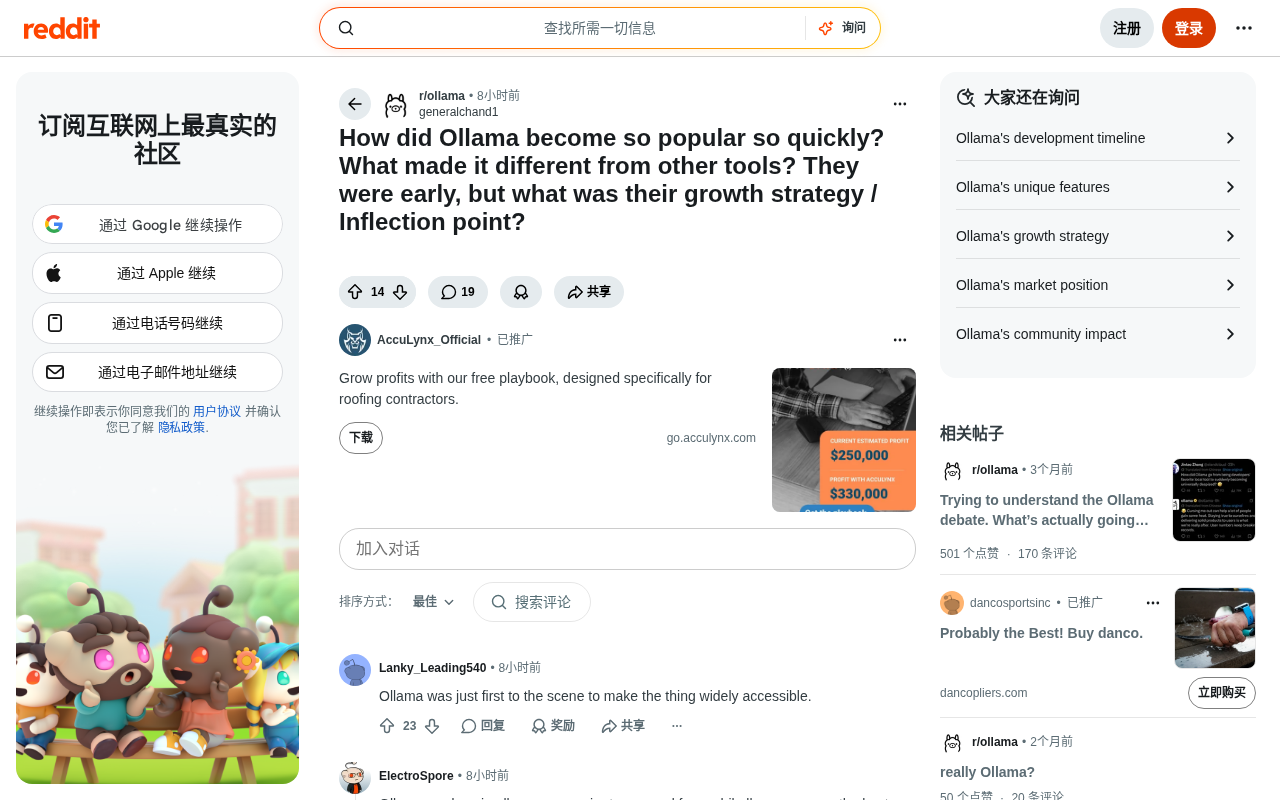
In the ecosystem of tools for running large language models (LLMs) locally, Ollama has undoubtedly been one of the most eye-catching dark horses of the past two years. It has rapidly grown from a niche open-source project into the default choice for the developer community. A recent discussion in the Reddit community attempts to answer a key question: Why has Ollama become so popular in such a short time? And where exactly does it differ from other tools?
Drawing on perspectives from that community discussion, this article breaks down the core logic behind Ollama's success across three dimensions: product design, technical strategy, and ecosystem building.
An Ultimate Out-of-the-Box Experience
Ollama's most central differentiating advantage—one that nearly every participant in the discussion points to—is its extremely low barrier to entry.
Before Ollama came along, running an open-source model locally often meant a series of tedious operations: configuring a Python environment, handling CUDA dependencies, manually downloading weight files, debugging quantization formats, and writing inference scripts. For anyone who wasn't a professional machine learning engineer, the environment setup alone was enough to deter most people.
Ollama compressed all of this into a single command:
ollama run llama3
Type this command, and the tool automatically downloads the model, loads the weights, and starts an interactive conversation. This "as simple as installing an app" experience directly mirrors Docker's design philosophy. Docker was incubated internally at dotCloud and open-sourced by Solomon Hykes in 2013; it achieves process isolation through the Linux kernel's namespace and cgroups mechanisms, packaging an application's runtime environment into portable image layers. Its core innovation lies in encapsulating an application and all its dependencies into a standardized, distributable unit, completely solving the long-standing "it works on my machine" problem that plagued developers. What Ollama borrows is not just command semantics (ollama pull, ollama list closely align with Docker's image management), but more importantly the core design philosophy of "encapsulating complex dependencies into a single distributable unit, so that distribution, version management, and execution are fully standardized"—letting the large number of engineers already familiar with container tools get started with almost zero learning cost.
At the engineering level, Ollama chose Go as its primary development language, a decision that itself reflects careful thought. Go was officially released by Google in 2009, and its design philosophy naturally fits the needs of system-level tool development. Go's static compilation allows Ollama to be packaged as a single executable binary with no runtime dependencies, greatly simplifying distribution and installation across macOS, Linux, and Windows. It's worth noting that Go's goroutine concurrency model deserves equal credit—each API request can be handled in an independent goroutine, and a goroutine's memory overhead is only about 2KB (far below the several MB of stack space required by an operating system thread), enabling Ollama to concurrently handle inference requests from multiple local clients at minimal overhead. At the GPU acceleration level, Ollama uses a unified abstraction layer to simultaneously manage three completely different GPU compute stacks—NVIDIA CUDA, AMD ROCm, and Apple Metal (the GPU compute framework for M-series chips)—so users automatically get hardware acceleration without manually configuring drivers. This is precisely the consistent experience that many competitors struggle to deliver across platforms.
Understanding Ollama's rise also requires an important hardware backdrop: around 2020, consumer-grade hardware capabilities took a historic leap. NVIDIA's 3090/4090 series graphics cards pushed the consumer GPU VRAM ceiling to 24GB, while Apple's M1 chip, launched in 2020, popularized 16GB and even 32GB of memory as the mainstream configuration thanks to its Unified Memory Architecture (in which the CPU and GPU share a single high-bandwidth memory pool). The significance of this architecture goes far beyond the numbers: the M3 Max chip offers unified memory bandwidth of up to 400GB/s, and CPU and GPU cores can directly access the same memory pool at the same speed, completely eliminating the data-copy bottleneck of the traditional PCIe bus (about 64GB/s). A Mac Studio equipped with 96GB of unified memory can theoretically run a 70B-parameter Q4-quantized model smoothly, making macOS the most local-LLM-friendly consumer platform—and the fundamental reason Ollama's penetration among Mac users is particularly striking. This means running a 7B-parameter 4-bit quantized model (requiring about 4GB of memory) is no longer a real obstacle for mainstream developer laptops. It is precisely this historic window of "hardware that's just barely good enough" that expanded Ollama's potential user base from the theoretical "engineers with professional workstations" to tens of millions of ordinary developers.
This design captured a long-underestimated market need: a large number of developers want to experiment with local LLMs, but don't want to become deep learning experts. Ollama filled exactly that gap.
Standing on the Shoulders of llama.cpp
Another key point repeatedly raised in the community discussion is that Ollama did not build its inference engine from scratch, but cleverly wrapped llama.cpp, the underlying high-performance inference framework.
llama.cpp was released in March 2023 by Bulgarian programmer Georgi Gerganov, whose original motivation was simply to run the LLaMA model on a MacBook. Its core advantage comes from its self-developed GGUF (GPT-Generated Unified Format) quantized storage format.
GGUF itself went through an important technical evolution: it is the second-generation storage format that llama.cpp introduced in August 2023, replacing the earlier GGML format. GGUF adopts a key-value metadata header design, supports forward compatibility, and has all the model metadata needed for execution—such as the tokenizer vocabulary—built in, so that a single file can fully describe a runnable model. This design greatly simplifies the model distribution process and laid the foundation for Ollama's model repository system.
The deeper mechanics of quantization are worth explaining in detail here: quantization is essentially a model compression technique that reduces memory footprint and computational load by lowering the numerical precision of weight parameters. Modern large language models typically store weights as 32-bit (FP32) or 16-bit (FP16/BF16) floating-point numbers, whereas the GGUF format supports compressing them down to 2-bit through 8-bit integers. Taking a 7-billion-parameter model as an example, FP16 format requires about 14GB of VRAM, while after 4-bit quantization it needs only about 4GB, allowing it to run on consumer-grade GPUs or even pure CPUs.
The core challenge of quantization lies in controlling precision loss. llama.cpp's "K-quants" series (Q4_K, Q5_K, etc.) adopts a super-block grouped quantization strategy, applying differentiated quantization precision to weight matrix layers of different importance. Compared to earlier uniform quantization schemes, it can reduce perplexity loss by about 20–30% at the same compression ratio. Taking Llama 3 8B as an example, the Q4_K_M quantized version is about 4.7GB and can reach around 10–15 tokens per second in CPU inference, while the Q8_0 version is about 8.5GB, with precision closer to the original FP16 but double the memory requirement. This ability to finely tune between size and quality is precisely the core technical reason llama.cpp has long maintained its reputation for inference quality. Backed by this technology as well as efficient hybrid CPU/GPU inference, llama.cpp quickly became the technical cornerstone of running models locally.
But llama.cpp itself is not friendly to ordinary users—it requires manual compilation, has complex command-line arguments, and leaves all model management to the user.
Ollama's cleverness lies in this: it didn't reinvent the wheel, but built an elegant layer of user experience and engineering encapsulation on top of mature underlying technology. It handles the "dirty, grunt work" of model distribution, version management, API services, and cross-platform packaging, wrapping the powerful capabilities of llama.cpp into a product that ordinary people can use directly.
Ollama also introduced a feature that's easy to overlook but strategically valuable—the Modelfile. Analogous to Docker's Dockerfile, a Modelfile is a declarative configuration file that lets users customize the system prompt on top of a base model, adjust inference parameters (such as temperature and context length), and even merge LoRA adapter weights, thereby creating and distributing personalized "custom models." This mechanism turns Ollama's model repository (ollama.com/library) into not just a model download hub, but a community-built platform for distributing model configurations. LoRA (Low-Rank Adaptation) is a parameter-efficient fine-tuning method proposed by Microsoft Research in 2021, which achieves domain customization by injecting low-rank decomposition matrices alongside the original weight matrices. Its adapter files are usually only tens of MB, making them ideal for community distribution—and the Modelfile's native support for them further deepens Ollama's ecosystem lock-in effect.
This strategy of "leveraging the lower layers, innovating at the upper layers" allowed Ollama to focus its energy on the aspects that create the most value, which also explains why it was able to rapidly iterate and mature in such a short time.
The Dual Dividend of Timing and Ecosystem
Hitting the Window of the Open-Source LLM Explosion
Ollama's rise is inseparable from the open-sourcing of Meta's Llama model series. Meta released LLaMA 1 in February 2023, released the commercially usable LLaMA 2 in July of the same year, and in April 2024 launched LLaMA 3 with a substantial leap in performance. At the same time, organizations such as Mistral AI, Alibaba (Qwen), and Google (Gemma) successively open-sourced high-quality models, forming an open-source wave that swept across the entire AI community. The deeper driving force behind this wave is: privacy concerns over closed-source model APIs, non-negligible usage costs, and heavy dependence on network connectivity, all of which pushed a large number of enterprises and individual developers to seek local deployment options. When high-quality open-source models like Llama 2, Llama 3, and Mistral were released one after another, the market developed enormous demand for "how to conveniently run these models locally," and Ollama happened to provide the smoothest answer during this window, becoming the best vehicle to absorb this wave of demand.
Entering early combined with the right timing is an important external reason for the steepness of Ollama's growth curve.
Providing a Standardized Local API
Ollama is not just a chat tool; it also provides a local REST API service that is partially compatible with OpenAI's interface format.
The strategic significance of OpenAI API compatibility goes far beyond what it appears on the surface: the OpenAI Chat Completions API was officially released in March 2023 alongside GPT-3.5-turbo. Its way of representing conversations—a messages array plus role annotations (the role field distinguishing system/user/assistant)—along with its streaming output mechanism based on Server-Sent Events (the stream parameter), quickly became the industry de facto standard for AI inference interfaces. Notably, the influence of this standard has already extended far beyond OpenAI itself: mainstream inference services such as Anthropic Claude, Mistral, Together AI, and Groq all provide interfaces compatible with this format, forming a universal protocol layer for the AI inference tier.
This standardization produced a deep architectural effect: mainstream AI development frameworks such as LangChain, LlamaIndex, and Semantic Kernel hard-code support for this format at the bottom of their LLM abstraction layers, meaning any backend compatible with this interface can be swapped in directly. By choosing to be compatible with this standard, Ollama effectively plugged into a standard socket that already had thousands of downstream consumers, rather than redefining the interface specification—a pragmatic strategy that sacrifices interface dominance in exchange for rapid ecosystem adoption. Because of this compatibility design, enterprises can migrate inference from the cloud to local with just a single configuration change, without modifying their core business code, greatly lowering the barriers and costs of adoption and migration.
This design quickly made Ollama the "infrastructure" of the entire local AI application ecosystem. More and more third-party projects—from Open WebUI and Continue to Dify—support Ollama as a backend by default, forming a powerful network effect: the more people use it, the more tools integrate it; the more tools integrate it, the more users it attracts.
The Growth Flywheel: A Positive Loop of Community and Integration
From the perspective of growth strategy, Ollama's success can be summarized as a self-reinforcing flywheel:
- A low-barrier experience brings in a large number of first-time users;
- Users' positive word of mouth spreads rapidly across communities like Reddit, Hacker News, and YouTube;
- The developer ecosystem begins integrating Ollama as the default local backend;
- Widespread integration in turn boosts Ollama's practical value, further expanding the user base.
This growth model is nothing new in the developer tools space. Homebrew's success likewise stemmed from an extremely low installation barrier and a community-contributed package ecosystem, rather than the originality of its underlying package management technology—what truly determines a tool's adoption is who can turn complex technology into a daily necessity that developers are willing to proactively recommend to their colleagues. Ollama is walking the same path.
Network effects and ecosystem lock-in are worth understanding in depth here: network effects in the developer tools space differ from those of consumer products, with the core driving force being ecosystem interoperability rather than direct interaction between users. This effect is often realized through a "centralized integration hub"—when a tool becomes the default dependency of enough projects, a new entrant faces not just technical challenges, but the enormous coordination cost of simultaneously persuading every project in the entire ecosystem chain to migrate in sync.
Notably, the network effect of developer tools also has a unique propagation mechanism: code examples in technical blogs, tutorial videos, and Stack Overflow answers create a "search engine SEO sediment" that lasts for years. When a tool becomes the default choice in enough tutorials, newly onboarding developers who search for solutions repeatedly encounter example code based on that tool, forming a self-reinforcing feedback loop that strengthens its position—this is highly similar to how npm became entrenched in the Node.js ecosystem: even though alternative runtimes like Deno are more modern at the technical level, npm's massive package registry and ubiquitous tutorial references still constitute a substantial migration barrier. Ollama has already been listed as the preferred backend by dozens of active projects, including Open WebUI (over 40,000 GitHub stars), Continue (a VS Code AI coding plugin), and Dify. The ecosystem lock-in effect is taking shape, sharing the same underlying logic behind npm's strategic position in the JavaScript ecosystem.
Interestingly, Ollama has always remained open-source and free, with cross-platform support for macOS, Linux, and Windows, removing every barrier to users trying it out. Its open-source nature also makes the community willing to contribute documentation, tutorials, and integration solutions, further accelerating its spread.
Controversies and Reflections
Dissenting voices also exist in the community discussion. Some argue that Ollama's success is largely "llama.cpp's achievement," and that Ollama is more of a "wrapper layer" whose technical moat isn't very deep. Others worry that as llama.cpp itself, as well as competitors like LM Studio and GPT4All, continue to improve their experiences, it remains uncertain whether Ollama's first-mover advantage can be sustained over the long term.
These doubts are not without merit. But from the perspective of product evolution, excellent encapsulation and user experience are themselves a form of core competitiveness. Just as Docker is to container technology and Homebrew is to package management, what truly determines a tool's degree of adoption is often not the underlying technology itself, but who can make complex technology usable by everyone. The reality that dozens of active open-source projects already list Ollama as their preferred backend also indicates that the ecosystem lock-in effect is beginning to form, and that the first-mover advantage is not without barriers.
Conclusion
Ollama's rapid rise is essentially a classic product story about "lowering barriers": at the right time, standing on top of mature underlying technology, it used an extremely simple experience to capture the demand dividend brought by the explosion of open-source large models, and through an open API and an active community, it built a self-reinforcing ecosystem flywheel.
For any developer looking for opportunities in the AI tools space, Ollama's path offers a valuable lesson: the cutting edge of technology is certainly important, but turning cutting-edge technology into a product that ordinary people can use can create just as much value.
Key Takeaways
Related articles

Felix Rieseberg Personal Homepage
Felix Rieseberg's personal homepage sparks attention on Hacker News. This article covers the Slack engineer's technical background, the rise and fall of nativefier, and the value of a developer homepage as a tech calling card.

@ai-sdk/vue 3.0.306 Patch Release Syncs with [email protected] Update
@ai-sdk/vue 3.0.306 released, synced with [email protected]. A routine patch release for the Vercel AI SDK ecosystem with no public API changes; the Vue adapter layer stays version-aligned with the core package.

Gemini 4 Argon API Launches: The Era of Million-Token Output Begins
Google launches Gemini 4 Argon with sparse MoE architecture, up to 1M output tokens, and a 68.90% Vals Index score, available across API, AI Studio, and the Gemini app.