Why Did Sam Altman's RAM Comments Ignite the Internet?

Altman calls idle personal memory wasteful; netizens meme it, exposing the AI compute allocation debate.
The article traces the RAM meme wave on Reddit. Sam Altman argued on a podcast that idle personal computer memory is wasteful and maximizing cloud utilization is better. The soundbite sparked "stealing memory" jokes but quickly turned to serious debate: efficiency vs. personal computing freedom, tech giants squeezing the consumer market, and local vs. cloud inference trade-offs. Technically, memory-GPU integration makes remote sharing infeasible; memes became a filter for public anxiety over AI infrastructure and platform power.
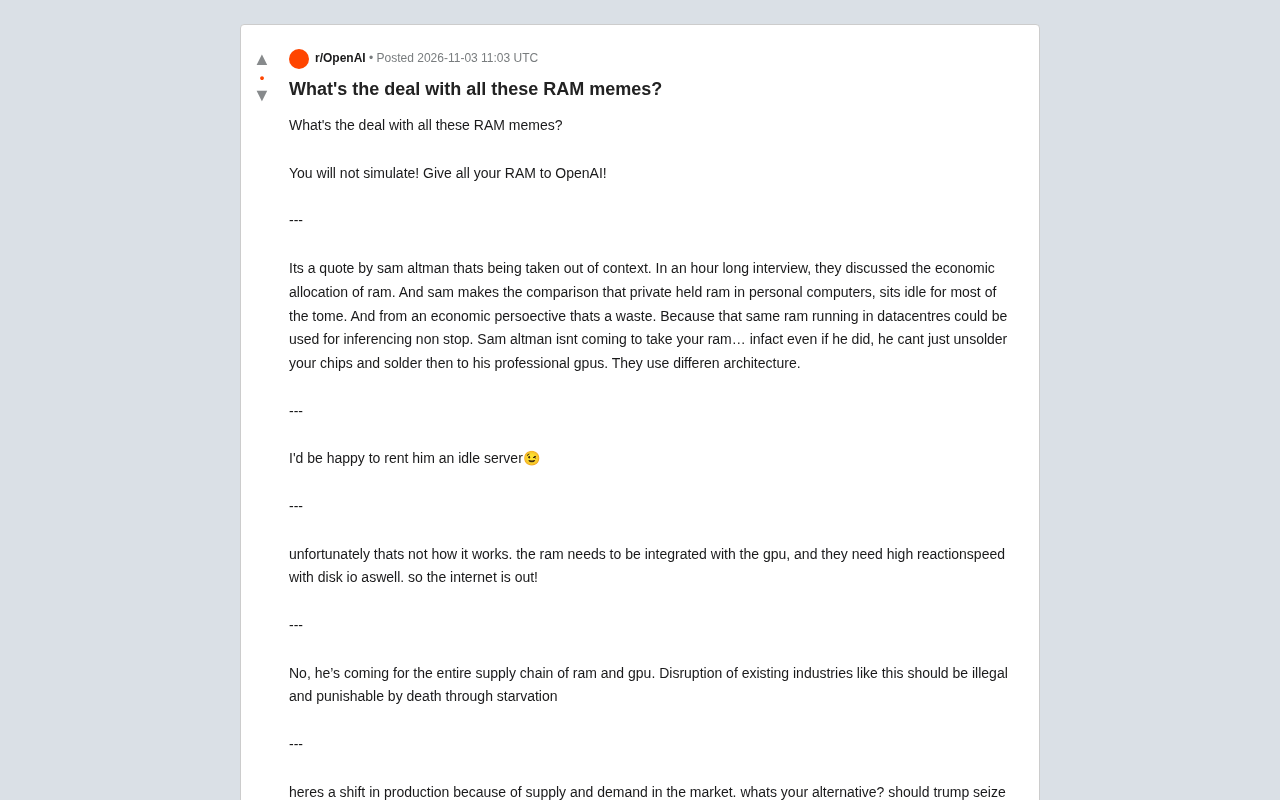
Recently, a wave of RAM memes swept across Reddit, sparked by a comment from OpenAI CEO Sam Altman on a podcast. Many netizens interpreted it as "Altman wants to take away the memory in your computer," which spawned a flood of satirical memes. But is that really what happened? The discussion actually touches on a deeper conflict: how compute resources should be allocated in the AI era.
The Origin: A Soundbite Taken Out of Context
In a hour-long interview, Altman and host John Collison discussed the global DRAM supply crunch. Altman noted that many people want to run open-source models locally, but from a global resource allocation perspective, having everyone hoard a pile of DRAM in their computers that sits idle 95% of the time is "pretty bad." He argued that in a supply-constrained environment, maximizing utilization in the cloud is the better solution.
The clip quickly went viral on social media. One netizen joked: "You can't simulate! Hand all the RAM to OpenAI!" But in reality, Altman never said he would confiscate personal computers' memory. As one Reddit user pointed out, even if he wanted to, he couldn't just solder your memory chips onto his professional GPUs, because the architectures are completely different.
DRAM (Dynamic Random Access Memory) is the most common type of main memory in personal computers and servers, responsible for temporarily storing data and instructions that the CPU is processing. In recent years, global DRAM supply has remained tight, mainly due to large-scale expansion of AI data centers, recovering demand for consumer electronics, and lagging capacity adjustments by major manufacturers. The DRAM market is highly concentrated, with Samsung, SK Hynix, and Micron holding the vast majority of share, so any fluctuation in production capacity quickly translates into price changes. Altman's reference to "global resource allocation" is based on this backdrop: when supply is constrained, allocating limited DRAM capacity to cloud data centers could theoretically serve more users, while memory in personal computers sits idle most of the time. However, this macro-efficiency perspective inherently conflicts with individual users' intuitive sense of hardware ownership, which is the deeper reason the soundbite ignited public debate so quickly.
The Controversy: Efficiency vs. Personal Computing
Although the "stealing memory" claim is exaggerated, many netizens believe Altman's remarks weren't entirely taken out of context. One user commented: "He'd probably love to tighten consumer RAM supply and shift more capacity to data centers because it's 'more efficient.'" This reflects concerns about tech giants monopolizing hardware resources.
Another user offered an economic critique: "Utilization rate is not the only factor determining consumer utility." Even if a personal computer's RAM sits idle most of the time, it still provides users with convenience and control available at any moment. Altman's position is seen as having a vested interest—if users can't run models locally, they'll have to buy his inference API services.
Technical Reality: The Trade-off Between Local and Cloud Inference
From a technical standpoint, Altman's argument has merit. Data center memory and GPUs can run 24/7 to support large-scale inference tasks, while personal computer memory indeed sits idle most of the time. But the issue is that local inference has advantages the cloud cannot replace: privacy, low latency, offline availability, and complete user control over the model.
One netizen proposed a compromise: "I'd be happy to rent him an idle server." But someone immediately pointed out this isn't feasible, because RAM needs to be tightly integrated with GPUs and requires extremely high responsiveness to disk I/O, which remote access over the internet cannot satisfy.
Local inference refers to running AI models on a user's own computer or server, while cloud inference sends requests to remote data centers for processing. The hardware requirements differ significantly: large language model inference requires substantial VRAM to hold model weights and KV cache, and consumer GPUs typically have far less VRAM than data center GPUs, so locally users can often only run smaller or quantized models. The advantage of cloud inference lies in scale—data centers can batch schedule requests, improve GPU utilization, and enable multi-GPU collaboration through specialized interconnects (like NVLink). But local inference is irreplaceable in privacy-sensitive scenarios, offline environments, and low-latency interactions. Notably, ordinary DRAM and GPU memory (such as GDDR6, HBM) differ completely in architecture and bandwidth, and personal computer memory sticks cannot be directly used in data center GPUs—this is the fundamental reason why "remote shared memory" is physically infeasible.
Community Reaction: From Jokes to Serious Debate
The discussion initially spread as memes but quickly evolved into a serious debate about AI infrastructure allocation, the boundaries of tech giant power, and the future of personal computing. One user even jokingly said: "He's destroying existing industries; he should be starved to death as punishment." Behind such exaggerated expression lies anxiety about unfair resource allocation.
Others held different views: "This is capacity shifting driven by market supply and demand. What's your alternative? Have the government confiscate all RAM and ration it?" This camp believes that resource reallocation under market mechanisms is normal, and the key is how to balance efficiency and fairness.
Reddit's meme culture excels at compressing complex issues into exaggerated symbols, lowering the barrier to discussion and attracting broad participation. The spread of these RAM memes typically exemplifies this mechanism: first amplifying the absurdity of "Altman wants to steal your memory" in a joking manner, then gradually shifting in the comments toward rational analysis of compute monopoly, hardware capacity allocation, and platform power boundaries. This "joking start, serious finish" discussion pattern is not uncommon in tech communities; it provides an outlet for emotional release while also acting as a filter for public issues—only topics that truly touch on collective anxiety can evolve from memes into days-long serious debate. For highly specialized topics like AI infrastructure, memes actually play an agenda-setting role, bringing resource allocation issues previously confined to the industry into the public eye.
Conclusion: A Conversation About the Future
The reason Altman's remarks generated such a strong response is that they touch on a sensitive topic: in an era of explosive growth in AI compute demand, how should limited hardware resources be allocated? Should priority go to cloud-scale efficiency or to individual computing freedom? This discussion has no simple answer, but at least it has got more people thinking about the resource game behind technological development.
As one netizen put it: "People joke, but no one really believes he'll come take our RAM. What everyone is really worried about is that in the name of 'efficiency,' he'll further squeeze the consumer market, leaving us no choice but to depend on his services." That may be the most thought-provoking part behind this RAM meme frenzy.
One-line Summary
Altman said idle personal memory is wasteful, netizens turned it into memes—behind it lies the battle over AI compute resource allocation.
Paragraph Summary
The article traces the origins of the RAM meme wave on Reddit. It began with Sam Altman discussing the global DRAM supply crunch on a podcast, arguing that personal computer memory sitting idle most of the time is wasteful and that maximizing cloud utilization is the better solution. After the soundbite spread, jokes about "stealing memory" emerged, but the discussion quickly turned to serious issues: the conflict between efficiency and personal computing freedom, whether tech giants are squeezing the consumer market in the name of efficiency, and the trade-offs between local and cloud inference. Technically, the tight integration of memory and GPUs makes remote sharing infeasible; at the community level, memes act as a filter for public issues, reflecting deep anxiety about AI infrastructure allocation and platform power.
Related articles

Running a Local LLM on a Laptop CPU: Ollama + Qwen3 Gives a Desktop Pet a Brain
An ordinary laptop without a GPU can run a local LLM: a Bilibili creator uses Ollama plus open-source Qwen3 8B on pure CPU to give an original desktop pet a local brain, with DeepSeekHarness handling plugin development and three rounds of debugging — 0 yuan, works offline, privacy stays on-device.

AgentScope 2.0 in Practice: A Guide to Enterprise-Level AI Agent Development in Java
AgentScope 2.0 is Alibaba's Java enterprise-grade distributed agent framework. This article explains why it suits server-side AI applications, contrasts client-side AI apps in permissions, state management, and concurrency, and outlines a practical learning path from environment setup to project integration.

GPT-6 Astra Directly Edits Weights to Fix Models? Full Analysis of the MIT Paper and Leaks
MIT paper shows GPT-6 Astra repairs small models by directly editing weights, raising math scores from 7.9% to 48.1%; OpenAI internal charts hint an unreleased model leads on BenchCAD 2.0; Fable 5.5 pure-code movies and the Claude WiFi radar incident analyzed.