Why Does Gemini Keep Throwing Errors? Root Cause Analysis and Solutions

An analysis of why Google Gemini keeps throwing errors and practical ways to deal with it.
Recent Reddit complaints reveal widespread Gemini errors. This article identifies three root causes: overwhelming inference demand as Gemini is embedded across Google products, instability from frequent canary model releases, and safety filter false positives. It offers practical fixes — retrying, rephrasing prompts, splitting complex requests, and keeping backup AI tools — while arguing that service reliability is becoming the key battleground in the AI industry.
User Complaints: What's Going On with Gemini Lately?
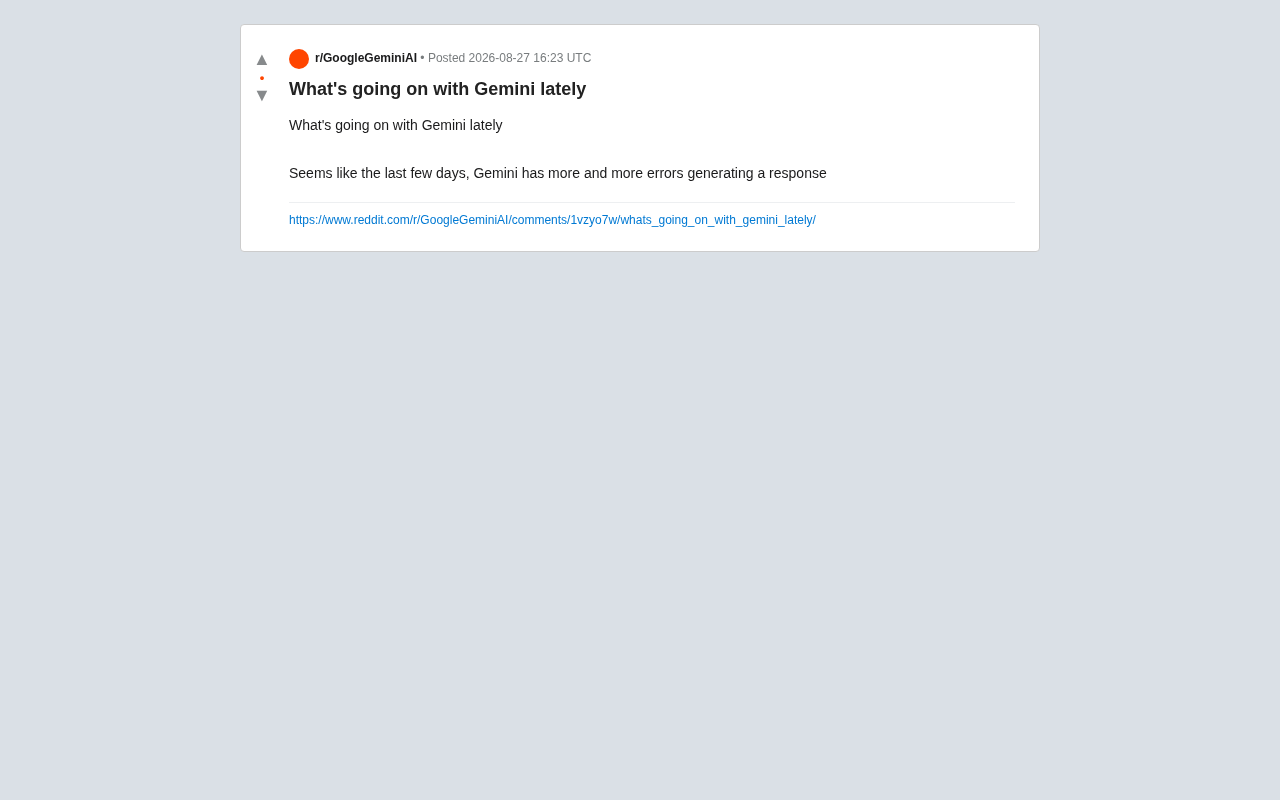
Recently, a wave of complaint posts about Google Gemini has flooded the Reddit community. One user put it bluntly: "Seems like the last few days, Gemini has more and more errors generating a response." What appeared to be a simple gripe sparked massive agreement in the comments, indicating this isn't an isolated incident but rather a widespread decline in user experience over a period of time.
For users who rely on AI tools for their daily work, a model's ability to produce stable output is often more important than how high its ceiling is. When a product frequently throws "error generating response" messages at critical moments, user trust erodes rapidly — no matter how powerful the underlying capabilities may be.
Three Major Reasons Behind Gemini's Frequent Errors
To understand Gemini's recent instability, you first need to appreciate the complexity that large language model services face in production environments. Running LLMs in production is far more complex than users might imagine — behind every streamed text output a user sees after entering a prompt lies a neural network with billions of parameters performing forward inference on GPU clusters. For a model at Gemini's scale, a single inference pass may require multiple high-end GPUs (such as NVIDIA H100s or Google's proprietary TPU v5p) for seconds or even tens of seconds of compute time. When millions of users send requests simultaneously, efficiently scheduling work across limited hardware resources becomes an extremely complex distributed systems engineering problem. These "error generating response" issues typically aren't a degradation of the model's capabilities themselves, but rather multi-layered engineering and operational challenges.
Service Load and Capacity Pressure
As Gemini has been integrated into Google Search, Workspace, Android, and a range of other products, backend inference request volumes have grown explosively. The compute bottleneck for AI inference is a systemic challenge facing the entire industry. According to industry estimates, while the cost of a single inference pass for a hundred-billion-parameter model has dropped significantly, multiplied by hundreds of millions of daily requests, the total cost remains staggering. Although Google has a cost advantage with its custom TPU chips, after Gemini was embedded into high-frequency products like Search, Gmail, and Docs, the growth in inference demand may have outpaced infrastructure scaling. This supply-demand imbalance is known in the industry as the "Inference Wall" and is one of the key bottlenecks constraining AI service quality.
When concurrent requests exceed a cluster's capacity, the system typically protects overall service health through rate limiting, queuing, or directly returning errors. The "generation failed" message users see is very likely a degraded response under high backend load.
Frequent Model Iterations and Canary Releases
Google has been rolling out intensive updates to the Gemini series recently, including new model versions and ongoing backend optimizations. It's worth explaining the concept of "canary releases" here: a canary release (also known as a gradual rollout or A/B release) is a common strategy for updating internet services. The core idea is to avoid pushing a new version to all users at once — instead, a small percentage of traffic (say 1%-5% of users) is directed to the new version first. Key metrics (error rates, latency, user feedback) are monitored for normalcy before gradually expanding coverage. This mechanism is well-established in traditional web services, but applying it to large model services introduces additional challenges — different model versions may vary dramatically in output style, capability boundaries, and resource consumption, making user experience fluctuations during canary transitions much more noticeable.
During a canary release, different users may be routed to different model versions or inference services. If a particular version has configuration defects or is incompatible with existing systems, it can cause concentrated errors for a subset of users. This also explains why problems often appear "suddenly in the last few days" and may quietly disappear a few days later.
Safety Filters and Content Policy False Triggers
Another category of issues easily mistaken for "bugs" is the triggering of the model's safety filtering mechanisms. Modern AI products universally deploy multi-layered safety filtering systems, typically including input filters (detecting whether user prompts contain policy-violating content), output filters (detecting whether model-generated content violates policies), and real-time monitoring layers. These filters are themselves machine learning models and are susceptible to misjudgments — so-called "false positives." Google has adopted a relatively conservative safety strategy for Gemini, which sparked widespread controversy in early 2024 over excessive political correctness in image generation. Safety policy threshold settings are a dynamically adjusted process, and each adjustment can affect the pass-through rate of some legitimate requests.
When input or generated content triggers a content safety policy, the system may abort generation and return an error rather than providing a clear explanation. To the user, this is virtually indistinguishable from a genuine technical failure.
This Isn't Gemini's First Stability Issue
You may not have noticed, but stability and consistency issues have accompanied Gemini since its launch. From early image generation controversies to repeated user reports of "wildly fluctuating answer quality" and "the same question getting good and bad answers," Google has been paying an experience cost for its aggressive iteration pace while racing to catch up with competitors.
This phenomenon of "improving capabilities coexisting with declining stability" is not uncommon across the large model industry. Vendors universally face a dilemma: on one hand, they must continuously ship stronger models to remain competitive; on the other, they must ensure the reliability of existing services. When these goals conflict, users often become guinea pigs during version transitions.
From an industry comparison perspective, OpenAI's ChatGPT has also experienced multiple large-scale outage events, and Anthropic's Claude has imposed strict rate limits on free users due to capacity constraints. However, from a user perception standpoint, ChatGPT has significantly improved its service stability after nearly two and a half years of operation, with API uptime typically maintained above 99.5%. By contrast, Gemini, as a latecomer, faces the more daunting challenge of completing the triple jump from "functional" to "good" to "reliably good" in a shorter timeframe.
Practical Solutions for Gemini Errors
Facing Gemini's recent instability, here are several methods to help you cope effectively:
- Retry or rephrase: Most generation errors are temporary. Waiting a moment and retrying, or slightly rephrasing your prompt, will often successfully produce a response. The rationale behind rephrasing is that different wording may bypass the safety filter's false-positive thresholds and may also be routed to a different model instance for processing.
- Break down complex requests: Overly long or complex inputs are more likely to trigger timeouts or errors. This is because longer inputs mean more tokens to process, with inference time and memory usage increasing proportionally, raising the probability of exceeding the resource quota for a single request. Splitting tasks into multiple smaller steps can significantly improve success rates.
- Have alternative AI tools ready: For important tasks, don't pin all your hopes on a single AI tool — ChatGPT, Claude, and others are reliable backup options. In practice, an increasing number of professional users are adopting a "multi-model parallel" strategy, sending the same request to multiple AI services simultaneously and using the best result.
- Check Google's official status page: Google discloses known outages on its service status page (Google Workspace Status Dashboard). When encountering widespread errors, check there first to see if it's an officially acknowledged incident, avoiding wasted troubleshooting on your own configuration.
Stability Is Becoming a Key Competitive Factor for AI Tools
This discussion about Gemini reflects a deeper trend in the AI industry: as the "on-paper capabilities" of various models converge, stability, availability, and consistency are becoming the decisive factors in user retention. This closely mirrors the development trajectory of cloud computing — early users focused on "what cloud can do," while the core competitive advantage in the mature stage shifted to SLA (Service Level Agreement) guarantees, meaning commitments to 99.9% or even 99.99% uptime. AI services are undergoing the same transformation.
For Google, Gemini is backed by an enormous product ecosystem — a massive distribution advantage, but one that also means any backend fluctuation is simultaneously perceived and amplified by countless users. How to maintain service quality while keeping up iteration speed will be a core challenge the Gemini team must solve. This requires more granular traffic isolation at the engineering architecture level — ensuring that experimental updates don't impact the inference service stability of core products.
For the industry as a whole, user expectations for AI tools are shifting from "can it do this" to "can it do this reliably every time." Whoever can first polish large model services into infrastructure as reliable as utilities will be best positioned to win this long game.
Key Takeaways
Related articles

Random Pruning of the DPO Computation Graph: 1.4x Training Speedup and Lower Peak Memory
DPO training too slow and memory-hungry? This paper proposes a random pruning framework for the DPO computation graph, sampling independently across position, sequence, and branch dimensions; branch pruning achieves a 1.426x step-time speedup and cuts training time by about 30%, with in-depth attribution of memory and time gains.

Why Does JEPA Underperform MLM in Longitudinal EHR Representation Learning?
New study compares JEPA and MLM for longitudinal EHR representation learning on MIMIC-IV: three JEPA variants train stably without collapse but underperform MLM; target size, not heterogeneity, drives prediction error.

Transfer Learning + Visible Light Communication: A New Approach to Energy-Efficient Indoor Positioning
A study proposes a transfer learning-based visible light communication indoor positioning method, achieving 47% accuracy improvement on the BOSCH factory dataset, 67.5% model efficiency under high noise, and introducing the ME composite metric for energy-efficient positioning in energy-constrained industrial IoT scenarios.