Why Does v-prediction Fail in Pixel-Space Flow Matching? Patch-wise PCA Reveals the Bandwidth Bottleneck

v-prediction fails in pixel-space Flow Matching due to a bandwidth bottleneck; x-prediction and the RiT architecture address it via a raw-input bypass.
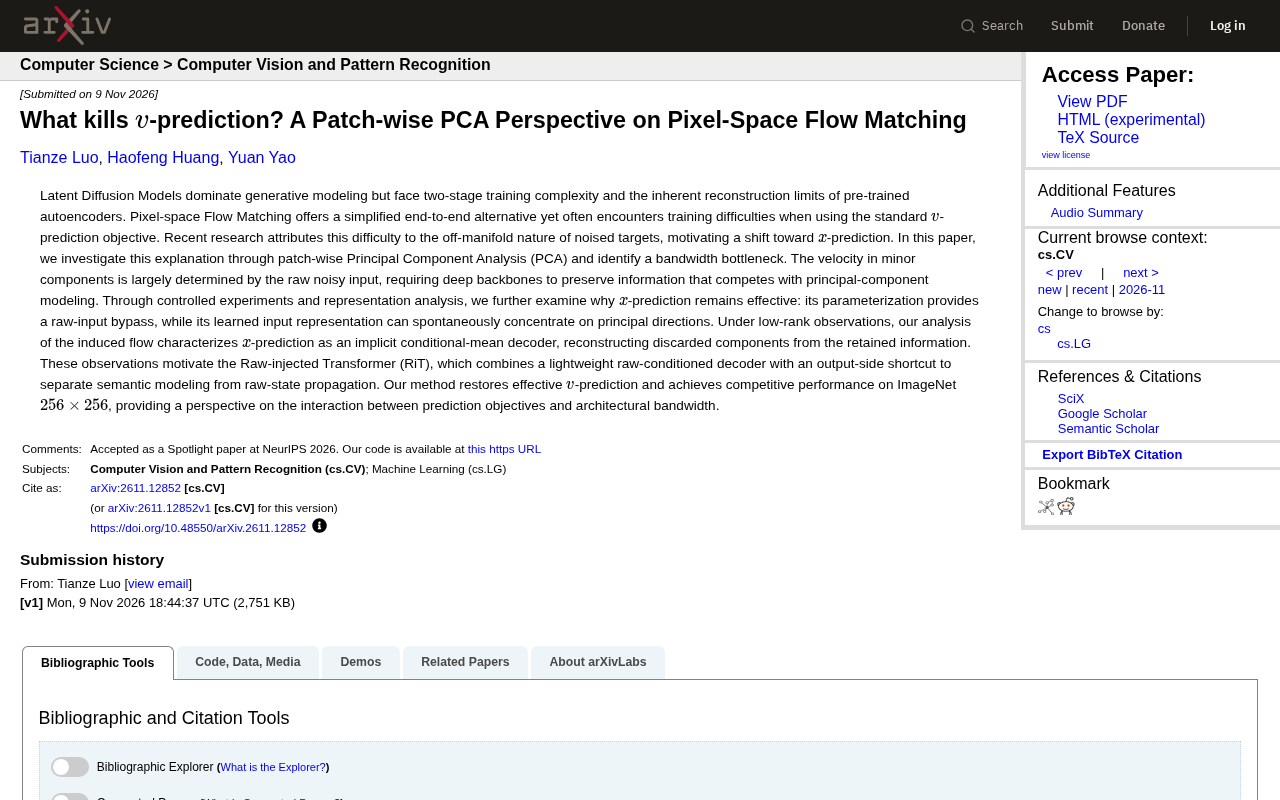
This article re-examines the training difficulties of v-prediction in pixel-space Flow Matching. While the conventional view attributes them to the off-manifold nature of the noise target, patch-wise PCA analysis reveals that the core issue is the information bandwidth bottleneck of the model architecture: minor-component velocities are mainly determined by the noise input, requiring the network to retain substantial raw information that competes with principal-component modeling. x-prediction alleviates the bandwidth pressure via a raw-input bypass and focus on principal directions, and under low-rank observations it acts as an implicit conditional-mean decoder. Based on this, the paper proposes the Raw-injected Transformer (RiT), which separates semantic modeling from raw-state propagation, restores effective v-prediction, and achieves competitive performance on ImageNet 256×256. The study highlights the co-design of prediction targets and architectures, offering a new perspective for generative model design.
Pixel-space Flow Matching is regarded as a simplified alternative to Latent Diffusion Models. It avoids the two-stage training complexity and reconstruction-loss limitations of pretrained autoencoders, enabling end-to-end generative modeling. However, when using the standard v-prediction objective, such models often encounter training difficulties. Recent research has attributed this difficulty to the off-manifold nature of the noise target, which has driven a shift toward x-prediction. A recent paper re-examines this explanation through patch-wise principal component analysis (PCA) and proposes an entirely new perspective: the bandwidth bottleneck.
Revisiting the Plight of v-prediction
The conventional view holds that v-prediction performs poorly in pixel-space Flow Matching because its prediction target—the velocity field—deviates from the data manifold under noisy inputs. However, through patch-wise PCA analysis, the paper finds that the core of the problem lies in the information bandwidth bottleneck within the model architecture. Specifically, in the PCA decomposition, the velocity of the minor components is primarily determined by the raw noise input, which requires the deep backbone network to retain a large amount of raw information. This information competes with the principal-component modeling task, making it difficult for the network to learn effectively.
This finding challenges the earlier "off-manifold target" explanation and shifts the focus to the trade-off between model capacity and information transfer efficiency. In other words, v-prediction is not inherently flawed; rather, standard architectures fail to provide sufficient bandwidth to simultaneously handle the semantic modeling of principal components and the noise propagation of minor components.
Target definitions for v-prediction and x-prediction
In diffusion/flow matching models, the choice of prediction target directly affects training stability. Suppose the clean data is $x_0$, the noise is $\epsilon$, and the time step is $t$; then the noised sample is $x_t = \alpha_t x_0 + \sigma_t \epsilon$. The target of v-prediction is $v = \alpha_t \epsilon - \sigma_t x_0$ (the velocity field), whereas x-prediction directly predicts $x_0$. In pixel space, the dimensionality of $x_t$ is extremely high and the noise component dominates. v-prediction requires the network to simultaneously separate the linear combination of $\epsilon$ and $x_0$ from $x_t$, which forces the network to retain a large amount of raw noise information in its deep representations; x-prediction, by contrast, allows the network to directly output an estimate of $x_0$, and the noise information can be passed through a bypass. This difference in target definition is the premise for understanding the bandwidth bottleneck.
Why x-prediction Works: Raw-Input Bypass and Focus on Principal Directions
The paper further investigates the effectiveness of x-prediction through controlled experiments and representation analysis. The study finds that the parameterization of x-prediction provides a raw-input bypass, allowing the network to directly exploit information in the noise input without having to fully retain it in deep representations. At the same time, the input representations learned by x-prediction spontaneously concentrate on the principal directions, thereby modeling the data distribution more efficiently.
Under low-rank observations, the analysis of the induced flow characterizes x-prediction as an implicit conditional-mean decoder, which can reconstruct the discarded components from the retained information. This mechanism explains why x-prediction is more stable and effective during training.
The role of principal component analysis (PCA) at the patch-wise level
PCA is a statistical method that uses an orthogonal transformation to convert a set of possibly correlated variables into principal components, with the first principal component direction corresponding to the direction of greatest data variance. In image generation, performing PCA on image patches rather than the full image can capture the dominant variation patterns of local structures. The patch-wise PCA in the paper decomposes the velocity field of each image patch into multiple components: the principal components correspond to semantic variations on the data manifold (such as edges and textures), while the minor components mainly reflect the random fluctuations of the noise input. By analyzing the correlation between each component and the noise input, the authors find that the velocity of the minor components is almost entirely determined by noise, meaning that the network must retain the complete information of the noise to accurately predict v. This analytical framework transforms the abstract "off-manifold" problem into a quantifiable bandwidth competition problem.
Raw-injected Transformer: Separating Semantic Modeling from Raw-State Propagation
Based on the above observations, the paper proposes the Raw-injected Transformer (RiT). This architecture combines a lightweight raw-conditioned decoder with an output-side shortcut, aiming to separate semantic modeling from raw-state propagation. In this way, RiT restores effective v-prediction training and achieves competitive performance on ImageNet 256×256.
The design philosophy of RiT reflects a deep understanding of the interaction between the prediction target and architectural bandwidth. It does not simply replace the prediction target; instead, it compensates for the bandwidth deficiency of v-prediction through architectural innovation, thereby preserving the theoretical advantages of v-prediction.
Architectural details of the Raw-injected Transformer
The core of RiT is a dual-path design: one path is a standard Transformer backbone, responsible for extracting semantic features from the input and modeling principal components; the other path is a lightweight raw-conditioned decoder that directly receives the raw noise input (or shallow features) and fuses it with the output of the backbone. The output-side shortcut directly adds part of the raw input to the final prediction, forming a residual-style information bypass. This design eliminates the need for the network to compress and retain all noise information in deep representations, thereby freeing up bandwidth for semantic modeling. Experiments show that while maintaining the v-prediction objective, RiT significantly improves both training stability and generation quality, validating the bandwidth bottleneck hypothesis.
Implications for Generative Model Design
This study provides a new explanation and solution for the training difficulties of pixel-space Flow Matching. It emphasizes the tight coupling between the prediction target and the network architecture, suggesting that researchers must consider both when designing generative models. In addition, the patch-wise PCA analysis framework provides a powerful tool for understanding representation learning in diffusion models and flow matching models.
Although this work focuses on pixel-space Flow Matching, its insights regarding the bandwidth bottleneck and raw-input bypass may be inspiring for the broader field of generative modeling. Future work could further explore how to apply this perspective to other prediction targets or architectural designs.
One-line Summary
v-prediction fails in pixel-space Flow Matching due to a bandwidth bottleneck, and x-prediction and the RiT architecture solve this problem through a raw-input bypass.
Paragraph Summary
This article re-examines the training difficulties of v-prediction in pixel-space Flow Matching. The conventional view attributes them to the off-manifold nature of the noise target, but through patch-wise PCA analysis, the authors find that the core issue is the information bandwidth bottleneck of the model architecture: the velocity of minor components is mainly determined by the noise input, requiring the network to retain a large amount of raw information, which competes with principal-component modeling. x-prediction alleviates the bandwidth pressure through a raw-input bypass and focus on principal directions, and under low-rank observations it behaves as an implicit conditional-mean decoder. Based on this, the paper proposes the Raw-injected Transformer (RiT), which separates semantic modeling from raw-state propagation, restores the effectiveness of v-prediction, and achieves competitive performance on ImageNet 256×256. The study emphasizes the co-design of prediction targets and architectures, offering a new perspective for generative model design.
Related articles

VP ≠ VNP: A Major Breakthrough in Computational Complexity Theory
A study claiming to prove VP ≠ VNP over every field sparks heated discussion on Hacker News. This article analyzes the algebraic complexity background of VP and VNP, the proof approach, community controversy, and its potential impact on computational complexity theory.

Developer Naming Woes: The Technical Names That Drive Us Crazy
Why is technical naming so maddening? From Nginx and Vite to Qt and Sudo, a YouTube creator rants about the chaos of developer naming and pronunciation, revealing the tug-of-war between creators' intentions and community habits, and the cultural roots behind spelling traps like PyPI and GNOME.

Figma Workplace Scandal: Employee Sues CEO for Forcing Confrontation with Harasser
Figma and its CEO are sued by a current employee alleging sexual harassment and discrimination, and forcing the victim to confront her harasser. This article outlines the background, potential impact, and industry reflection.