Why Flow Matching Models Can Escape the Curse of Dimensionality: A Generalization Theory for Low-Dimensional Data

New theory proves flow matching generalization is governed by intrinsic data dimension, not ambient dimension.
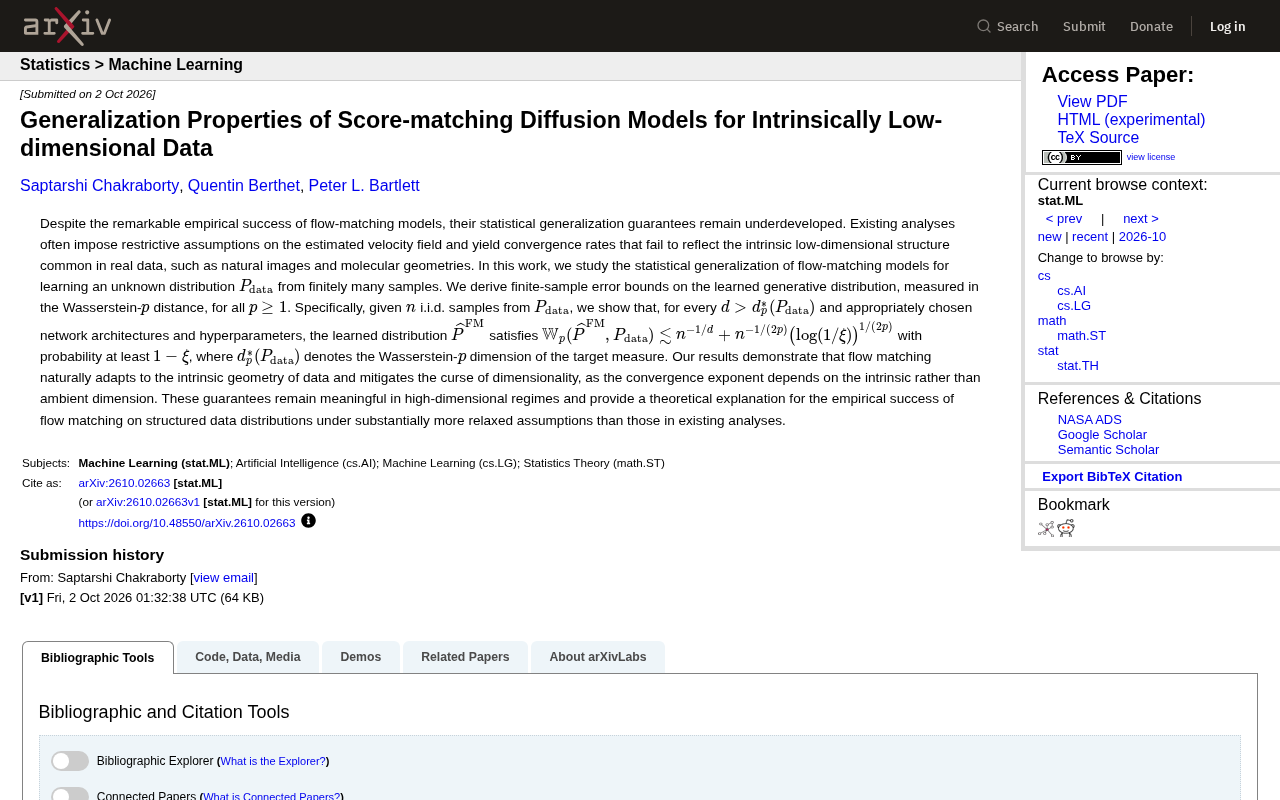
This arXiv paper (arXiv:2610.02663) addresses the long-standing lack of rigorous generalization theory for flow matching and diffusion models by deriving finite-sample Wasserstein-p error bounds under an intrinsically low-dimensional data assumption. The core finding is that the convergence rate exponent is determined by the data's Wasserstein-p intrinsic dimension $d_p^*$, not the high-dimensional ambient space. When data concentrates on low-dimensional structure, sample efficiency is governed by that structure, mitigating the curse of dimensionality. The results hold under significantly weaker assumptions on the velocity field and cover all Wasserstein-p distances with p ≥ 1, providing quantifiable theoretical grounding for flow matching's empirical success on structured data.
A Long-Standing Open Theoretical Question
Flow Matching and Diffusion Models have achieved remarkable empirical results on tasks such as image generation and molecular structure modeling, yet the statistical generalization guarantees underlying these methods have remained underdeveloped. In other words, we know these models "work well in practice," but a rigorous mathematical explanation for how they learn the true data distribution from finite samples has been missing.
A recent arXiv paper (arXiv:2610.02663) targets precisely this gap, systematically studying the generalization properties of score-matching-based diffusion and flow matching models on intrinsically low-dimensional data. The central contribution is a finite-sample error bound for the learned distribution, which provides a principled explanation for why flow matching remains effective in high-dimensional settings.
Two Key Limitations of Existing Analysis
To appreciate the value of this work, it helps to first understand the shortcomings of prior theory.
Overly Restrictive Assumptions
Previous generalization analyses of flow matching and diffusion models typically impose strong restrictive assumptions on the estimated velocity field. While mathematically convenient, these assumptions are far removed from what neural networks actually learn during training, severely limiting the practical relevance of theoretical conclusions.
The velocity field is the central object in the flow matching framework. The idea is to learn a time-dependent vector field $v_t(x)$ such that the ordinary differential equation (ODE) driven by this field transports a simple reference distribution (e.g., a standard Gaussian) to the target data distribution. The training objective minimizes the mean squared error between the network's predicted velocity field and a reference velocity field — this is the flow matching embodiment of the score matching idea. To remain mathematically tractable, prior theoretical analyses often assume the estimated velocity field satisfies global Lipschitz continuity, bounded norms, or specific regularity conditions. Since deep networks trained in practice offer no such guarantees, a fundamental gap between theory and practice persists.
Convergence Rates That Ignore Intrinsic Data Structure
Real-world data — such as natural images or molecular geometries — nominally lives in extremely high-dimensional spaces, yet in practice concentrates near a low-dimensional manifold whose dimension is far smaller than the ambient dimension. Existing convergence rate analyses, however, typically depend on the ambient dimension, causing the theoretically predicted convergence speed to become essentially vacuous in high dimensions. This is the curse of dimensionality: theory says the model cannot learn effectively, yet practice consistently proves otherwise.
The Manifold Hypothesis is the core backdrop here: it posits that high-dimensional observations (images, speech, molecular configurations) approximately lie on a low-dimensional Riemannian manifold embedded in the high-dimensional ambient space. For example, a 256×256 color image nominally has around 200,000 pixel dimensions, yet "natural-looking" images occupy only a tiny subset of that space, with an intrinsic degree of freedom potentially in the hundreds or fewer. The Curse of Dimensionality has a precise meaning in classical statistics: in nonparametric density estimation, the number of samples required to achieve accuracy $\varepsilon$ grows as $\varepsilon^{-D}$ with the ambient dimension $D$, making the sample requirement infeasible when $D$ is large. Consequently, any theoretical bound that depends on the ambient dimension offers no practical guidance — it predicts sample requirements far exceeding the size of any realistic dataset.
Core Result: Error Bounds and Intrinsic Dimension
The paper's main result establishes that after drawing $n$ i.i.d. samples from $P_{\mathrm{data}}$, the learned generative distribution $\widehat{P}^{\mathrm{FM}}$ satisfies a finite-sample error bound in Wasserstein-$p$ distance.
Specifically, for all $p \geq 1$ and any $d > d_p^\ast(P_{\mathrm{data}})$, with an appropriate choice of network architecture and hyperparameters, with probability at least $1 - \xi$:
$$\mathbb{W}p(\widehat{P}^{\mathrm{FM}}, P{\mathrm{data}}) \lesssim n^{-1/d} + n^{-1/(2p)}\bigl(\log(1/\xi)\bigr)^{1/(2p)}$$
where $d_p^\ast(P_{\mathrm{data}})$ denotes the Wasserstein-$p$ dimension of the target measure.
This expression may look complex, but the key message is clear: the convergence rate exponent is governed by the intrinsic dimension of the data, not the ambient dimension. This means that even when images are represented in a pixel space of millions of dimensions, as long as the true distribution concentrates on a low-dimensional structure, the model's sample efficiency is determined by that low-dimensional structure.
Wasserstein-$p$ dimension (denoted $d_p^(P)$) is the key concept for interpreting this error bound. It characterizes the "effective intrinsic complexity" of a probability measure $P$. Intuitively, it captures the dimensionality actually required to approximate $P$ in the Wasserstein-$p$ sense — a more statistically operational notion than the topological dimension of a manifold. When $P_{\mathrm{data}}$ is supported on a smooth $d_0$-dimensional submanifold, $d_p^$ is typically of the same order as $d_0$, far smaller than the ambient dimension $D$. The $n^{-1/d}$ term in the error bound reflects the classical nonparametric estimation principle that learning a $d$-dimensional distribution requires $O(n^d)$ samples; the $n^{-1/(2p)}$ term captures stochastic error from finite-sample fluctuations. The dominant term determines the overall convergence rate, and both exponents are tied to the intrinsic data structure rather than the ambient dimension.
Why This Mitigates the Curse of Dimensionality
The essence of the curse of dimensionality is that error deteriorates exponentially with dimension, requiring astronomically large sample sizes to learn distributions in high-dimensional spaces. This work shows that flow matching naturally adapts to the intrinsic geometric structure of the data: the convergence exponent is tied to $d_p^\ast$ rather than the ambient dimension $D$.
When the intrinsic dimension is far smaller than the ambient dimension, the $n^{-1/d}$ term decays significantly faster than a bound based on the ambient dimension. As a result, the error bound remains meaningful in high-dimensional regimes rather than collapsing into a vacuous statement. This provides a solid theoretical explanation for the empirical success of flow matching models on structured data distributions.
Significance and Impact
From a theoretical research perspective, the value of this paper manifests at three levels.
First, it provides generalization guarantees under significantly weaker assumptions — compared to prior analyses that require strong constraints on the velocity field, the bar is lower and far closer to practice.
Second, it covers all Wasserstein-$p$ distances with $p \geq 1$ rather than being limited to a single specific metric, giving the results broader generality.
Third, it narrows the gap between "empirically effective" and "theoretically provable." For a long time, the generative modeling community relied largely on empirical intuition to explain the benefits of low-dimensional structure; this work formalizes that intuition into quantifiable convergence rates.
For researchers working on generative models and diffusion/flow matching methods, as well as engineers concerned with sample complexity, this result is a reminder: the intrinsic geometry of data, not its surface-level dimensionality, is the true variable governing learning difficulty. This also lends theoretical support to an empirical consensus — on structured data, flow matching methods tend to perform far better than worst-case theory would suggest.
Summary
This paper develops a central thesis: the generalization capability of flow matching models adapts to the intrinsic low-dimensional structure of the data, thereby mitigating the curse of dimensionality. It grounds this thesis in provable mathematical results through finite-sample Wasserstein-$p$ error bounds, established under weaker assumptions than prior work. For researchers seeking to understand why generative models work, this is a theoretical puzzle piece well worth attention.
Related articles

Gaussian Process Bandit Optimization: Exploration Strategies and Inference Regret Guarantees
Cumulative regret guarantees in Bayesian optimization fail to reflect final recommendation quality. This article examines a new study that provides inference regret guarantees for Gaussian process bandit optimization through exploration query strategies and fill distance analysis, validated on hyperparameter optimization and control tasks.

The Most Detailed Codex Guide on Bilibili: From Installation to Real-World Practice
The most detailed Codex guide on Bilibili: from app store installation to daily work mode configuration, with a real coffee shop project demonstrating file organization, data extraction, dashboard creation, and other practical tasks. Learn to use Plan Mode and desktop pets to leverage Codex efficiently.

Appearance Compensation in Volume Rendering: Why RGB Accuracy Cannot Guarantee Density Correctness
Volume rendering research reveals that volumetric data perfectly reproducing external RGB views may still contain density errors: appearance compensation can double central density and keep external rays unchanged even when L2 error exceeds 14.52%. Density recovery depends on appearance capacity, spatial resolution, and measurement design.