Why Has Torch Surpassed TensorFlow? A Deep Dive from Reddit Developers

PyTorch surpassed TensorFlow to become the mainstream deep learning framework thanks to dynamic graphs, Pythonic design, and positive feedback from the Hugging Face ecosystem.
Starting from a Reddit developer's confusion, the article explores why PyTorch replaced TensorFlow as the mainstream deep learning framework. Community views boil down to four points: dynamic computation graphs make debugging more intuitive, the research community shifted to PyTorch for its flexibility, the Hugging Face ecosystem centered on PyTorch creates positive feedback, and the painful TensorFlow 1.x-to-2.x migration led to user attrition. Although TensorFlow still has advantages in production deployment (TF Serving, TF Lite), the consensus is that PyTorch already dominates research and prototyping, and ecosystem inertia is hard to reverse.
Introduction
Recently, a developer's question on Reddit sparked widespread discussion: Why has PyTorch (Torch) been able to surpass TensorFlow and become the mainstream choice for deep learning frameworks? This developer started with TensorFlow 1.x, grew accustomed to the graph-construction paradigm, and found PyTorch's "Python-loop training" puzzling—yet now feels compelled to switch to PyTorch because of the Hugging Face ecosystem. His confusion reflects the sentiments of many traditional TensorFlow users.
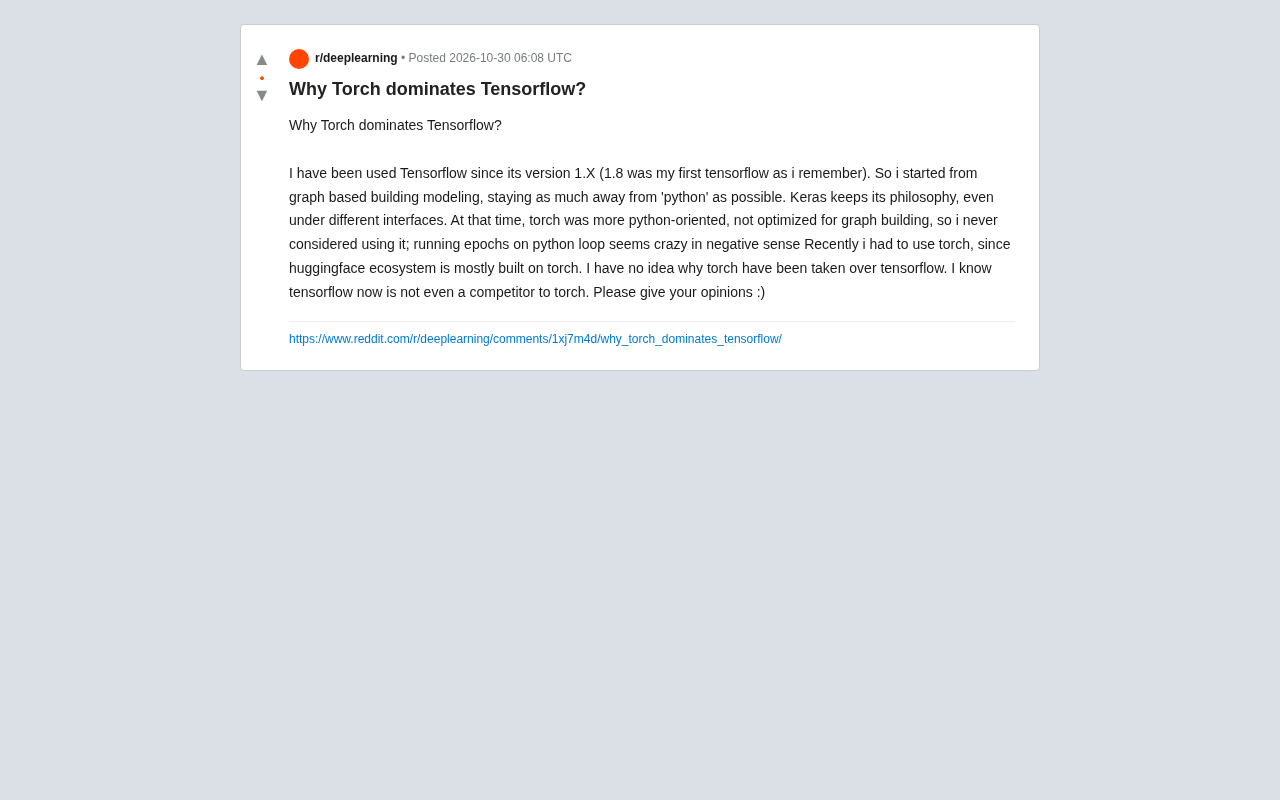
Developer Background and Confusion
The original poster says he began using TensorFlow from version 1.8, went through the phase of building graph-based models, and tried to avoid "Pythonic" writing as much as possible. Keras continued this philosophy, even if the interface differed. At the time, PyTorch leaned more toward Python style and was not optimized for graph construction, so he never considered using it—running epochs in Python loops seemed "crazy." However, recently, because the Hugging Face ecosystem is primarily based on PyTorch, he had to use Torch. He is confused: Why has PyTorch been able to take over from TensorFlow? He knows that TensorFlow is no longer a competitor to PyTorch today.
Community Perspectives: Why PyTorch Wins
In the discussion, community members analyzed the reasons why PyTorch has gained the upper hand from multiple angles. According to common views among Reddit users and the Hugging Face ecosystem, the following points are key:
1. Dynamic Computation Graphs and Pythonic Programming
PyTorch's dynamic computation graph (Eager Execution) lets developers build models just like writing ordinary Python code, making debugging more intuitive. In contrast, TensorFlow 1.x's static graph requires defining first and then running, increasing the learning curve and debugging difficulty. Although TensorFlow 2.x introduced Eager mode, PyTorch made it the core from the very beginning and won the favor of researchers.
The core difference between Eager Execution (dynamic graph) and static graphs lies in when the computation graph is built. Static graph mode (such as TensorFlow 1.x) requires fully defining the computation graph first and then executing it through a Session; the graph structure is fixed before running, which facilitates compiler optimization and cross-platform deployment, but makes it difficult to inspect intermediate results line by line during debugging. Dynamic graph mode (such as PyTorch) builds the computation graph on the fly during each forward pass, so developers can directly inspect any tensor with Python's native debugging tools (such as pdb, print), and control flow (if/for) is entirely driven by the Python interpreter. The cost was that early dynamic graphs were weaker than static graphs in performance optimization and deployment, but with the emergence of intermediate representations such as TorchScript and ONNX, this gap has been greatly narrowed. TensorFlow 2.x enabling Eager mode by default is precisely a response to this trend.
2. The Shift of the Research Community
According to analyses by multiple YouTube tech channels, PyTorch's adoption in academia has risen rapidly. Researchers prefer flexible frameworks that are easy to experiment with, and PyTorch's dynamic characteristics precisely meet the need. As a large amount of paper code is released based on PyTorch, it has gradually become the research standard.
3. The Push from the Hugging Face Ecosystem
Hugging Face's Transformers library was initially based on PyTorch and quickly became the standard in the NLP field. This forced many developers to switch to PyTorch, just as the original poster experienced. The positive feedback loop of the ecosystem has also made PyTorch increasingly popular in industry.
The Hugging Face Transformers library is an open-source NLP toolkit that provides a unified API for thousands of pretrained models (such as BERT, GPT, T5). Its core design is "model as configuration": users load weights through from_pretrained() and complete inference with a few lines of code using pipeline(). The library was initially (2018) implemented based on PyTorch; although a TensorFlow backend was later added, the PyTorch version has always been the most fully featured and fastest-updated "first-class citizen." This ecosystem lock-in effect is significant: when researchers release new models, they usually provide only PyTorch weights, and industry users of these models are naturally pulled into the PyTorch camp. The number of PyTorch-format models on the Hugging Face Hub far exceeds that of TensorFlow-format models, further reinforcing the positive feedback loop.
4. TensorFlow's Fragmentation and Transition Pains
The migration from TensorFlow 1.x to 2.x brought compatibility issues, and Keras integration also underwent multiple adjustments. According to discussions by Bilibili creators and on Reddit, this fragmentation frustrated some developers, who turned to the more consistent PyTorch.
The migration from TensorFlow 1.x to 2.x was a "breaking upgrade." The static graph APIs of 1.x (such as tf.Session, tf.placeholder) were completely removed in 2.x; the official recommendation is to use Keras as the high-level interface and enable Eager mode by default. This caused a large amount of existing code to fail to run directly, and enterprises had to invest manpower to rewrite it. More troublesome is that Keras underwent multiple positioning adjustments within TensorFlow: from an independent library to tf.keras, and then to Keras 3's multi-backend support, with API semantics changing repeatedly. In contrast, PyTorch's API remained highly backward compatible from 1.x to 2.x, adding only incremental features such as torch.compile. This consistency reduced long-term maintenance costs and became an important driver of developer attrition.
Divergence and Consensus
There are some disagreements in the community regarding PyTorch's rise. For example, some argue that TensorFlow still has advantages in production deployment (such as TF Serving and TF Lite), but the consensus is that PyTorch has become dominant in research and prototyping. Other users point out that improvements in TensorFlow 2.x have narrowed the gap, but ecosystem inertia is difficult to reverse.
Conclusion
PyTorch's victory is no accident: through dynamic graphs, Pythonic design, and a strong community ecosystem, it lowered the barrier to entry for deep learning and captured the needs of the research community. Although TensorFlow is still evolving, PyTorch's first-mover advantage has formed a powerful network effect. For developers, adapting to this trend may be the wise move.
Related articles

Mistral Large 4 Open-Sources a Trillion Parameters, Microsoft Offers Voluntary Severance to 60,000 Employees
Mistral Large 4 open-sources a trillion-parameter multimodal model with a coding agent score of 48; SanDisk earnings show AI inference reshaping NAND demand; Google Gemini adds in-app file editing, OpenAI raises Codex quotas, and Microsoft offers voluntary severance to 60,000 employees.
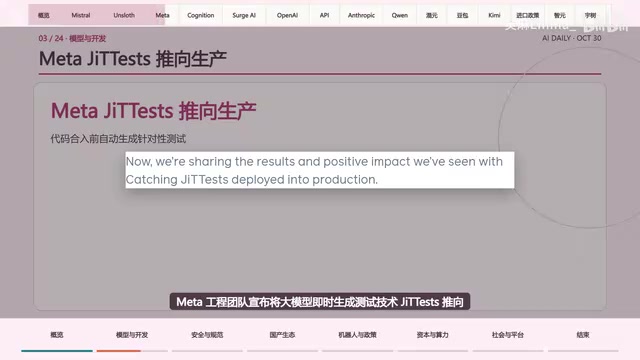
Mistral Large 4 Opens Its Weights: AI Morning Brief Roundup of Models and Ecosystem Trends
Mistral Large 4 opens its weights, a 1-trillion-parameter MoE architecture that can run locally on MacStudio; Meta's test-generation technology enters production; top tax benchmark pass rate only 10.8%; Canadian government takes a stake in Cohere; Doubao Work opens third-party model calls. This AI Morning Brief rounds up model, ecosystem, capital, and policy developments.

Mistral Large 4 Goes Open Source: A 1T-Parameter European Qwen Challenging DeepSeek
Mistral Large 4 is now open source: 1T total parameters, 52B activated, focused on coding and cybersecurity, with ~610G NVFP4 weights. We analyze its comparison with DeepSeek V4 Flash, API pricing, demo realism, and local deployment value.