Why Is DeepSeek Called "National Destiny-Level"? Liang Wenfeng's AGI Obsession and the Open-Source Revolution

DeepSeek opened up a lane-changing path for Chinese AI with open-source chain-of-thought, low-cost training, and Ascend adaptation.
The article reviews the collective anxiety in Chinese AI after 2023 over "following the US tech stack" versus "forging ahead independently," noting the mainstream strategy was to settle for adequate models and pivot to applications. DeepSeek-R1 broke the deadlock: fully open-sourcing its chain-of-thought and weights at under $6 million in training cost, triggering over $1 trillion in single-day losses across US tech stocks. Founder Liang Wenfeng rejected big-company-style commercialization to focus on AGI. DeepSeek then open-sourced CUDA-equivalent components for Huawei's Ascend, sharply lowering migration costs. The article argues open source isn't charity but a lane-changing strategy to win standard-setting power through developer ecosystems.
The Fork in the Road for Chinese AI: Follow the Leader or Forge Ahead?
After ChatGPT burst onto the scene in 2023, China's AI industry fell into a collective anxiety. There were only two paths forward: either follow the American tech stack—use their chips, play by their rules—or pour money into independent R&D with no guaranteed outcome. According to analyses by several tech creators on Bilibili, many industry experts were pessimistic at the time, believing this competition could only be a "protracted war"—like the chip industry, accept that the other side leads while we buckle down and catch up.
Baidu also had fierce internal debates over open source versus closed source, ultimately choosing the closed-source route for ERNIE Bot, with other major players following suit to defend their turf in the domestic market. The most realistic calculus in the industry at the time was: how much would it cost to catch up, and how long before we break even? No one could say. So "as long as the model runs, focus energy on applications and grabbing traffic" became the mainstream way of doing things.
The Shockwave of DeepSeek-R1: Open-Source Chain-of-Thought and Cost Transparency
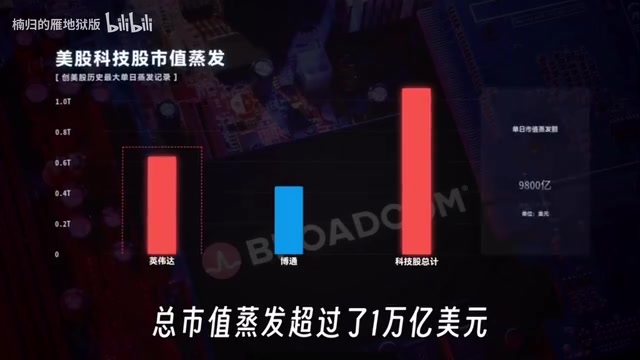
The turning point came when DeepSeekAd-R1 launched. The model was fully open source, with even its core chain-of-thought completely disclosed—essentially sharing its problem-solving approach with the entire world. Even more stunning was the cost: OpenAI had claimed training a single run cost hundreds of millions of dollars, while DeepSeek disclosed a cost of under $6 million. That number detonated the capital markets—Nvidia plunged intraday, losing nearly $590 billion in market value, the largest single-day wipeout in US stock market history; Broadcom fell even harder the same day, and total US tech stock market value evaporated by over $1 trillion in a single day.
According to analyses on YouTube channels, the world's most formidable tech giants had their landscape shattered by this startup team from China, and the market began to re-examine whether America's "stack compute, outspend everyone" AI playbook still held up. DeepSeek was the first model in the world to release a complete chain-of-thought alongside its weights. Had it chosen to stay closed, the world would still have only two top-tier AI models, and tokens would likely have become a monopolized digital resource—using good AI would cost you at least 10 times what it does now.
Chain-of-Thought (CoT) refers to the technique where large models explicitly show their intermediate reasoning steps before giving a final answer. Previously, mainstream closed-source models only output results, hiding the reasoning process; DeepSeek-R1 open-sourced the complete chain-of-thought along with model weights, meaning researchers worldwide can not only use the model but also examine and reproduce its reasoning logic, and build on that for distillation, fine-tuning, or alignment research. This has direct value for interpretability, security auditing, and academic reproducibility, and means newcomers don't have to figure out reasoning-capability training methods from scratch.
Liang Wenfeng's AGI Obsession: An "Oddball" in No Hurry to Monetize
More interesting still is Liang Wenfeng's approach. Other companies think about how to make money first when doing AI—roll out a multimodal feature today, launch an app tomorrow, always keeping an eye on monetization. But Liang Wenfeng has eyes only for Artificial General Intelligence (AGI)—making AI capable of doing all human cognitive work. According to a Bilibili creator citing Liang's remarks at an internal meeting, he didn't want to take the big-company path: video generation, multimodality, super apps—no matter how big the volume, these are sesame seeds that can't compare to the watermelon of AGI. He was even more direct at a closed-door meeting: now is not the time to maximize returns on products; you don't need to expend too much thought and energy on consumer or enterprise products.
Big companies' goal is commercialization, and they may be lured by commercial opportunities along the way, ultimately missing the chance to summit AGI. But Liang Wenfeng is different—he's aiming straight for that peak. Even if AI commercialization doesn't work out, he'll keep buying compute and doing R&D, never stopping until he reaches the goal. This composure—this refusal to rush monetization—later led him to do something commercial companies typically wouldn't.
AGI (Artificial General Intelligence) refers to intelligent systems capable of reaching or surpassing human levels across a wide range of tasks and possessing cross-domain transferability, as opposed to "narrow AI" that performs well only on specific tasks. The industry has no consensus on whether or when AGI is achievable, but it's often used as a coordinate system for evaluating technology roadmaps: pursuing AGI means sustained investment in foundational capabilities and reasoning generalization, rather than prioritizing polish on single-scenario products. Liang Wenfeng viewing multimodality, video generation, and super apps as "sesame seeds" is precisely using the long-term goal of AGI to calibrate resource allocation.
A "Universal Adapter" for Ascend: The Ecosystem Significance of Open-Sourcing the Foundation Layer
On September 30, DeepSeek open-sourced a set of low-level components for Huawei's Ascend platform. These components correspond one-to-one with Nvidia's open-source versions, and in many tests their compute and communication performance approach the hardware's limits. Previously, developers using Nvidia were locked into the CUDA ecosystem; switching to Ascend meant tearing everything down and starting over—this high migration cost was Nvidia's most fortified moat. But now DeepSeek has essentially given Ascend a universal adapter: the development logic is the same as Nvidia's, so developers don't need to relearn or heavily rewrite code—switching compute platforms is like switching outlets.
According to analyses across multiple tech communities, Ascend has long been criticized for being hard to develop on precisely because its supporting software ecosystem was too weak, and DeepSeek's move directly connected the most critical missing link. This is also why people call DeepSeek "national destiny-level"—not because of its valuation or how much money it's made, but because at a moment when Chinese AI was collectively lost and even preparing to resign itself to a three-year catch-up, it not only broke through on its own but left the smashed-open technological door open for everyone.

CUDA (Compute Unified Device Architecture) is Nvidia's parallel computing platform and programming model, through which developers use GPUs for general-purpose computing. After more than a decade of accumulation, mainstream deep learning frameworks, operator libraries, and tuning tools almost all prioritize CUDA compatibility, creating an ecosystem barrier where "software locks in hardware." When developers migrate to other chips, they often need to rewrite operators and re-tune, at extremely high cost. DeepSeek open-sourcing CUDA-equivalent low-level components for Ascend is essentially building compatible interfaces at the software layer, allowing existing code and development habits to carry over, thereby weakening this lock-in effect.
Open Source Isn't Charity—It's a Strategy for Changing Lanes and Overtaking
DeepSeek's open-source strategy is often misunderstood as "selflessness," but from an industry-competition perspective, it's more like changing lanes to overtake. While closed-source giants are still mired in involution over API call volumes and user retention rates, DeepSeek has built a developer-ecosystem moat through open source—disclosing the chain-of-thought means researchers worldwide can build improvements on it, and open-sourcing the Ascend components means the domestic compute ecosystem has a usable software stack. The returns on this strategy aren't in short-term financial reports but in the power to set technical standards.
Liang Wenfeng says he's just "tightening screws" and can't bear such heavy praise. But it's precisely this posture—placing himself on the foundation of the open-source community—that has led DeepSeek to make choices on its technical path radically different from the big players. Domestic large-model products aimed at ordinary people, such as ERNIE Bot and Doubao, have entered a phase of rapid iteration, and compared with 2023, the landscape has completely changed. And the starting point of it all may well be that moment when someone decided to release the chain-of-thought and weights together.
Related articles

VP ≠ VNP: A Major Breakthrough in Computational Complexity Theory
A study claiming to prove VP ≠ VNP over every field sparks heated discussion on Hacker News. This article analyzes the algebraic complexity background of VP and VNP, the proof approach, community controversy, and its potential impact on computational complexity theory.

Developer Naming Woes: The Technical Names That Drive Us Crazy
Why is technical naming so maddening? From Nginx and Vite to Qt and Sudo, a YouTube creator rants about the chaos of developer naming and pronunciation, revealing the tug-of-war between creators' intentions and community habits, and the cultural roots behind spelling traps like PyPI and GNOME.

Figma Workplace Scandal: Employee Sues CEO for Forcing Confrontation with Harasser
Figma and its CEO are sued by a current employee alleging sexual harassment and discrimination, and forcing the victim to confront her harasser. This article outlines the background, potential impact, and industry reflection.