Why Is do-calculus Not Enough? New Progress in Research on Universal Identifiability of Causal Effects
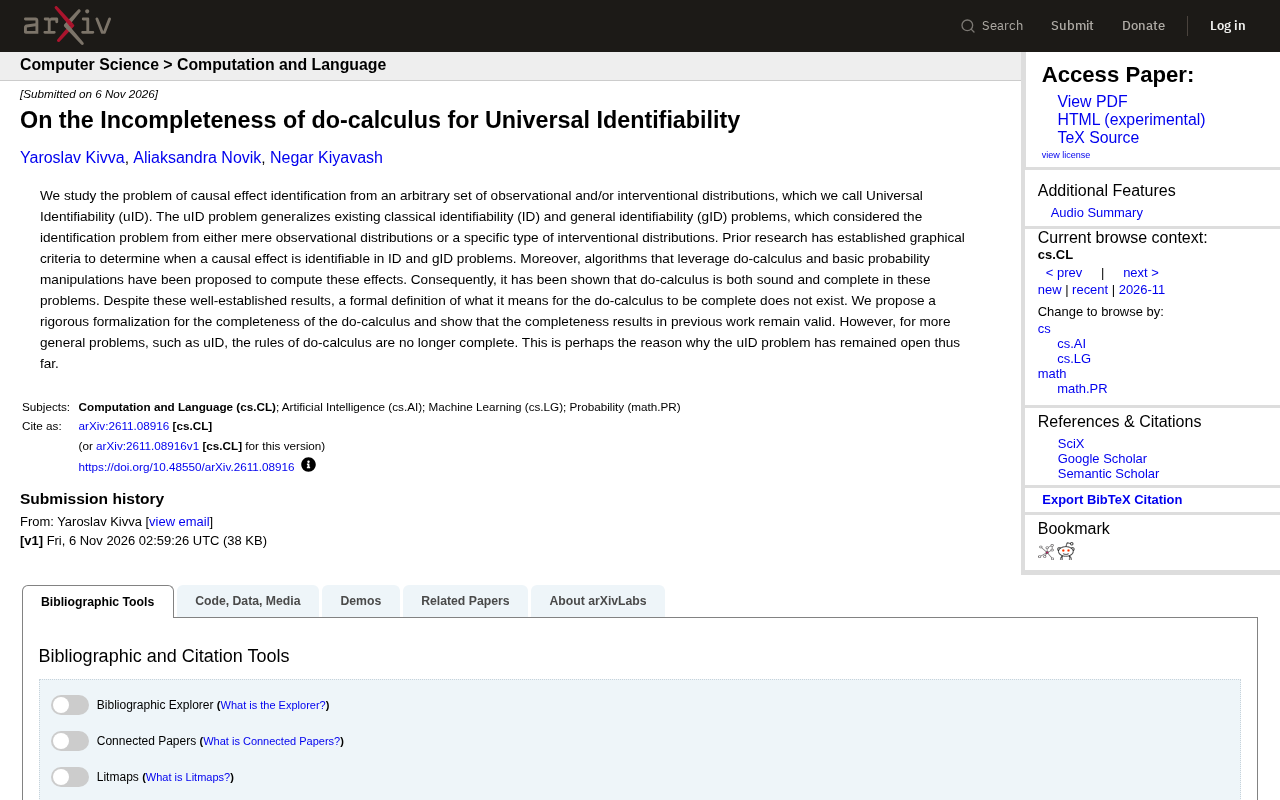
A new study formally defines do-calculus completeness and proves that it is no longer complete in the universal identifiability problem.
Causal inference has long relied on do-calculus as the core tool for identifying causal effects, but a new study reveals its boundary. The paper first unifies and generalizes the classical identifiability (ID) and general identifiability (gID) problems into the universal identifiability (uID) problem, allowing an arbitrary set of observational distributions and/or interventional distributions as input. The authors point out that the academic community had never rigorously defined the meaning of "do-calculus completeness," so they propose a rigorous formal framework and, under this framework, confirm that do-calculus remains complete in ID and gID. However, the core conclusion is that do-calculus is no longer complete in the uID problem: there exist causal effects that are identifiable but cannot be derived using do-calculus rules. The authors conjecture that this is precisely why the uID problem has long remained unsolved, suggesting that future work needs new inference rules or graphical criteria beyond do-calculus. For practitioners, when data sources are mixed, one cannot assume by default that do-calculus covers all identifiable effects.
Causal inference has long relied on do-calculus as a core tool, but a new study reveals its boundary: in the more general universal identifiability problem, the rules of do-calculus are no longer complete. This paper not only provides a rigorous formal definition of do-calculus completeness, but also explains why the uID problem has remained unsolved for so long.
From Classical Identifiability to Universal Identifiability
Causal effect identification aims to answer: given only observational data and partial interventional data, can a certain causal quantity be uniquely determined? The classical identifiability (ID) problem considers only observational distributions, while the general identifiability (gID) problem is restricted to specific types of interventional distributions. Both have mature graphical decision criteria and computational algorithms based on do-calculus and basic probability operations.
The universal identifiability (uID) problem proposed in the paper unifies and generalizes the above two classes of problems: given any set of observational distributions and/or interventional distributions, determine whether the target causal effect is identifiable. This generalization covers a broader range of real-world scenarios, for example when researchers can only obtain data under certain interventions, while the intervention set itself is arbitrary.
do-calculus is an axiomatic system proposed by Judea Pearl for deriving interventional distributions from causal graphs. It contains three core rules (insertion/deletion of observations, insertion/deletion of interventions, insertion/deletion of actions), which correspond to graphical conditions such as d-separation. The soundness of do-calculus means that the expressions derived by the rules are correct, while completeness means that all identifiable causal effects can be derived through the rules. In the classical ID problem, do-calculus has been proven to be both sound and complete.
Differences among ID, gID, and uID: The ID problem is given only an observational distribution and asks whether the interventional distribution P(y|do(x)) is identifiable; the gID problem is given an observational distribution and a certain class of interventional distributions (such as P(v|do(z))) and asks whether another interventional distribution is identifiable; uID allows an arbitrary mixed set of observational distributions and interventional distributions as input and asks whether the target causal quantity is identifiable. The input to uID is a set of distributions rather than a single distribution, so its identifiability definition needs to handle constraint relationships among multiple distributions, which is also why it is more general and more difficult than the previous two.
do-calculus Completeness: A Missing Formal Definition
Although previous work has proven that do-calculus is both sound and complete in the ID and gID problems, the paper points out that the academic community has never rigorously defined what "do-calculus completeness" actually means. This ambiguity in definition has made it impossible to precisely compare the capability boundaries of do-calculus across different problems.
To address this, the authors propose a rigorous formal framework to characterize the completeness of do-calculus, and under this framework they re-verify that the completeness conclusions of previous work still hold. This formalization has independent value: it provides a common language for subsequent discussions of how do-calculus performs in more complex problems.
In the causal inference literature, "completeness" usually has two meanings: semantic completeness means that if a causal effect is identifiable within a certain class of causal models, then there exists an expression that can be derived from the allowed operations; syntactic completeness means that the derivation system can generate all identifiable expressions. Previous proofs of do-calculus completeness mostly relied on constructive algorithms (such as the ID algorithm and the gID algorithm), but did not clearly define the boundary between "the do-calculus rule set" and "basic probability operations"—for example, whether conditional independence assumptions, Bayes' rule, marginalization, and so on are allowed. The formal definition in the paper is precisely intended to fix these operations, thereby precisely characterizing "what can be derived using only do-calculus."
do-calculus Is No Longer Complete in Universal Settings
The core conclusion of the paper is that when the problem is generalized to uID, the rules of do-calculus are no longer complete. In other words, there exist certain causal effects that are identifiable under the uID framework but cannot be derived using only the rules of do-calculus and basic probability operations.
The authors conjecture that this is precisely why the uID problem has remained unresolved for so long—researchers have been trying to find decision criteria and computational algorithms within the framework of do-calculus, while that framework itself is no longer sufficient in the universal setting. This finding suggests that solving the uID problem may require new inference rules or new graphical criteria that go beyond do-calculus.
An intuitive example of identifiable but non-derivable: Suppose we have two interventional distributions P(y|do(x)) and P(z|do(x)), as well as an observational distribution P(x,y,z), and the target quantity is P(y|do(x), do(z)). Under the uID framework, in some cases this target quantity can be uniquely determined by a combination of multiple distributions, but the three rules of do-calculus can only act on graphical operations within a single distribution and cannot combine information across distributions, so they cannot generate the corresponding expression. This reveals the locality of do-calculus: it was designed for intervention derivation within a single distribution, whereas uID requires global reasoning across distributions.
Implications for Causal Inference Practice
For researchers applying causal inference, the value of this work lies in clarifying the boundaries of the tool. When data sources mix observational distributions and multiple interventional distributions, one cannot assume by default that do-calculus can yield all identifiable causal effects. Practitioners need to be aware that although certain effects are theoretically identifiable, existing algorithms based on do-calculus may not be able to find the corresponding expression.
The paper does not provide a complete solution to the uID problem, but it elevates the problem from the level of "algorithm design" to the level of "completeness of the inference system." Future research aiming to break through uID may need to introduce new identification rules or re-examine the structural properties of the set of interventional distributions.
A practical checklist: When data contain multiple sources (for example, a mixture of experimental data under different interventions and observational data), it is advisable to first determine whether the problem falls within the scope of uID. If it does, one should not rely solely on do-calculus tools (such as the identification algorithms in libraries like DoWhy), but should instead attempt manual derivation based on joint constraints over the set of distributions, or use the formal framework proposed in the paper to verify identifiability. In addition, if the target effect is theoretically identifiable but do-calculus cannot find an expression, it may be necessary to estimate it directly using numerical optimization or semiparametric methods rather than seeking an analytical expression.
Related articles

Seven Years of Evolution: How Far Has the Foldable Come From the First Generation?
From the first foldable to today's latest models, what has seven years changed? Shallower creases, higher brightness, thinner bodies, and smoother software migration—has the foldable crossed the chasm from enthusiasts to ordinary users? This article discusses the question based on a video comparison.

When Did Humans Start Eating Salt? A 10,000-Year History of Salt
When did humans start eating salt? From salt use at the dawn of agriculture 11,000 years ago to ancient seawater evaporation and rock salt mining, and on to the salt trade, salt taxes, and Gandhi's Salt March, this article traces salt's key role in human civilization.
Microsoft Paza Research: How African Language Speech Recognition Breaks Through Architecture and Data Bottlenecks
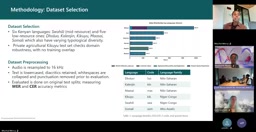
Microsoft's Paza research evaluates 53 speech models across 39 African languages, revealing architecture choice matters more than pre-training coverage, 200-300 hours is the practical data threshold, and language typology deeply influences recognition performance.