Why Is GPT-6 Causing Such a Stir? From Conversational Tool to Autonomous Agent

GPT-6 ditches API dependency to operate software visually, marking AI's leap from chatbot to autonomous agent.
OpenAI's GPT-6 (codenamed Astral) represents a pivotal shift in AI interaction: instead of relying on traditional APIs, it uses multimodal vision to read computer screens and operate any GUI-based software autonomously — handling complex, multi-step tasks from start to finish. It achieved 72.6% accuracy on OS World 2.0 while cutting average task time nearly in half. This unexpectedly revives the importance of GUI interfaces and challenges API-dependent agent development. Still, the author remains grounded: GPT-6 is limited to the digital domain, requires time to train on third-party software, and falls short of true AGI — though the technical foundation is now firmly in place.
From Chatting to Executing: A Shift in Interaction Paradigm
The release of GPT-6 by OpenAI has sparked intense discussion across the tech world. Unlike previous versions, the excitement isn't just about bigger parameters or higher benchmark scores — it's about a fundamentally new form of capability. GPT-6 has evolved from an AI that simply "chats and answers" into an agent that can autonomously invoke software and independently complete end-to-end tasks.
According to analyses from Bilibili content creators, the most critical change in GPT-6 is this: users simply state what they need, and the model handles the entire pipeline — thinking, breaking down the problem, and executing — on its own. This is no longer the passive "you ask, it answers" dynamic. The shift has been compared to the moment the iPhone removed the physical keyboard and ushered in the smartphone era — it could fundamentally reshape how humans interact with computers.
To Understand GPT-6, First Understand AGI
To properly evaluate GPT-6, you can't avoid the concept of AGI (Artificial General Intelligence). The goal of AGI is to understand, learn, and perform any intellectual task the way a human would — not just generate PowerPoint slides or write a piece of code, but to be dropped into any environment and, through self-directed learning, fulfill whatever the user needs.
The path toward AGI can be broken down into several progressive stages:
Stage 1: Large Language Models (LLMs)
These are the general-purpose large models we use every day. Their core strength lies in text processing, powered by the Transformer self-attention mechanism — the foundation for most current AI products.
The Transformer's Self-Attention mechanism is the core architecture of today's large language models, introduced by Google in the 2017 paper Attention is All You Need. The key idea is that when processing text, the model simultaneously "sees" every word in the sequence and dynamically computes relevance weights between each word and all others — unlike earlier RNNs that processed text word by word in sequence. This parallel computation allows the model to efficiently capture long-range semantic dependencies, such as figuring out which subject "it" refers to in a long sentence. The scalability of this mechanism is what allowed researchers to keep improving language understanding and generation by scaling up parameters (from hundreds of millions to trillions), forming the shared technical foundation of GPT, Claude, Gemini, and other leading models.
Stage 2: Multimodality
No longer limited to text — the model can understand audio, video, images, and more. Multimodality has become a key competitive battleground among major players, with enormous progress from the early rough AI-generated videos to what's possible today.
Stage 3: Deep Reasoning
Deep reasoning is consistently emphasized as an essential capability for AGI. The model must be able to think, decompose hard problems, and demonstrate strong math and coding skills. Without sufficient reasoning ability, AI cannot truly complete goal-oriented tasks in any domain.
Stage 4: Agents
Since certain products went viral, the concept of "agents" has become a hot topic. But earlier agent tools were largely confined to their own built-in toolsets — generating a presentation or a block of text, for instance — and struggled with cross-software operations. Getting an AI to automatically open a browser, write an article, save it, and upload it was nearly impossible.
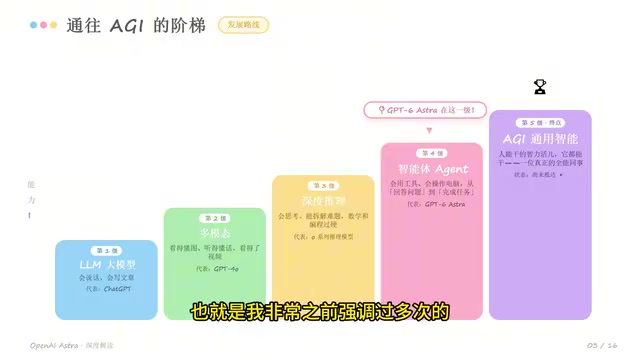
In AI contexts, an Agent refers specifically to a system that can perceive its environment, autonomously plan, and continuously execute multi-step actions to achieve a goal — distinct from models that only handle single-turn Q&A. Agents typically operate in a "perceive → reason → act → feedback" loop: the model understands the current state, formulates a sub-task plan, calls tools or interfaces to execute, then adjusts its next action based on the results. Two key bottlenecks have historically limited real-world Agent deployment: first, cross-software operations depend on each vendor providing standardized APIs, making integration extremely costly; second, insufficient model reasoning causes cascading errors in multi-step tasks. GPT-6 attempts to bypass API dependency through multimodal visual perception — a direct attack on that first bottleneck.
What Makes GPT-6 So Powerful: Autonomous Operation Without APIs
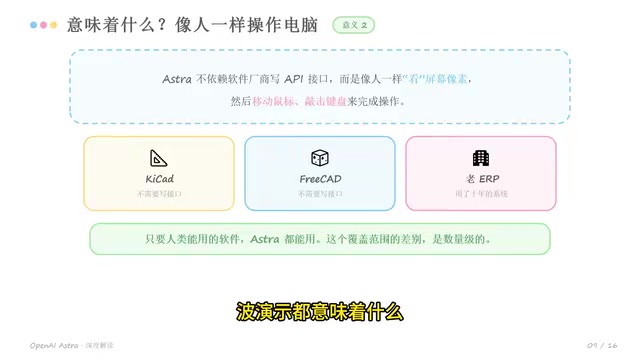
What's truly remarkable about GPT-6 (referred to as "Astral" in demo videos) is that it can autonomously operate a wide range of software — and OpenAI has explicitly stated this is not done through traditional API integrations, but by using multimodal capabilities to visually interpret what's on the computer screen.
In other words, when a model's ability to recognize desktop visuals is strong enough — and its reasoning is sharp enough — it can "look at the screen, think with its brain, and operate with its hands," just like a human. This is seen as the foundational technical value: in theory, any software a human can use, Astral can use too, because it no longer depends on vendors building dedicated interfaces.
Several representative demos were shown:
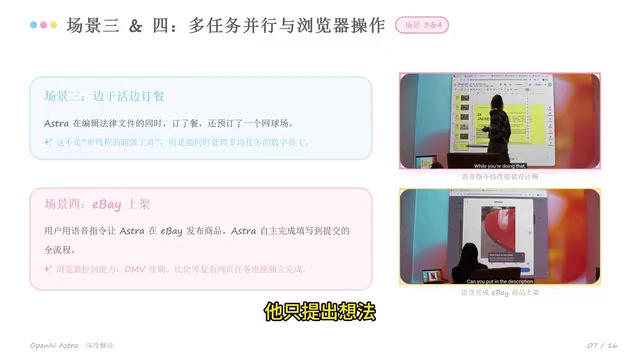
- Rocket model development: The user simply conversed with GPT, which completed diagram generation, detail revisions, invoked a third-party 3D modeling tool, and ultimately produced a digital file ready for 3D printing — all spanning multiple software applications, modalities, and skill sets.
- Designer workflow: A designer only needed to state preferences (e.g., "make the colors brighter" or a particular style), and GPT independently produced the finished design.
- eBay second-hand listing: The user described the product and any caveats; the model logged into the website, filled in the listing, and published it — similar to posting a used item on platforms like Xianyu or Zhuanzhuan.
Benchmark Performance: Results on OS World 2.0
Beyond conceptual breakthroughs, GPT-6's benchmark performance also represents a qualitative leap. According to cited data, Astral achieved a 72.6% success rate on OS World 2.0, completing tasks in roughly 40 minutes on average — compared to nearly 75 minutes for the previous generation, cutting time almost in half while significantly improving accuracy.
On tasks like finding pet care services or organizing job listing information — which require searching, coordinating, and consolidating documents — the AI demonstrated efficiency far exceeding what a human could manage manually. That said, a note of caution is warranted: the dramatic contrasts shown in demos (e.g., "5 minutes 20 seconds vs. 30 minutes") may not reflect real-world use cases, and actual performance will need to be validated once third-party products ship.
GPT-6 also showed impressive results across general intelligence tests, math problem benchmarks, cybersecurity challenges, and computer operation tasks. However, these are OpenAI's own test results — the true capability ceiling won't be established until users can test it themselves after full release.
OS World is an academic benchmark specifically designed to evaluate AI's ability to operate in real computer environments. Tasks cover everyday computer workflows like file management, web browsing, and cross-software collaboration, requiring the model to complete objectives in a full operating system environment — not a sandboxed simulation — with task success rate as the primary metric. Version 2.0 significantly raised the bar in both task complexity and software coverage compared to the original, which makes the 72.6% accuracy particularly meaningful. The benchmark judges whether a task was ultimately completed, not merely whether individual steps were correct — giving it a more realistic signal of an Agent's usability in actual work scenarios.
What This Means for the Industry: The Return of GUI
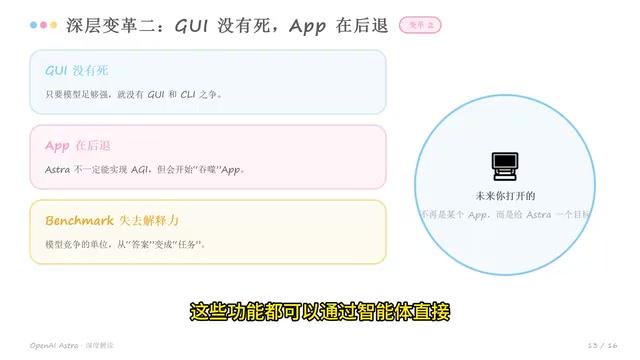
GPT-6's demos send a clear signal to the entire industry. Prior agent development largely required vendors to expose API endpoints before an Agent could interact with their systems — demanding significant development investment. Astral sidesteps all of that by directly recognizing and operating the desktop interface visually.
This creates an interesting reversal: earlier, as multimodal capabilities were limited, many assumed that graphical user interfaces (GUIs) would become less relevant in an AI-dominated future. GPT-6 demonstrates instead that GUI interfaces are perfectly usable by powerful agents — and actually align well with human operating habits. If every company can develop its own product interface independently, then tasks like ordering food — previously requiring dedicated apps — could potentially be handled by an agent navigating a website directly, weakening the need for certain app-specific functions.
This raises the question of how we'll evaluate agents going forward: the focus will shift to whether an agent can complete a goal, rather than staying at the level of text-based back-and-forth. Once you finish communicating your intent to an Agent, it should think independently, invoke the right capabilities, and deliver results — not just offer suggestions. This poses a serious challenge to other agent developers.
An API (Application Programming Interface) is a standardized channel through which software components call each other's functions. For example, if an Agent wants to add an event to a calendar app, it typically needs that app to provide a dedicated API, then sends commands in the prescribed format. This approach is stable and predictable, but requires separate integration work for every piece of software — high in both effort and cost. A GUI (Graphical User Interface) is the visual interface humans use daily — buttons, menus, input fields. GPT-6's approach means that as long as an AI can "read" a screen like a human and simulate mouse and keyboard inputs, it can operate any GUI-based software — completely bypassing the API integration step. If this logic holds, whether a software vendor provides an AI-specific interface will no longer be the deciding factor in what an Agent can or cannot do.
A Rational Take: The Foundation Is There, But AGI Is Still Far Off
OpenAI co-founder Greg Brockman has stated, "We have entered the AGI era." The measured view, however, is cautious: in some sense, GPT-6 has indeed met the baseline conditions for AGI and established the technical foundation for artificial general intelligence within the digital product domain — but it remains a meaningful distance from AGI in the true sense.
There are two layers to this judgment:
First, GPT-6 is currently limited to the digital realm — tasks performable on computers and phones — and cannot yet cross into the physical world.
Second, its support for large numbers of third-party software applications isn't ready out of the box; it requires significant time to train on each one. The good news is that this is a "matter of time," not a fundamental roadblock — the technical approach is proven, and what remains is the painstaking work of training the model to operate each piece of software reliably.
The conclusion, then: GPT-6 is a generational product with the potential to lead a transformation in how we interact with digital devices. In the coming years, we may even see computers operated entirely by voice — no mouse, no keyboard. But calling it AGI in the full sense of the term is still premature. The possibility of this transformation is real; it just needs time to fully materialize.
Related articles

Receipt Forgery Detection Near Random? Real-World Struggles and Solutions in Document Image Forensics
A receipt forgery detection project with ROC-AUC near random reveals the pitfalls of small-sample document forensics. Explores anomaly detection, self-supervised pre-training, and numerical consistency as viable alternatives.

From Workflows to Eval-Driven Development: A Paradigm Shift in How We Solve Problems with AI
AI problem-solving is shifting from deterministic workflows to "define evals + hillclimb." This piece explores how eval-driven development reshapes tasks, data vendors, human roles, and Agent UX.

Tesla Powerwall + Electric Vehicle: A Dual Backup Power Solution for Outages
Tesla Powerwall combined with EV bidirectional charging can provide multi-layer home backup power during outages. We break down runtime, V2H realities, and Supercharger loop feasibility.