Why Is GTNH So Addictive? The Design Philosophy Behind 200 Hours Just to Reach HV
GTNH's addictive design secret: clear goals and visible progress make 200-hour grinds feel rewarding.
A player spent 200 hours reaching the HV stage in GregTech: New Horizons and called it "a more complex Cookie Clicker." This article analyzes how GTNH's combination of clear milestone goals, visible progress feedback, and progressively escalating complexity creates a powerful retention loop — and what product designers can learn from it.
A Single Post That Sparked a Deeper Thought
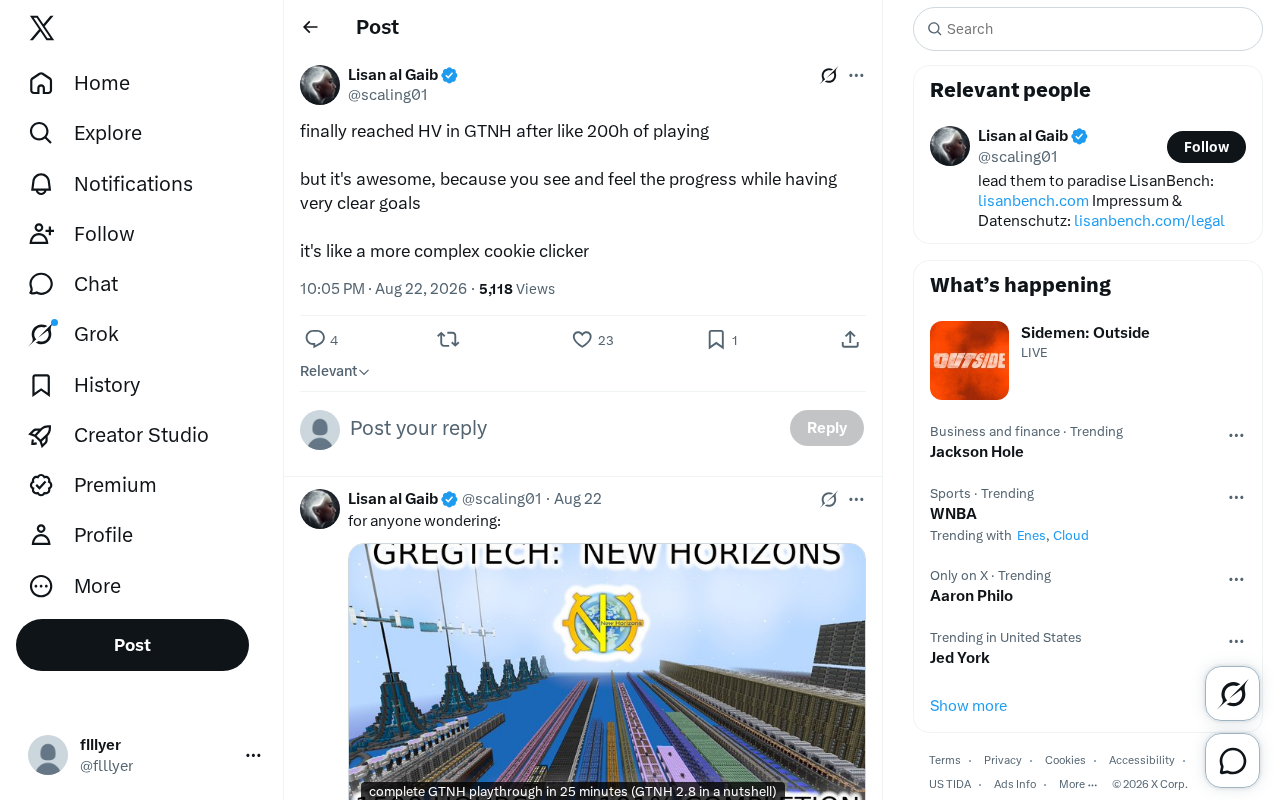
Recently, a gamer shared their progress in GregTech: New Horizons (GTNH) on social media: after investing roughly 200 hours, they had finally reached the HV (High Voltage) tech stage. What seemed like a casual gaming update actually revealed a product design philosophy worth examining closely.
The player wrote: "Although it took about 200 hours to get to HV, it's awesome because you can clearly see and feel your progress while having very clear goals. It's like a more complex Cookie Clicker."
Behind this brief comment lies a deeper design logic involving addiction mechanics, progress feedback systems, and goal-setting. GTNH is widely recognized in the Minecraft modding community as a "hell-tier" modpack — so why are players willing to pour hundreds or even thousands of hours into it? The answer may be more universally applicable than you'd think.
What Exactly Is GTNH: Minecraft's Most Hardcore Modpack
A Tech Progression System Known for Extreme Complexity
GregTech: New Horizons is a massive Minecraft modpack famous across the MC community for its extreme complexity and grueling tech progression curve. It divides technological development into multiple voltage tiers — starting from LV (Low Voltage) and MV (Medium Voltage), through the HV (High Voltage) stage the player mentioned, and continuing to EV, IV, and even higher cosmic-level technologies.
Each voltage tier requires players to build complex automated production lines, work through tedious multi-step crafting recipes, and manage intricate resource chains. According to widespread community feedback, a full playthrough of GTNH typically demands thousands of hours — extreme even by single-player game standards. The fact that a player spent 200 hours just to reach HV perfectly illustrates the game's intimidating depth.
Tracing its history, the GregTech mod was originally created by German modder GregoriusT in 2012 as an addon for IndustrialCraft 2. It was known for drastically increasing crafting recipe complexity and resource processing steps, sparking heated debate in the Minecraft modding community — some players felt it ruined the vanilla experience, while others saw it as the ultimate challenge. The GTNH modpack built upon this foundation by integrating over 300 mods, maintained to this day by an international volunteer team. It's widely regarded as one of the most complex and time-consuming modpacks in Minecraft history. It's precisely this design refinement, honed over more than a decade, that gives it its unique hardcore appeal.
Complexity Designed Around Clear Goals
Here's an important detail: GTNH's complexity is anything but chaotic. Its core design ensures that no matter how convoluted the process gets, players always know "what to do next." Every tech stage has explicit unlock conditions and a tech tree, and every ounce of effort translates into visible progress.
This combination of "clear goals + deep complexity" is exactly what the player meant by being able to "see and feel your progress." From an academic perspective, GTNH's design aligns with Goal Setting Theory, proposed by organizational psychologists Edwin Locke and Gary Latham in the 1960s. Decades of empirical research have shown that specific, challenging goals lead to over 35% higher performance compared to vague "do your best" goals — provided the goals are measurable and accompanied by feedback mechanisms. The game's voltage tier system perfectly satisfies the theory's five core elements: Clarity, Challenge, Commitment, Feedback, and Task Complexity management. GTNH may not have intentionally followed this theory, but its design intuition aligns remarkably well with psychological research findings.
"A More Complex Cookie Clicker": A Spot-On Analogy
The Core Pleasure Mechanism of Incremental Games
The player's comparison of GTNH to "a more complex Cookie Clicker" is remarkably insightful. Cookie Clicker, as a classic representative of the incremental game genre, derives its core appeal from "the positive feedback of continuously growing numbers" — players click, upgrade, and unlock new content, watching the numbers steadily climb at every step.
For context, Cookie Clicker was released by French programmer Julien Thiennot (known online as Orteil) in 2013. Originally just a web experiment, it unexpectedly spawned an entire genre of incremental games. The design core of these games draws on a clever application of the Skinner Box principle — using variable ratio reinforcement schedules to keep players engaged. It later inspired numerous titles including Adventure Capitalist, Clicker Heroes, and Universal Paperclips. Academics categorize these games under "self-efficacy games," where the core attraction lies in transforming abstract numerical growth into a player-perceived sense of mastery and a narrative of personal growth.
GTNH fundamentally shares this underlying psychological mechanism: players gain a continuous sense of progress by building production lines, increasing output, and unlocking new technologies. The difference is that GTNH replaces Cookie Clicker's simple clicking with extremely high operational complexity and strategic depth, delivering a far stronger sense of achievement.
The Psychological Value of Progress Feedback
From a behavioral psychology perspective, this design precisely targets humanity's innate craving for "visualized progress." When players can clearly perceive their leap from LV to MV to HV, the brain continuously releases dopamine, forming a positive reinforcement loop.
Neuroscience research further reveals the deeper mechanism at work. Dopamine is not simply a "pleasure chemical" — it's a neurotransmitter closely tied to "anticipated reward." Stanford neuroscientist Andrew Huberman's research indicates that the dopamine system responds most strongly to "predictable rewards that require effort to obtain" — which is precisely the design logic of GTNH's tech tree. When players know the next voltage tier lies ahead and clearly understand the path to reach it, the brain continuously releases dopamine during the pursuit of the goal (not just upon achieving it). This stands in stark contrast to the addiction pathway of random rewards (like gacha mechanics), which rely more on dopamine's "prediction error" effect. In other words, GTNH delivers a healthier, more sustainable model of psychological motivation.
This also explains why 200 hours of investment doesn't feel tedious but instead feels "awesome" — because reaching each stage is a genuine confirmation of achievement. By contrast, complex games that lack clear goals often leave players feeling lost, ultimately leading them to quit.
Implications for Product Design and User Retention
Complexity Isn't the Enemy — Ambiguity Is
GTNH's success offers a lesson for all product designers: complexity itself doesn't drive users away — what truly causes churn is the feeling of "not knowing where you're headed." As long as goals are clear and feedback is timely, users are willing to accept extremely high learning costs and time investments.
This principle applies equally to software products, learning platforms, and even AI tool design. A feature-rich product with clear guidance will always outperform a simple product that leaves users feeling lost.
The Secret to Long-Cycle User Retention
In today's product landscape obsessed with "instant gratification," GTNH represents a counter-trend design philosophy — it dares to demand massive time investments from users because it understands how to sustain long-term motivation through milestone goals and visible progress.
This "delayed gratification" design philosophy has successful precedents in commercial products as well. Duolingo's language learning path breaks down vast language systems into daily bite-sized lessons, using streak counts and level systems to maintain long-term motivation. GitHub's contribution heatmap transforms a developer's year-round coding activity into an instantly readable matrix of green squares. Strava's milestone system ensures runners can always see their cumulative achievements throughout long training cycles. All these products employ similar phased progress visualization strategies. Notably, this design approach differs fundamentally from the popular concept of "gamification" — gamification often amounts to superficially slapping points and badges onto non-game products, whereas GTNH-style design deeply embeds a sense of progress into every aspect of the core experience, making goal achievement itself the reward.
For any product aiming to improve user retention, this offers invaluable insight: break down a grand ultimate goal into a series of clear, achievable milestones, ensuring users can always feel the forward momentum throughout their long journey.
Conclusion
A single post about game progress inadvertently revealed the core secret of addictive design: clear goals, visible progress, and progressively escalating complexity. GTNH's 200-hour journey proves that truly excellent experience design makes users feel growth through challenge and maintain direction through complexity.
Whether you're a game developer, product manager, or content creator, there's inspiration to be drawn from this "more complex Cookie Clicker" — users are never afraid of difficulty; they're only afraid of losing their way.
Related articles

"Black October": Did AI Uncover 3% of All Critical Vulnerabilities Ever?
A Reddit post claims 3% of all critical software vulnerabilities ever were found in the past month, dubbed 'Black October.' We break down the statistical issues, how AI-assisted code auditing accelerates discovery, and how developers should respond.

Microsoft Project Gecko: Using AI to Bridge Language Gaps for African Farmers
Microsoft's Project Gecko launches PharmaChat, letting African farmers ask questions in their native language and get precise video clips and farming book chapters via AI. The project also releases three interactive manuals to advance inclusive AI.

Musk's Space Dominance: How Starlink Throttling Undermines Ukraine's Defense
SpaceX's Starshield throttling disabled Ukraine's high-speed interceptor drones, exposing how Musk's private control over low Earth orbit communications affects battlefield dynamics and national security, and highlighting the risks of commercial space militarization and space governance dilemmas.