Why Is HTML Exploding in Popularity Again in the AI Era? The Logic Behind Silicon Valley Leaders' Collective Endorsement

AI has made HTML the most efficient communication medium between humans and machines.
Silicon Valley leaders including Karpathy are championing HTML as the essential language of the AI era. Its plain-text format is perfect for LLMs to read and write, browsers provide a secure cross-platform runtime, and 30 years of web data make AI exceptionally fluent in HTML. Combined with AI tools, HTML enables anyone to rapidly build interactive product prototypes without design or coding skills.
Silicon Valley Leaders Rally Behind HTML
Last month, the Claude Code team published a blog post titled "The Unreasonable Effectiveness of Claude Code Writing HTML." This phrasing is actually a nod to physicist Eugene Wigner's classic 1960 paper, The Unreasonable Effectiveness of Mathematics in the Natural Sciences — in which Wigner posed a profound philosophical question: why can mathematics, a product of pure abstract thought, describe the physical world with such precision? The Claude team borrowed this title to suggest that HTML's expressiveness in the AI era far exceeds what people expect from an "old technology."
Shortly after, a wave of Silicon Valley heavyweights retweeted and endorsed the post on Twitter — including former OpenAI co-founder Andrej Karpathy. Karpathy is one of the most influential figures in deep learning. He served as Tesla's AI Director overseeing the Autopilot vision system, and his Stanford course CS231n is widely regarded as the gold standard for deep learning education. In recent years, he has repeatedly championed the concept of "vibe coding" — the idea that non-professional programmers can collaborate with AI using natural language to accomplish programming tasks — and HTML is the ideal medium for this philosophy. His public endorsement is often seen as a signal that a technology is about to go mainstream. Recently, apps like Slack and many other international platforms have also rapidly added support for HTML rendering.
AI can already help you build products, write code, and even edit videos. So why are these people at the very forefront of AI suddenly having a collective discussion about a technology from the 1990s?
The answer is: HTML is not a technology of the past — it is precisely a language you must understand in the AI era.
HTML Never Left: A 30-Year Evolution
HTML was born in 1990 and is now over 30 years old. But it has never stopped evolving:
The 1990s: Sina, Sohu, Yahoo, Facebook, Amazon — all built on HTML. Back then, it did relatively simple things: displaying content and basic interactions.
The 2010s: HTML upgraded to HTML5 and exploded alongside the mobile internet. The HTML5 standard, officially finalized in 2014, brought revolutionary changes: the Canvas element enabled browsers to draw 2D graphics and run games, WebGL supported 3D graphics rendering, WebSocket enabled real-time bidirectional communication, and LocalStorage and IndexedDB provided local data storage capabilities. These APIs transformed HTML from a "document display language" into an "application development platform." Meituan, Didi, WeChat Official Accounts — all powered by HTML behind the scenes. The tech stacks of WeChat Mini Programs and Alipay Mini Programs are essentially variants of HTML5.
Today: Notion, Feishu (Lark), and even Photoshop, Word, and Excel all have web versions. OpenAI's product pages and even SpaceX's control panels use HTML-related technologies. The fact that you can play AAA games, edit videos, and run Photoshop in a browser today is all thanks to HTML5's underlying capabilities.
The entire development of the internet is inseparable from HTML.
Why Is HTML Indispensable in the AI Era?
Reason 1: The Browser Is a Natural Code Runtime Environment
Open Doubao (or any AI assistant) and tell it "make me a Snake game" — it outputs a piece of HTML. Why? Because code needs somewhere to run, and the browser is a natural code runtime environment. Phones, tablets, and computers all have browsers — just drag the HTML file in and it runs immediately.
The browser can play this role because modern browsers have a complete rendering engine and JavaScript engine built in. Take Chrome as an example: it uses the Blink engine to parse HTML and CSS, and the V8 engine to execute JavaScript. V8 uses Just-In-Time (JIT) compilation to compile JavaScript directly into machine code, achieving performance close to native applications. More critically, browsers provide a sandbox security mechanism: code runs in an isolated environment and cannot directly access the user's file system or operating system resources. This means you can safely run AI-generated HTML code without worrying about it damaging your computer. This combination of "security + cross-platform + zero installation" is unmatched by any other runtime environment.
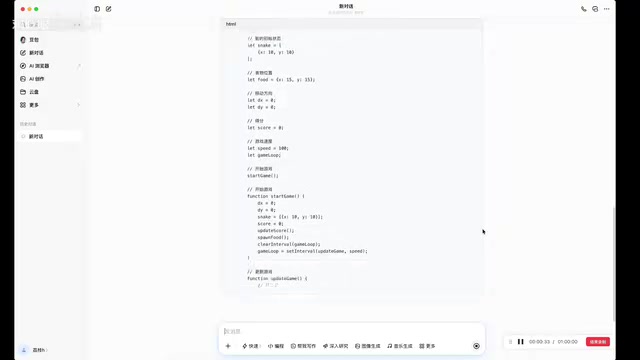
Reason 2: Plain Text Format — AI Reads and Writes It Effortlessly
At its core, AI is a large language model, and what it does best is read and write text. The core mechanism of a Large Language Model (LLM) is sequence-to-sequence prediction based on the Transformer architecture: the model splits input text into tokens, each token maps to a numerical vector, then attention mechanisms calculate relationships between tokens, and finally the model predicts the next most likely token one by one. This means LLMs are naturally adept at processing structured plain text formats.
In the early days of AI collaboration, people used Markdown files because they're plain text with simple syntax. But Markdown has a ceiling: it can only express documents — no buttons, no interactions, no interfaces.
HTML tears down that wall. It's also plain text, so AI writes it just as easily, but its expressiveness far exceeds Markdown — with interfaces, interactions, and animations that make it easy for people to understand what the AI is trying to express. HTML's tag syntax (like <div>, <p>) is essentially text with explicit semantic markers, and models can precisely understand the meaning and nesting relationships of each tag. By contrast, binary formats (like .psd or .sketch design files) are virtually unreadable black boxes for AI — which explains why AI chooses HTML over other formats when generating interfaces.
Reason 3: 30 Years of Data — AI Is Most Fluent in HTML
HTML has accumulated 30 years of data on the internet, and AI training datasets are packed with HTML samples. As a result, AI writes HTML more fluently than any other programming language. You type your request, the browser renders it, and you see results in seconds.
To sum it up, there are two core advantages: one makes it easy for AI to write (plain text), and the other makes it easy for humans to see (visual rendering). HTML is the lingua franca of the digital world — you don't normally think of it as cutting-edge, but whenever you need to communicate with the digital world, you need to know it.
Understand HTML Structure in Three Minutes
Using a Snake game as an example, an HTML file consists of three core parts:

HTML Tags = The Skeleton
Tags typically come in opening and closing pairs. Besides <html>, there are <head> and <body>. When a file ends with .html, the browser uses its HTML rendering engine to parse it. HTML determines what content is on the page.
CSS Styles = The Skin
CSS determines how the entire page looks — colors, font sizes, layout — everything related to appearance is controlled by CSS. Styles are usually placed inside <head> so the appearance can be rendered before the page loads, preventing layout glitches.
In fact, modern CSS capabilities go far beyond simple color and font size settings. CSS Grid and Flexbox provide powerful two-dimensional and one-dimensional layout systems. CSS Animations and Transitions can create smooth 60fps effects. CSS Custom Properties support theme switching. Even some simple interactions — like dropdown menus, accordion folds, and dark mode toggles — can now be achieved with pure CSS, no JavaScript needed. This is especially friendly for AI-generated code, as it reduces code complexity and the probability of errors.
JavaScript = The Muscles
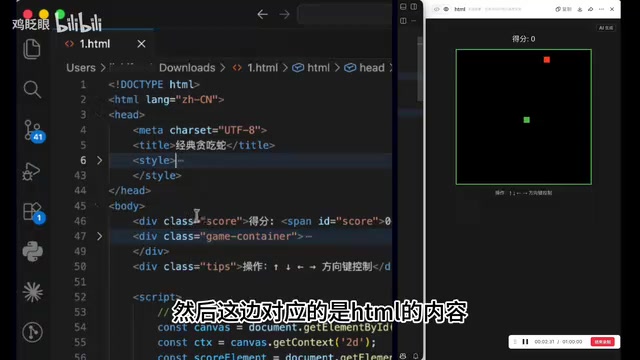
The <script> tag wraps JavaScript, which determines what the page can do — all interactions, clicks, navigation, form submissions, and game logic are defined here. For example, the up-down-left-right movement in Snake is controlled by JS.
Remember these three metaphors: HTML is the skeleton, CSS is the skin, JS is the muscles. Remember these, and you already know more than 99% of non-programmers. Next time AI gives you a piece of code, you can glance at it and immediately identify where the structure is, where the styling is, and where the interactions are.
Hands-On: Building Product Prototypes with AI + HTML
Here's a real-world example. The author previously built a local file management tool called PieceWiki. The first version was a command-line tool aimed at programmers. Now the goal is to turn it into a desktop client that ordinary people can use.
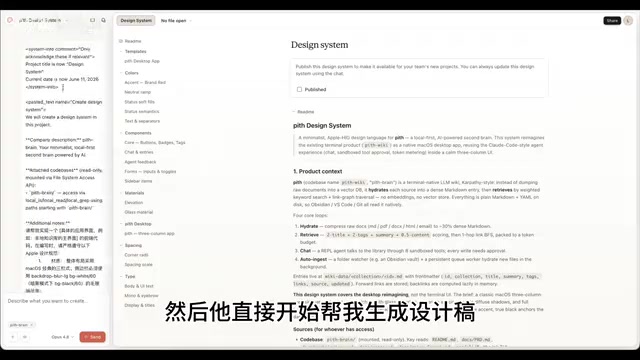
The approach: use Claude Design to create prototypes, sync all existing code to it, and let the AI generate design mockups directly. And every version of the design mockup it generates is essentially a piece of HTML.
This is the most powerful way to use HTML today:
- You don't need to know how to draw, design UI, or understand front-end development
- Just describe your requirements to AI, and it gives you a real, clickable, interactive user interface
- With this interface in hand, you know exactly what the final product will look like
- Then hand the HTML to a local AI and have it translate the interactions into a desktop client format
The "translating into a desktop client" mentioned here has a mature technical pathway. The Electron framework (developed by GitHub) allows developers to build cross-platform desktop applications using HTML+CSS+JavaScript — VS Code, Slack, Discord, and the Notion desktop app are all built with Electron. A lighter alternative, Tauri, uses the system's built-in WebView to render HTML interfaces, with package sizes only one-tenth of Electron's. This means AI-generated HTML prototypes can theoretically be packaged into real desktop applications with nearly zero modifications. This workflow of "AI generates HTML → validate interactions → package as client app" is becoming the standard product development path for indie developers and small teams.
The Logic Behind "Unreasonable Effectiveness"
The phrase the Claude team used — "Unreasonable Effectiveness" — doesn't mean HTML is magical. It means: when you and AI speak the same language, efficiency is amplified exponentially.
You say one thing, AI produces a version; you review it and make tweaks, AI produces another version. After three rounds, while others might still be waiting in line for a designer's availability, your product is already live.
HTML didn't suddenly become popular again — it never left. It's just that this time, AI has made us see its value anew — it is the most efficient communication medium between humans and AI.
Key Takeaways
Related articles

Amphibious Transforming Drone: Beyond 100x Power Savings, What Are the Real Needs?
Is the amphibious transforming drone just a gimmick? Starting from the 100x power difference of the M4 Morphobot, explore real application scenarios and thesis topic ideas, analyzing boundary conditions where pure drones and pure ground robots both fail.

Warhound Raises $200 Million: Genetically Engineered "War Dogs" Paired with Anduril Gear
Warhound raises $200M, backed by Ben Lamm and Palmer Luckey, to genetically engineer dogs for military and law enforcement use and equip them with Anduril gear. This article analyzes its technology direction, funding logic, and ethical controversy.

Claude API Comes to Google Cloud: IAM Integration and SDK Access Guide
Anthropic hosts the full Claude API on Google Cloud with IAM-controlled permissions and unified billing. This guide covers the Vertex AI and Anthropic-hosted entry points, IAM role configuration, and SDK access.