Why Is Skill Breaking Out of Software Development? Uncovering the Underlying Structure of Knowledge Work

Skill transcends software development by encoding the method and judgment at the heart of all knowledge work.
This article explains why the Skill concept — originally rooted in LLM tool-calling and frameworks like Microsoft's Semantic Kernel — is now spreading across legal, finance, research, and beyond. By breaking knowledge work into three cores (knowing what, operating systems, and knowing how), it shows that Skill uniquely encapsulates the hardest part: expert judgment. It also introduces the Skill Library as a future core AI asset and draws a firm line: capability can scale, but professional responsibility cannot be delegated to AI.
From a Programmer's Toy to an Industry-Wide Buzzword
The concept of Skill was first widely discussed in AI coding tools, which led many people to instinctively dismiss it as just another programmer's toy — a fancy Copilot that writes functions and autocompletes code. But reality is shattering that stereotype.
Technical Origins: The Skill concept originally emerged from the fields of Large Language Model (LLM) "Tool Calling" and "Prompt Engineering." Microsoft first systematized it in the Semantic Kernel framework, defining it as a capability unit that encapsulates domain-specific reasoning logic and can be repeatedly invoked by an AI Orchestrator. Unlike a plain API endpoint, a Skill embeds "the sequence and rationale for doing something" — not just "the entry point for doing it." That's precisely what gives it a natural foundation for cross-industry transfer.
Look around and you'll find that document processing, data analysis, design, research, operations, finance, legal — virtually every knowledge-intensive industry is now talking about Skills. This phenomenon points to something critical: Skill doesn't map to any single industry. It maps to the underlying structure shared by all knowledge work. It is "jailbreaking" itself out of the world of code and into the broader organizational landscape.
This article digs all the way down to that underlying structure — examining why Skill can cross industry boundaries and become the operational foundation for an entire organization.
Deconstructing the Three Cores of Knowledge Work
To understand why Skill can sweep across every industry, we first need to take knowledge work apart. The "black box" inside any expert's head, when opened, contains exactly three things:
- Facts and information: what you know
- Tools and systems: what you can operate
- Methods and judgment: how something should be done
Every piece of knowledge work fits within these three categories. Lay them out, and a clear arc of technological evolution comes into focus.
The First Core: Knowing What — From Knowledge Bases to "Data Morgues"
In the past, enterprise knowledge bases were built primarily to solve the problem of storing "what we know" and making it retrievable. But there's a harsh truth: many corporate knowledge bases ended up as glorified "data morgues" — piled high with documents, reports, and historical records, gathering dust, impossible to make sense of when you actually need them.
The Evolution of Knowledge Management: The concept of enterprise Knowledge Management (KM) rose to prominence in the 1990s, grounded in Peter Drucker's theory of the "knowledge worker." Early solutions — represented by Lotus Notes and SharePoint — focused mainly on document storage and retrieval. In the 2010s, tools like Confluence and Notion ushered knowledge bases into the collaborative era. The emergence of RAG (Retrieval-Augmented Generation) technology began connecting knowledge bases to LLMs — but this generation of solutions remained stuck at the level of "retrieving static knowledge," never touching the deeper question of "how to apply knowledge in making judgments." That is precisely the core pain point Skill targets.
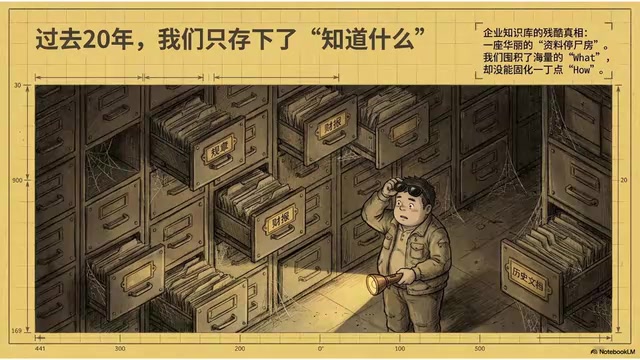
The core problem is this: organizations pour enormous effort into massive volumes of information but almost never codify how that information should actually be used. Knowledge sits there; the craft of applying it can't be preserved anywhere.
The Second Core: Being Able to Operate — Fast Hands, Slow Brain
Over the years, enterprises have progressively solved the "what can be operated" problem through APIs, RPA, and more recently MCP — enabling system-level capabilities to be called directly by programs and AI. It's like outfitting the company with a row of tireless robotic arms: fast and precise.
The Technical Background of RPA and MCP: RPA (Robotic Process Automation) automates repetitive desktop tasks by simulating human mouse and keyboard actions; leading vendors include UiPath and Automation Anywhere. MCP (Model Context Protocol) is an open protocol introduced by Anthropic in 2024, designed to standardize how AI models connect with external tools and data sources. It's been called the "USB port" of the AI era — any tool that implements the protocol can be called directly by an AI model, with no need to build a custom adapter for each one. Both approaches solve the problem of "making systems move," but neither embeds business judgment logic — and that is exactly the gap Skill is trying to fill.
But there's a fatal flaw: fast hands, no brain. These robotic arms are great at standardized tasks. The moment they encounter a non-standard situation requiring a nuanced judgment call, they're completely lost.
The Third Core: Knowing How to Do It — Skill's Real Battleground
Industries have been wrestling with "knowing what" and "being able to operate" for many years. What has never been systematically encapsulated is the hardest third category — method and judgment. And this is precisely what makes Skill genuinely special.
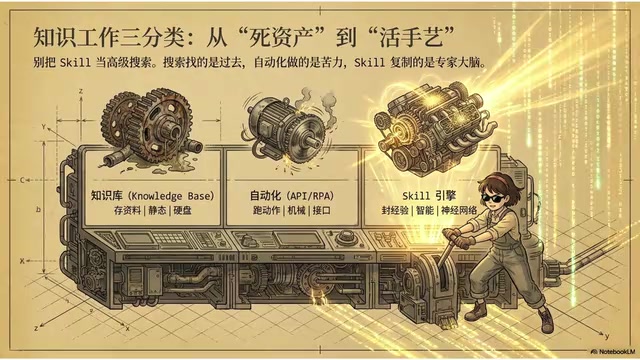
For the first time, Skill systematically encapsulates the real playbook inside the head of the seasoned expert who's been doing this for decades: what to look at first when a problem appears, what to check next, and where you must stop and think. This kind of knowledge was always the hardest to capture, the most valuable, and the most dependent on human intuition. Now it's being placed into a carrier that can be replicated and passed down.
The Essential Contrast Between the Three Cores
Put all three side by side and the differences become immediately clear:
- A knowledge base is a hard drive — it stores static information and answers "what did we know in the past?"
- Automation is machinery — it runs fixed routines and handles repetitive grunt work
- Skill is an engine — it encapsulates experience and replicates an expert's judgment
In one sentence: search finds the past, automation does the heavy lifting, and Skill replicates a person's judgment. The first two store dead assets; Skill stores living craft.
Three Non-Programmer Use Cases: Evidence for Encapsulating "Method"
To make "encapsulating method" more concrete, consider three work scenarios that have nothing to do with programming.
Contract Review Skill
A legal Skill is not about having AI blindly read a contract as a PDF. It is a rigorous "adjudication assembly line": first confirm the contract type, then check the contracting parties and the rights and obligations of each side, then identify breach-of-contract clauses, data provisions, and dispute resolution mechanisms — and finally, most critically, draw a clear red line: which issues must be handed to a human legal professional for judgment, off-limits to AI. What it encapsulates is not the legal text itself, but the sequence and sense of proportion a senior attorney uses when reviewing a contract.
Research Report Skill
Don't imagine you can dump a pile of materials into AI and get a good report. An excellent research report Skill is a "precision simulation engine": it specifies how raw materials are classified, how facts are verified line by line, how conflicting viewpoints are handled, what evidence is required to support a final conclusion, and what structure organizes the entire report. Through two checkpoints — evidence validation and logical coherence — it weaves a tangled mess of materials into a single coherent thread.
Financial Analysis Skill
A competent financial Skill doesn't stop at throwing a spreadsheet at AI and asking it to crunch numbers. It specifies how data is validated, how metric definitions are standardized, how anomalies are flagged, what charting standards apply, and how risk factors are surfaced. Compared to traditional Excel, it has an extra pair of sharp eyes — and one absolute bottom line: never falsify the numbers.
None of these three examples is programmer work, but the logic they encapsulate is identical to that of a code review Skill.
Work That Can Be Skill-ified All Shares the Same Face
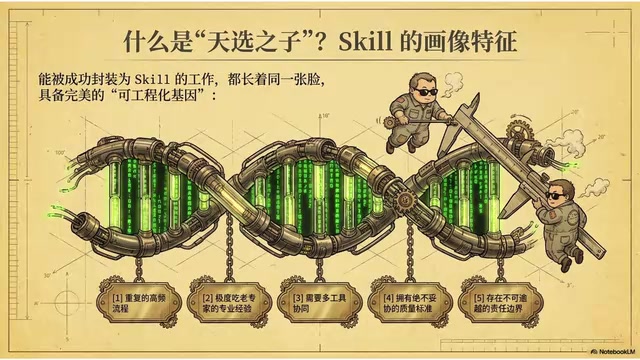
Why do these wildly different types of work look so similar? Because work that can be successfully encapsulated as a Skill all carries five "engineerable genes":
- High-frequency, repeatable processes
- Deep reliance on senior experts' professional experience
- Requires multiple types of information and tools working in concert
- Outputs have non-negotiable quality standards
- Hard responsibility boundaries that cannot be crossed
The Deep Isomorphism Between Engineerable Genes and Software Engineering: Skill's "engineerable genes" concept is deeply isomorphic with "Design for Testability" in software engineering. In software, whether a piece of code can be encapsulated as a reusable module depends on exactly the same factors: whether input/output boundaries are clear, whether logic can be decomposed, and whether exception handling is explicitly defined. Skill transposes this engineering mindset onto human cognitive work — only knowledge work whose processes can be decomposed, standards quantified, and boundaries defined is eligible for Skill-ification. This also explains why highly unstructured work like emotional support or creative inspiration currently remains difficult to Skill-ify effectively.
These five traits are Skill's most characteristic profile. Skill's journey from software into every industry is not a matter of chasing trends — it's because these industries' work was already shaped like something that should be Skill-encapsulated.
A Red Line That Must Be Held: Responsibility Cannot Be Transferred
On that fifth point — responsibility boundaries — a hard brake must be applied. Professional Skills cannot circumvent professional accountability — AI cannot go to prison for you.
A legal Skill cannot substitute for an attorney bearing responsibility for legal advice. A financial Skill cannot bypass final human review. A medical Skill certainly cannot automatically replace a physician's diagnosis. What Skill can do is extend the reach of professional methods — letting more people, in more contexts, access the practitioner's proven approach. But that final 1% of high-risk decisions must still be owned, and signed off on, by a qualified human. Remember these eight words: capability can be amplified; responsibility cannot be transferred. The deeper you go into professional domains, the more tightly this line must be held.
AI Engineering's Identity Shift: From the Back Room to the Organizational Foundation
Pull back to a higher vantage point and something even larger becomes visible: Skill's exit from software development signals a fundamental identity shift underway in AI engineering.
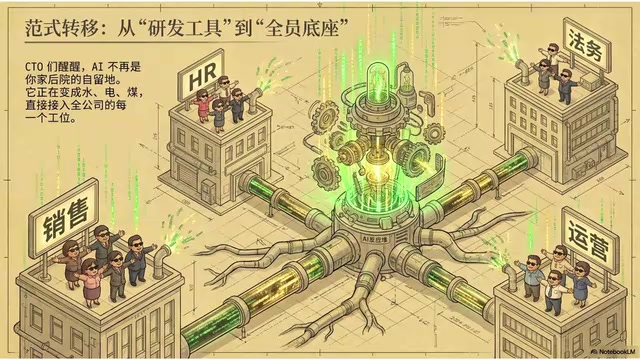
AI engineering used to be the "private garden" of R&D departments and technical teams. Now it is becoming infrastructure as fundamental as electricity and running water — plugging directly into HR, legal, sales, and operations, into every workstation across the entire company. It has transformed from a programmer's tool into the operational foundation for the whole organization. That is a significant inflection point.
The Core AI Asset of the Future: Skill Library
This leads to a clear conclusion: the core AI assets of future enterprises may not be limited to models, API accounts, and knowledge bases. A new entry will be added — a validated Skill Library.
A Skill Library and a knowledge base are fundamentally different in meaning: a knowledge base records "what we know" — the stockpile sitting on the hard drive. A Skill Library records "how we do things well" — the mastercraft refined through thousands of iterations. One stores knowledge; the other stores capability.
Skill Library and the Theory of Organizational Moats: The concept of a Skill Library aligns closely with the Resource-Based View (RBV) at the strategic level. RBV holds that the source of sustainable competitive advantage is resources that are Valuable, Rare, Inimitable, and Non-substitutable (the VRIN framework). Compared to data and models, business-validated Skills precisely satisfy the "inimitable" criterion — they sediment years of an organization's accumulated tacit experience and judgment logic. Even if a competitor gains access to the same foundation model, they cannot rapidly replicate this validated way of doing things. This creates an interesting digital-age echo of the Toyota Production System (TPS), where people and processes are deeply bound together: the real moat has never been the asset itself, but the way the asset is used.
What truly constitutes a moat — what competitors can't steal or copy — is precisely the latter: capability.
Conclusion
Skill's departure from software development is no accident. Because all knowledge work fits within the same three categories — knowing what, being able to operate, and knowing how — and Skill fills in exactly the third category that was always hardest to encapsulate: method and judgment. It gives an organization not just a knowledge base, but a Skill Library of how things get done.
But always remember the red line: capability can be amplified; professional responsibility cannot be transferred. As organizations accumulate more and more Skills, will we still need traditional software? Are GUI interfaces destined for the museum? These questions deserve serious reflection from every knowledge worker — and in your own industry, what is the "soul" that most urgently needs to be Skill-ified?
Key Takeaways
Related articles
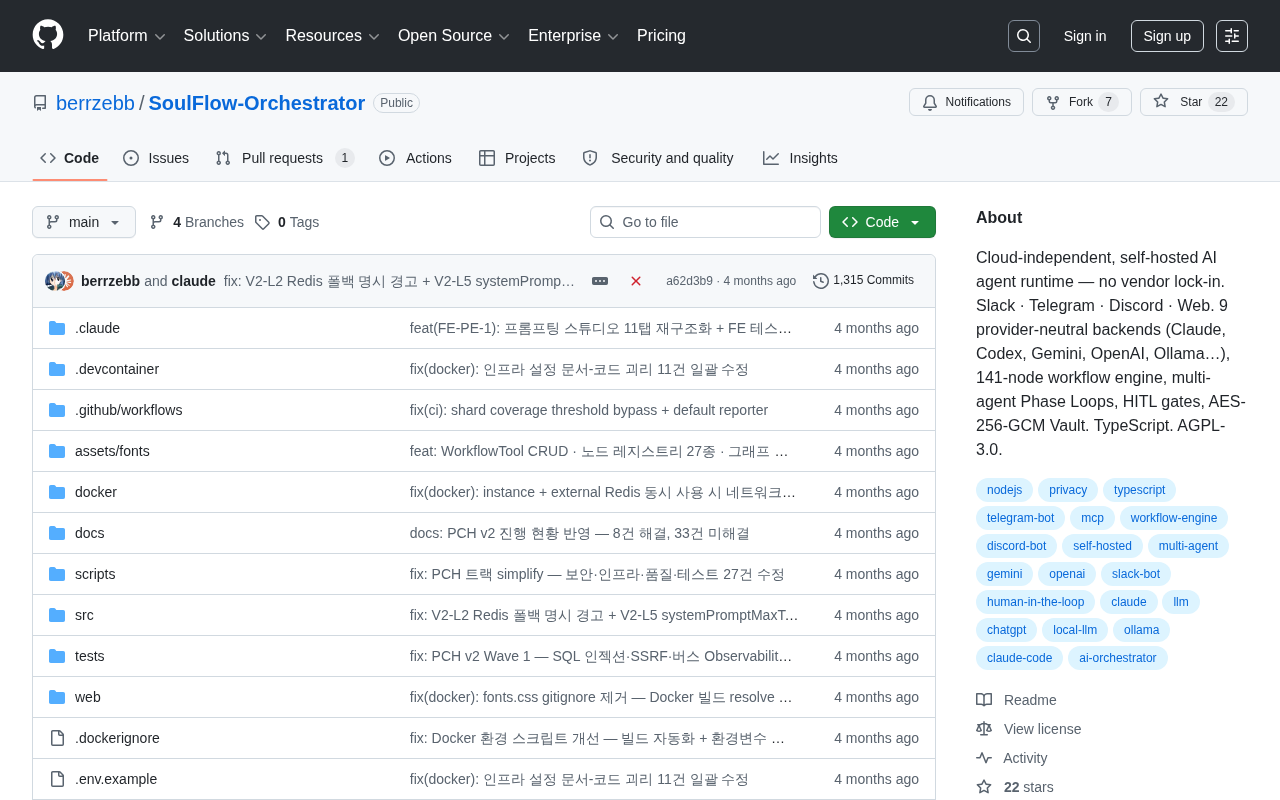
SoulFlow-Orchestrator: A Self-Hosted, Vendor-Lock-In-Free AI Agent Runtime
SoulFlow-Orchestrator is an open-source, self-hosted AI agent runtime with no vendor lock-in. Supports 9 neutral backends (Claude, OpenAI, Ollama), 141-node workflow engine, multi-agent loops, and HITL gates.
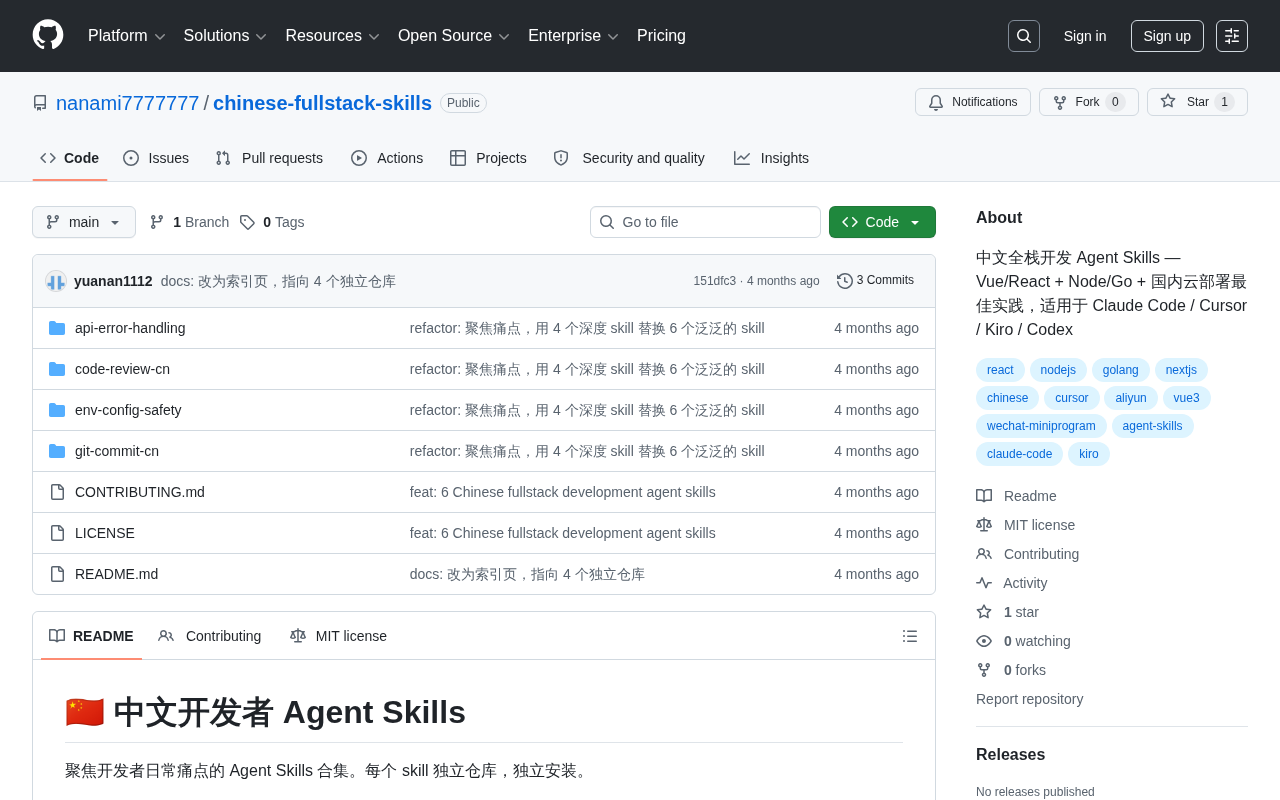
Chinese Full-Stack Agent Skills: A Skill Library Tailored for Domestic AI-Assisted Development
chinese-fullstack-skills is an Agent Skills library for Chinese full-stack development, covering Vue/React, Node/Go, and domestic cloud deployment best practices. Compatible with Claude Code, Cursor, Kiro, and Codex.
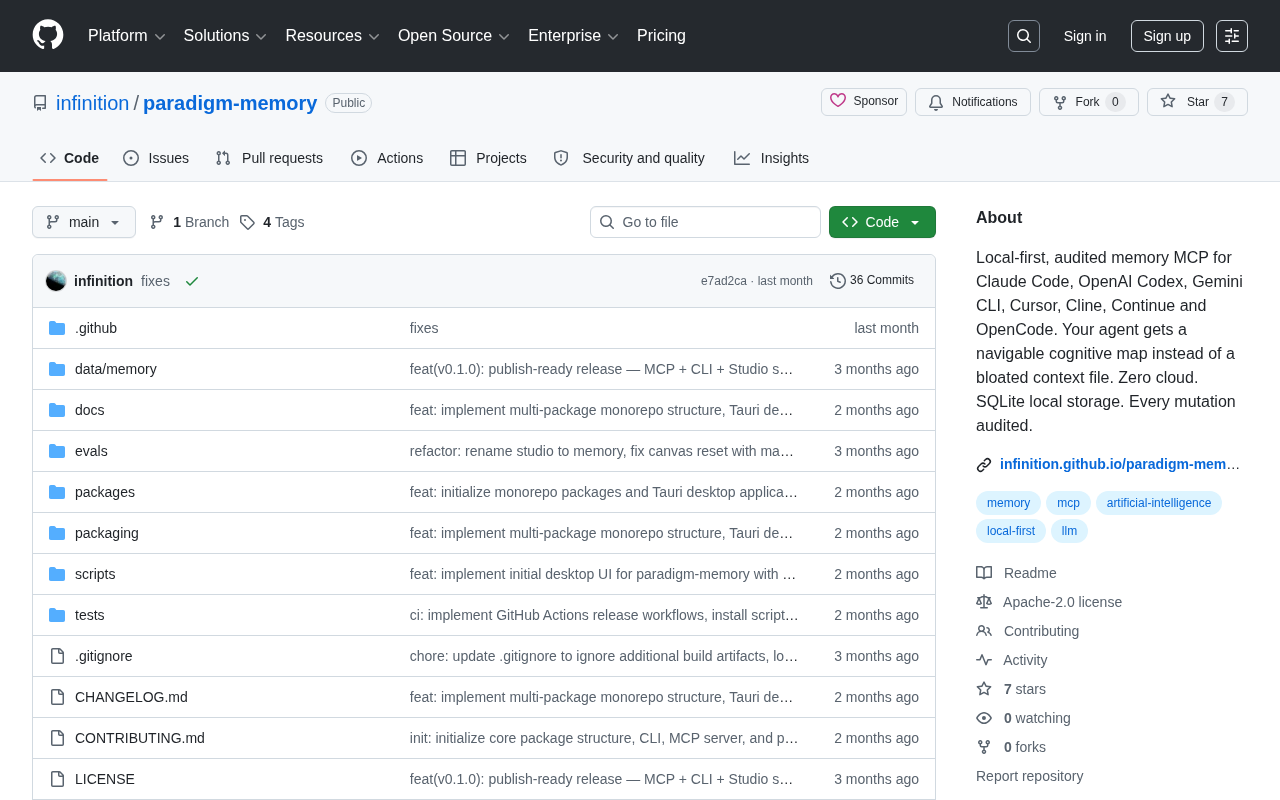
Paradigm Memory: A Local-First Memory System for AI Coding Assistants
paradigm-memory is a local MCP memory tool for Claude Code, Cursor, and Cline. It uses SQLite local storage, zero cloud, full audit trails, and a navigable cognitive map instead of bloated context files.