Why Mainstream Programming Languages Urgently Need Formal Verification Capabilities

Should mainstream languages have built-in formal verification? A structural discussion on reliability engineering.
Starting from a Hacker News discussion on whether mainstream programming languages need built-in formal verification, the article analyzes why formal verification has long been marginalized: fragmented toolchains, steep learning curves, and the tension between verification costs and development efficiency. It argues for native language support—embedding correctness into type systems or semantic layers and reusing existing IDE and debugging infrastructure—citing Rust's ownership model as an illuminating case. It compares progressive versus full verification and notes that extending contracts or dependent types on existing languages may be more pragmatic than building new ones. Finally, it highlights that static analysis, type checking, and property-based testing are permeating verification thinking, and developers should prepare methodology in advance.
Starting from a Hacker News Discussion
A discussion-provoking topic appeared on Hacker News: whether mainstream programming languages need built-in formal verification capabilities. The original post was titled "The need for a formally verifiable mainstream programming language." Although it didn't gain much initial traction, it touches on a long-standing deep contradiction in software engineering—we rely on increasingly complex software systems, yet lack mathematical-level reliability guarantees.
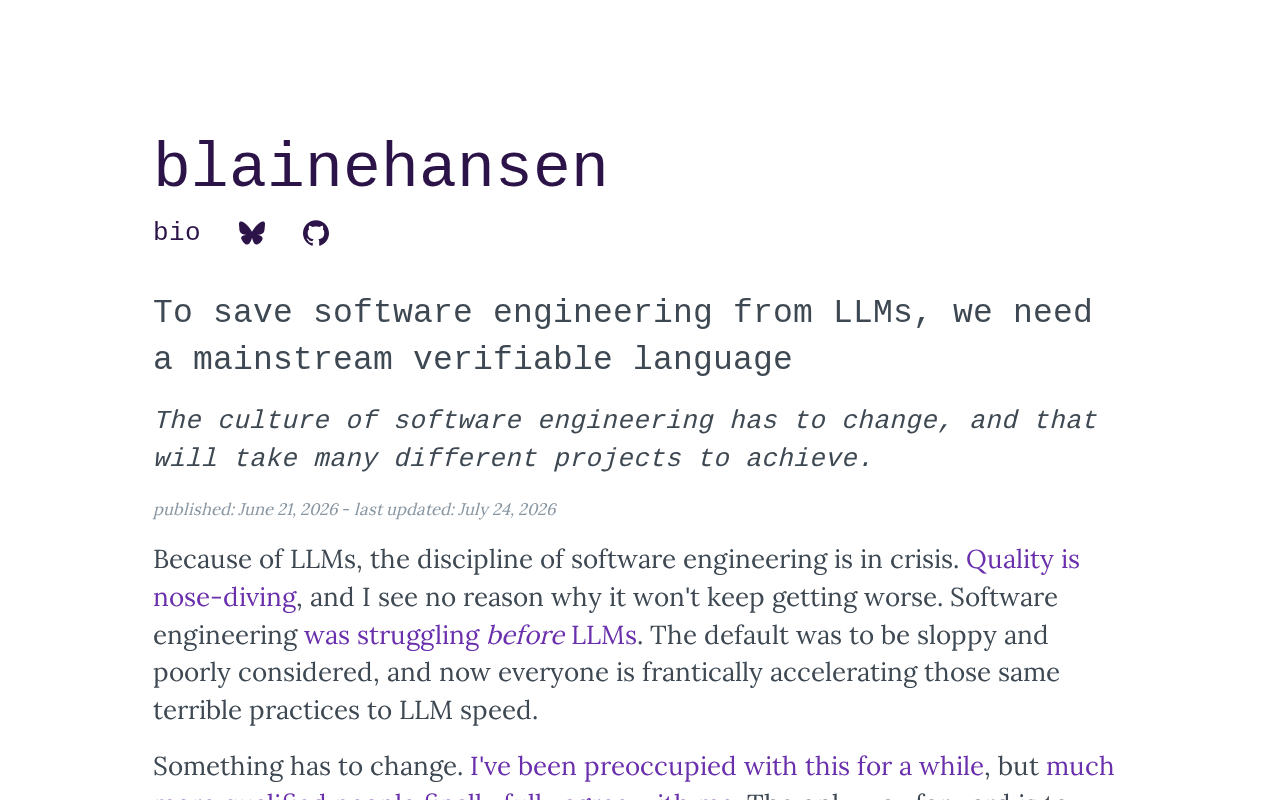
This question didn't arise by chance. As critical infrastructure, autonomous driving, and financial trading systems demand ever-higher software correctness, the limitations of traditional testing methods become increasingly apparent. Formal verification aims to mathematically prove that programs satisfy specific specifications, but for a long time it has been regarded as an academic toy or a luxury for high-security domains, with a chasm separating it from mainstream development practice.
The Real-World Dilemmas of Formal Verification
Steep Learning Curve and Fragmented Toolchains
The core idea of formal verification is to replace exhaustive testing with logical reasoning, but existing tools such as Coq, Isabelle, and TLA+ often require developers to have a solid foundation in mathematical logic. These tools are almost completely disconnected from mainstream language ecosystems (such as JavaScript, Python, and Java), forcing developers to switch back and forth between two systems at high cost. According to viewpoints in the HN discussion, the lack of an integrated "mainstream language + formal verification" solution is a key factor hindering the technology's adoption.
The Tension Between Verification Cost and Development Efficiency
Writing verifiable specifications itself requires considerable effort, and the verification process may introduce additional proof burden. For fast-iterating commercial projects, this overhead is often hard to bear. An implicit consensus in the discussion is: if formal verification cannot be lowered to a threshold acceptable to ordinary engineers, it will forever remain confined to niche scenarios.
The core of formal verification is the specification: using precise mathematical language to describe what a program "should do," then verifying through provers or model checking tools whether the implementation satisfies that specification. Common technical approaches include theorem proving (such as Coq and Isabelle, where humans guide proof search), model checking (such as TLA+ and SPIN, which exhaustively explore finite state spaces), and abstract interpretation (such as Astrée, which statically derives approximate invariants). Different approaches vary greatly in automation and scalability: model checking is fully automatic but limited by state explosion, while theorem proving is highly expressive but heavily dependent on human effort. Understanding this spectrum helps determine which verification method suits a given type of system.
Why Mainstream Languages Need Native Support
Making Correctness a Default Property
If a mainstream programming language incorporates formal verification into its type system or semantic layer from the outset, developers can naturally obtain partial correctness guarantees during everyday coding. Rust's ownership model is an illuminating example—it eliminates data races at compile time through the type system. Although it doesn't perform complete formal verification, it demonstrates how "language-level constraints" can improve reliability with low friction.
Dependent types are the key mechanism that enables a type system to carry arbitrary mathematical propositions: types can depend on values, such as "a vector of length n," thereby expressing properties like "the sorted array is ordered" at the type level. Languages such as Idris, Agda, and F* achieve "proofs as programs" through this approach. In contrast, contracts are a lighter-weight solution, such as Eiffel's design by contract or Dafny's pre/post-conditions, where the compiler generates runtime checks or static verification conditions. The design space also includes refinement types (such as Liquid Haskell) and separation logic (for verifying heap operations). The trade-offs these mechanisms make between expressiveness and decidability directly determine whether a language can be adopted in mainstream engineering.
Reducing the Marginal Cost of Verification
When verification capabilities are built into the language and toolchain, specification writing, proof assistance, and counterexample generation can all reuse existing IDE and debugging infrastructure. Developers don't need to learn a separate proof language, and verification activities can be progressively embedded into the development workflow—starting with critical functions and gradually extending to modules.
Possible Paths and Controversies
Progressive Verification vs. Full Verification
A pragmatic approach is to support progressive verification: developers can apply rigorous proofs to core modules while retaining traditional testing for non-critical paths. This hybrid model lowers the adoption barrier but also raises trust boundary issues when specification coverage is incomplete. Another viewpoint advocates more aggressive full verification, but the HN discussion clearly shows disagreement on this—the engineering feasibility of full verification remains questionable.
Progressive verification already has engineering precedents. Dafny allows specifications to be annotated on some methods while skipping verification for others; F* supports interoperability between verified modules and unverified OCaml/JavaScript code; tools like Rust's Miri and Kani attempt to layer formal checking on top of existing ecosystems. The key challenge of such approaches is the trust boundary: once unverified code is called, proof conclusions no longer cover the entire system, and interface contracts are needed to clearly delineate the assumptions of verified versus unverified regions. Academic research on "verified compilation" (such as CompCert) and "staged verification" precisely attempts to control verification costs while guaranteeing trustworthiness.
Compatibility with Existing Language Ecosystems
Brand-new languages face the cold-start problem of ecosystem building. A more feasible direction may be to extend verification capabilities on existing mainstream languages, for example through annotations, contracts, or optional dependent type systems. But language designers need to make difficult trade-offs among expressiveness, decidability, and usability. According to insights from the discussion, the lack of unified standards and interoperable specification languages is one of the root causes of the current fragmentation.
What This Means for Developers
Even if formal verification doesn't become mainstream immediately, related concepts are permeating everyday tools—static analysis, type checking, and property-based testing can all be seen as lightweight practices of verification thinking. Paying attention to this field helps developers build up methodology in advance as reliability requirements increase. For teams building critical systems, assessing the applicable boundaries of formal verification may be more realistic than waiting for a "perfect language" to appear.
Although this discussion was small in scale, it precisely hits a structural gap in software engineering: the systems we build increasingly resemble infrastructure, yet the tools we build them with remain at a "best-effort" level of reliability. Closing this gap requires not only academic breakthroughs but also the coordinated evolution of language design, toolchains, and engineering culture.
One-line Summary
Whether mainstream languages should have built-in formal verification capabilities sparks a structural discussion about reliability engineering.
Paragraph Summary
Starting from a Hacker News discussion about whether mainstream programming languages need built-in formal verification, the article analyzes why formal verification has long been marginalized: fragmented toolchains and mainstream ecosystems, steep learning curves, and the tension between verification costs and development efficiency. The article argues for the value of native language support—embedding correctness into type systems or semantic layers, reusing existing IDEs and debugging infrastructure, reducing the marginal cost of verification, and citing Rust's ownership model as an illuminating case. On path selection, the article compares the engineering feasibility divide between progressive verification and full verification, noting that extending contracts, annotations, or dependent types on existing languages may be more pragmatic than building entirely new languages. Finally, it emphasizes that lightweight practices such as static analysis, type checking, and property-based testing are permeating verification thinking, and developers should build up methodology in advance.
Related articles

A 19-Year-Old's Rental Horror Story: Ceiling Collapse, Bug Infestation, and the Lessons It Taught Me
At 19, my first off-campus rental brought bug infestations, no heat, a collapsed ceiling, and a ruined laptop with no renter's insurance. Here are the hard-won lessons for first-time student renters.

Veda Nurse's Cranial Nerve Exam: Why ASMR Role-Play Is Going Viral
Bilibili creator Veda's cranial nerve exam ASMR video goes viral, blending humor and sensory triggers through nurse role-play. This article analyzes its unique appeal and the audience psychology behind ASMR role-play.

LG Cinebeam AI Review: 120-Inch Giant Screen + 3000 Lumens, a New Choice for the Living Room Theater
LG Cinebeam AI projector review: 3000 ANSI lumens, 4K, 100 inches from about 8 cm and 120 inches from about 18 cm. Built-in webOS, AI Concierge voice recommendations, AI Sound Pro 11.1.2 virtual surround, and Game Optimizer—positioned for fixed living room installation, complementing the portable Cinebeam S.