Why Nobody Uses AI Agents to Order Takeout: A Sober Look at DoorDash Orders

A Hacker News discussion reveals almost no one uses AI agents for takeout ordering, reflecting the gap between technical feasibility and scenario viability.
A Hacker News post notes that almost no one uses AI agents to order DoorDash takeout, resonating in 33 comments. The article argues that takeout ordering has a short decision chain and low error tolerance, so AI agent intervention increases comprehension costs and risks; payment authorization involves mental accounting and trust thresholds, and users instinctively resist agents spending money; platform ecosystems are closed, leaving third-party agents to fragile simulated clicks. For AI agent entrepreneurs, technical feasibility doesn't equal scenario viability—suitable scenarios need long task chains, high decision complexity, and strong user willingness to authorize. Long-chain, high-cognitive-load tasks like coding assistance and itinerary planning are where opportunities lie.
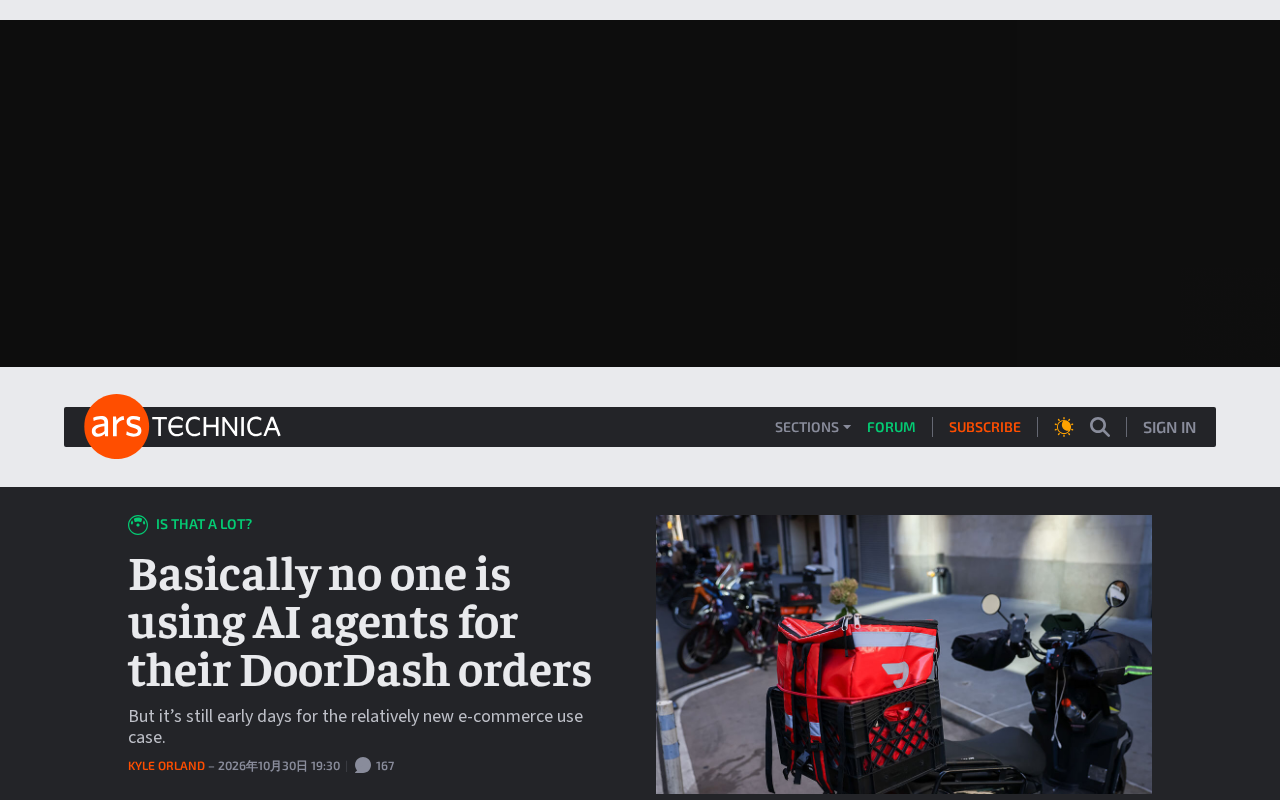
Recently on Hacker News, a post titled "Basically no one is using AI agents for their DoorDash orders" sparked discussion, garnering 31 points and 33 comments. The title bluntly points out a phenomenon: despite the hype around AI agents, in everyday scenarios like ordering takeout, almost no one actually lets AI do it for them.
A Counterintuitive and Little-Known Fact
Amid the flood of promotion for AI coding, automated workflows, and intelligent assistants, it's easy to get the illusion that AI agents have permeated every aspect of life. But the specific scenario of DoorDash orders acts like a mirror, reflecting the gap between ideal and reality. The post doesn't provide specific usage rate data, but judging from the absolute phrasing of the title and the resonance in the comments, this is not an isolated phenomenon but a widespread state of affairs.
The key here is that ordering takeout is a behavior with a "very short decision chain and extremely low error tolerance." Users open the app, choose a restaurant, pick dishes, confirm the address and payment—the whole process is completed within minutes. Bringing in an AI agent may actually increase the comprehension cost—it needs to know your taste preferences, budget, dietary restrictions, and accurately handle the payment process. If any link goes wrong, the trouble far exceeds the time saved.
Why AI Agents Don't Fit the Takeout Scenario
The Need Itself Doesn't Hold Up
Many people's motivation for using AI agents is "saving time," but the time cost of ordering takeout is inherently low. The truly time-consuming part is "deciding what to eat," and that's precisely what AI is worst at—it doesn't know how hungry you are right now, your mood, or what's still in your fridge. The discussion in the comments points to this too: users don't need an agent to order for them; they need better recommendations and less decision fatigue.
Decision Fatigue is a concept in psychology referring to the gradual decline in decision quality and willingness after a person makes a large number of consecutive choices. When ordering takeout, users face multi-dimensional combinatorial choices involving restaurants, dishes, flavors, delivery times, and more. This kind of low-value but high-frequency decision is precisely the most likely to trigger fatigue. If an AI agent merely "executes" the order for the user, it cannot alleviate decision fatigue; what's truly valuable is helping users narrow down their choices and providing personalized recommendations, thereby reducing cognitive load. This is also why users in the comments want "better recommendations" rather than "automatic ordering."
Trust and Authorization Are Hard Thresholds
Letting an AI agent complete a real payment means handing over your address, payment method, and even account permissions. Against the backdrop of frequent security incidents, users are extremely wary of such authorization. In the discussion sparked by the post, many commenters have an instinctive resistance to "letting an agent spend money for me." This is not a technical capability issue but a mental accounting issue—for small, high-frequency purchases, users prefer to stay in control themselves.
Mental Accounting, proposed by behavioral economist Richard Thaler, refers to how people psychologically categorize funds into different accounts and adopt different attitudes and rules for spending from each. In the takeout scenario, users tend to view daily dining expenses as a mental account of "high-frequency, small-amount, requiring immediate control," making them especially sensitive to AI agents paying on their behalf. By contrast, for large, low-frequency, or planned expenditures (such as travel bookings), users may be more willing to authorize an agent to handle them. Understanding the differences in mental accounting helps determine which payment scenarios are more likely to be accepted by users.
Platform Ecosystems Don't Welcome Third-Party Agents
From the platform's perspective, the core assets of services like DoorDash are user data and the closed transaction loop. Opening APIs to third-party AI agents amounts to handing over the gateway to someone else, while also bearing the customer service costs of agent errors. Without cooperation from the platform side, agents can only operate through fragile methods like simulated clicks, and the experience naturally suffers.
Screen Scraping / UI Automation refers to completing tasks by programmatically simulating a user's clicks, typing, and other operations on a graphical interface when no official API is available. This approach is extremely fragile: once the app interface updates, or CAPTCHAs or risk control policies are added, the agent fails; at the same time, simulated clicks may violate the platform's terms of service, posing legal and account-ban risks. For entrepreneurs relying on third-party agents, the lack of official platform APIs means always operating in a "gray zone," making it difficult to build a stable and reliable product experience.
Implications for AI Agent Entrepreneurs
This little-known fact is worth heeding for every team building AI agents: technical feasibility does not equal scenario viability. Whether a scenario suits AI agents must meet at least three conditions—the task chain is long enough, the decision complexity is high enough, and users' willingness to authorize is strong enough. Takeout ordering is unfavorable on all three counts. Instead, tasks like coding assistance, itinerary planning, and data organization—"long-chain, high cognitive load" tasks—are more likely to embody the value of agents.
This post on Hacker News is valuable not for talking down AI agents but for reminding us: real product opportunities often hide in the links where "users are already willing to endure the hassle." Rather than force agents into high-frequency, low-value scenarios, it's better to look for places where users actively seek help.
FAQ
Can AI agents not be used for takeout at all? Currently, the usage rate of standalone agents is extremely low, but in features like smart recommendations and one-click reordering launched officially by platforms, AI is already participating in a more lightweight way.
Why don't users trust AI agents with payments? The core issue is unclear responsibility. When an agent places a wrong order or overcharges, it's difficult for users to trace and defend their rights, and this uncertainty suppresses willingness to authorize.
Which scenarios are more suitable for AI agents? Scenarios with many task steps, scattered information, and the need for cross-app coordination—such as travel planning, code debugging, and report compilation—show more obvious gains from agents.
One-line Summary
A Hacker News discussion reveals that almost no one uses AI agents for takeout ordering, reflecting the gap between technical feasibility and scenario viability.
Paragraph Summary
A Hacker News post points out that almost no one uses AI agents to order DoorDash takeout, sparking resonance in 33 comments. The article analyzes that takeout ordering has a short decision chain and low error tolerance, and AI agent intervention actually increases comprehension costs and risks; payment authorization involves mental accounting and trust thresholds, and users instinctively resist letting agents spend money; platform ecosystems are closed, and third-party agents can only operate through fragile methods like simulated clicks. For AI agent entrepreneurs, technical feasibility does not equal scenario viability. Scenarios suitable for agents must meet three conditions: long task chains, high decision complexity, and strong user willingness to authorize. Long-chain, high-cognitive-load tasks like coding assistance and itinerary planning are where the opportunities lie.
Related articles

MiniMax H3 Image Open-Source Hands-On: 16 Reference Images, Poster Typography, and Agent-Based Image Generation Explained
Hands-on review of MiniMax's open-source H3 Image model: compared with GPT, Gemini, and Doubao on Chinese poster typography, 16 reference images, exploded views with Chinese labels, plus API integration with DeepSeek Harness for Agent-driven generation and recoloring.

DeepSeek Open-Sources Harness: A Plugin-Based Dev Tool with 270K Stars
DeepSeek's official open-source Harness hits 270K GitHub stars, written in TypeScript under MIT. We break down its plugin architecture, multi-model comparison, four use cases, and a three-step start.

New Claude Code Workflow: 9 Open-Source Skill Packs Take Over the Entire PR Lifecycle
Theo open-sources 9 AI agent skill packs for Claude Code and Codex, covering test verification, multi-model code review, PR submission, CI fixes, and auto-merge, with the main skill proving the problem first and humans retaining final merge authority.