Why Robots Haven't Had Their 'ChatGPT Moment' Yet — An NVIDIA Expert Will Explain
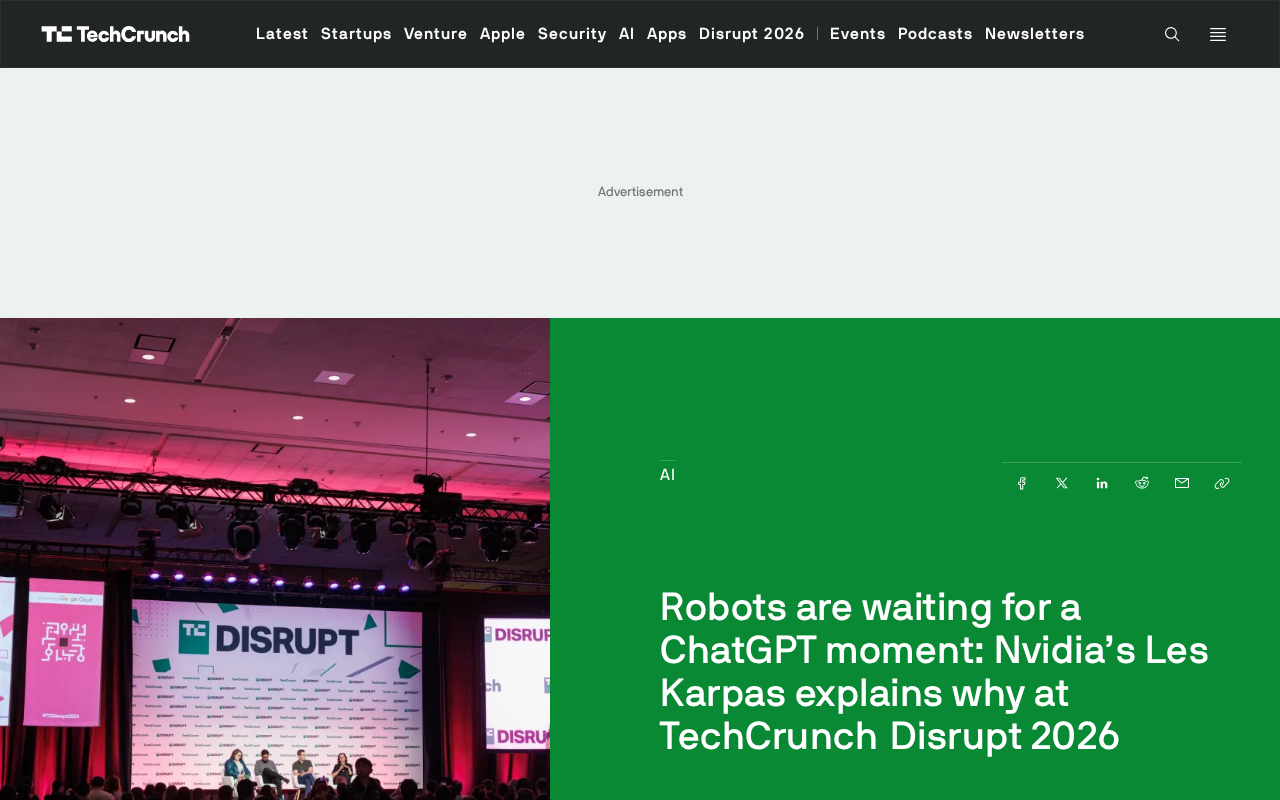
Data scarcity and hardware limitations are keeping robotics from its ChatGPT-style breakthrough moment.
Despite generative AI's explosive growth since ChatGPT, robotics has yet to reach its own inflection point. The core reason lies in physical-world complexity: unlike software AI, robots face perception, motion control, and force-feedback challenges, with real-world training data scarce and costly to collect. Companies like NVIDIA are bridging the gap through simulation training and synthetic data via platforms like Isaac, while hardware reliability and safety constraints slow iteration. Industry consensus holds that the breakthrough won't come from a single product, but from the convergence of foundation models, simulation data, and hardware cost maturity. NVIDIA's Les Karpas will address this at TechCrunch Disrupt 2026.
The Robotics Industry Is Still Waiting for Its 'ChatGPT Moment'
Generative AI has sparked a cognitive revolution over the past few years — ChatGPT gave everyday users their first tangible glimpse of what large models can do, and sent the entire industry into exponential growth mode. Yet in robotics, that critical inflection point — the one that makes technology truly accessible to the masses — still hasn't arrived.
NVIDIA's Les Karpas will take the stage at TechCrunch Disrupt 2026 to share his perspective on "why robots haven't had their ChatGPT moment yet." The question itself captures the core anxieties and aspirations driving the Embodied AI space today.
Embodied AI refers to the research direction of embedding intelligent systems into robots or agents that have physical bodies and can interact directly with the real world — as opposed to software AI that operates purely in digital space. The central thesis is that truly general intelligence can only emerge through continuous perception-action loops with the physical world, and that offline data like text or images alone is insufficient for learning skills like manipulation, navigation, and collaboration. The concept has regained momentum in recent years as large model capabilities have advanced — researchers are now exploring the use of vision-language models (VLMs) as a robot's "brain," providing semantic understanding and task planning, combined with low-level motion control for end-to-end intelligent operation. This has become the dominant technical paradigm in Embodied AI research today.
Why a Robotics Breakthrough Is Harder Than It Looks
Software AI spread so quickly in large part because data was abundantly available and deployment had near-zero marginal cost — a conversation, an image, and a model can scale its capabilities infinitely in the cloud. Robots, by contrast, must contend with the physical world, facing a complex web of challenges including perception, motion control, force feedback, and environmental adaptation.
Data scarcity is one of the core bottlenecks. The internet provides vast amounts of text and images for training language and vision models, but real-world interaction data for robot manipulation is extremely limited and expensive to collect. This is precisely why companies like NVIDIA have made heavy bets on simulation training and synthetic data in recent years — having robots "practice" millions of times in virtual environments to compensate for the lack of real-world data.
Beyond data, hardware reliability, cost, and safety requirements make it far harder for robots to iterate and scale the way software does. A language model making a mistake produces a wrong sentence; a robot making a mistake can cause physical harm.
Simulation training and synthetic data represent the industry's primary response to data scarcity. The core logic is "sim-to-real transfer": inside high-fidelity virtual physics engines, robots can practice grasping, walking, obstacle avoidance, and other tasks millions of times at minimal cost, then use techniques like domain randomization to generalize to real-world environments. The main challenge is the "sim-to-real gap" — virtual environments still don't perfectly replicate real-world friction, deformation, and lighting conditions, which means policies that perform well in simulation often degrade significantly on real robots. In recent years, improvements in physics engine fidelity and mixed training with real-world data have gradually narrowed this gap, though it has not been fully closed.
NVIDIA's Role in the Embodied AI Landscape
As the central supplier of AI compute, NVIDIA's presence in robotics extends well beyond chips. From the Isaac platform for robot simulation to foundational model research targeting Embodied AI, NVIDIA is positioning itself to provide the industry with a complete "training–simulation–deployment" technology stack.
Les Karpas, as the relevant lead at NVIDIA, carries significant weight as an industry bellwether. The core question he'll be addressing — when and how robots will hit their inflection point — directly informs the decisions of countless startups, investors, and manufacturing enterprises.
Notably, the prevailing view in the industry is that robotics' "ChatGPT moment" may not arrive in the form of a single product, but will instead emerge gradually as foundation models, simulation data, and hardware costs mature in concert.
The Isaac platform is NVIDIA's end-to-end toolchain for robot developers, encompassing Isaac Sim (a high-fidelity robot simulation environment built on Omniverse), Isaac ROS (a hardware-accelerated compute graph for ROS 2), and Isaac Lab (a training framework for reinforcement learning and imitation learning), among other modules. Isaac Sim leverages GPU ray tracing to achieve near-photorealistic physical and visual rendering, making it one of the most widely used platforms in the industry for generating synthetic training data. NVIDIA has also released GR00T, a foundation model for Embodied AI designed to provide humanoid robots with general-purpose perception-motor pretraining capabilities — a paradigm closely aligned with how large language models are pretrained on massive multimodal datasets before being fine-tuned for specific tasks.
What to Expect from TechCrunch Disrupt 2026
This talk will be delivered at TechCrunch Disrupt 2026. For practitioners focused on Embodied AI, robotics startups, and real-world AI deployment, first-hand perspectives from leading technology companies like this tend to offer far more actionable insight than generalized industry reports.
Based on available information, the specifics of Les Karpas' technical arguments will be revealed at the event itself. What is already clear, however, is that "robotics' ChatGPT moment" has become an important benchmark for measuring the maturity of the entire space. When that moment finally arrives, robots may well enter everyday life just as conversational AI has today.
Related articles

AI Agent Developer Job Hunt Guide: Four Hard Standards to Clear Before You Apply
A practical guide for landing AI Agent developer roles: four measurable standards — project runs, problems debuggable, solution explainable, interviews survivable.
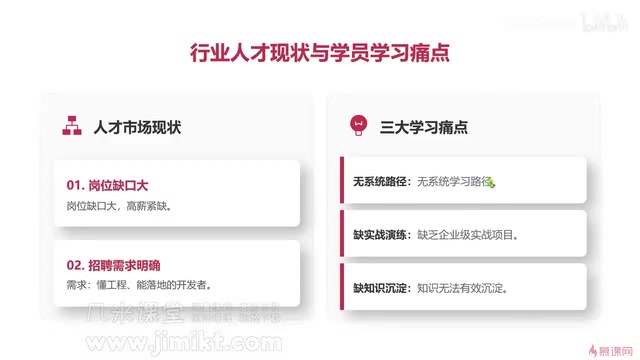
Multi-Agent Development Guide: From Monolithic AI to Team Collaboration in Practice
A beginner's guide to multi-agent development covering core advantages, common learning pain points, enterprise tech stacks, and engineering methodology for AI developers.
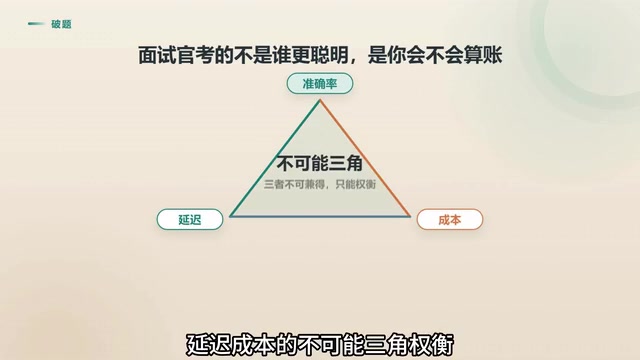
Agent Skill Routing: Retrieval vs. LLM vs. Two-Stage Architecture Compared
Retrieval or LLM for Agent skill routing? Compare coarse-filter vs. fine-select architectures on latency, accuracy, and cost — with 4 key production considerations.