Multi-Agent Development Guide: From Monolithic AI to Team Collaboration in Practice
Multi-agent AI moves from concept to enterprise necessity — here's how to break in and build real systems.
This article breaks down a multi-agent development course intro, covering four key advantages over single-model AI: parallel efficiency, cross-validation to reduce hallucinations, modular scalability, and better fit for complex automation. It also addresses three common pain points for newcomers — no learning path, no real projects, no knowledge consolidation — and introduces a methodology built around "Mastery Engineering" and self-evolving agent frameworks, backed by a full-stack project using LangChain, LangGraph, RAG, and multimodal models.
From Single Agents to Multi-Agent Team Collaboration
For the past two years, most AI applications we've encountered have revolved around a single agent. Think of it like a smart but solo employee — capable, yet unable to handle the complexity of enterprise-level business. The trend is shifting: companies are now combining multiple AI agents to work like a coordinated team.
In this architecture, some agents gather information, others analyze data, and still others write reports — each with a defined role, working in concert to complete complex tasks. This tutorial opens by establishing that multi-agent systems have evolved from a lab concept into a genuine enterprise necessity.
Industry signals back this up. As cited in the tutorial, Kai-Fu Lee has publicly called this the "Year One of Enterprise Multi-Agent Deployment." Tencent Cloud has launched a multi-agent platform, and Volcengine has released a multimodal multi-agent platform. The concentrated bets from major players signal that multi-agent architectures are becoming the mainstream path for enterprise AI adoption.
Why Enterprises Are Doubling Down on Multi-Agent: Four Core Advantages
The tutorial systematically outlines four advantages of multi-agent systems over single models — understanding these is key to grasping the direction of this technology.
Efficiency is the most obvious benefit. Multiple agents can divide labor and execute tasks in parallel, far outperforming the serial processing of a single agent. It's essentially upgrading from "one person working" to "a team collaborating."
Risk Control addresses one of the most stubborn problems with large language models: hallucinations. Errors from a single agent are hard to catch, but multiple agents can cross-validate each other's outputs, dramatically reducing the likelihood of mistakes. In high-stakes fields like finance and healthcare, this directly determines whether an agent system can actually be deployed.
Architectural Advantage comes down to scalability. Multi-agent systems use modular designs, so adding new features or agents later means plugging in new modules — not rebuilding from scratch.
Selection Rationale reflects industry consensus: for complex business automation scenarios, multi-agent architectures are simply better suited than a single massive model. In other words, multi-agent isn't a buzzword — it's a validated architectural choice.
Hallucination is an inherent flaw in large language models — the model generates incorrect or fabricated information with high confidence, and that output is often indistinguishable from accurate information. The root cause is that language models are trained to predict the next most likely token, not to rigorously verify facts. In a single-agent scenario, once hallucination occurs, the entire output pipeline carries that error forward, amplifying it. The cross-validation mechanism in multi-agent systems has multiple independent agents complete the same task or review each other's outputs, leveraging the statistical principle that "independent errors are uncorrelated" to reduce the probability of errors in the final result — similar to the "multiple independent reviewers" process control in contract auditing. This mechanism has substantive value in industries with extremely high accuracy requirements, such as financial compliance, medical diagnosis support, and legal document generation.
Three Common Pain Points for Aspiring Developers
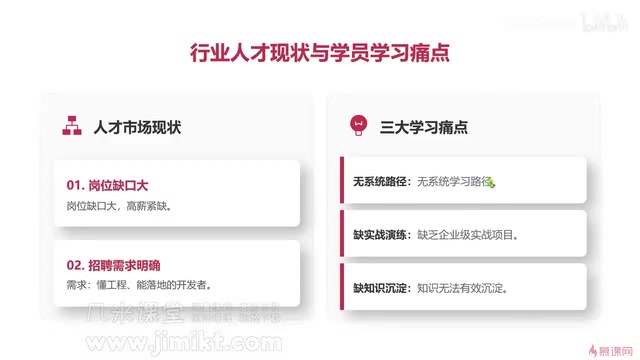
The industry is booming, but the talent gap remains large. Notably, hiring requirements have become explicit — companies don't want people who can only call APIs. They want multi-agent development engineers who understand engineering principles, can work on real projects, and can ship products that actually go live.
The tutorial identifies three barriers commonly faced by those trying to break in.
No systematic learning path: Watching a video today, reading a RAG article tomorrow — after months of scattered learning, you still can't build a fully deployable agent system.
No hands-on projects: Many courses only cover theory or produce simple demo prototypes. Students come away without any convincing, enterprise-grade projects to put on their résumés.
No knowledge consolidation: The knowledge accumulated along the way is scattered and disorganized, never crystallizing into a reusable personal knowledge asset.
These three pain points are interconnected — no systematic path leads to inefficient learning, no real projects means skills can't be validated, and no knowledge consolidation means growth is hard to sustain.
The Course's Technical Methodology: Mastery Engineering and Self-Evolution Framework
The tutorial introduces two core concepts that form the methodological foundation distinguishing it from similar content.
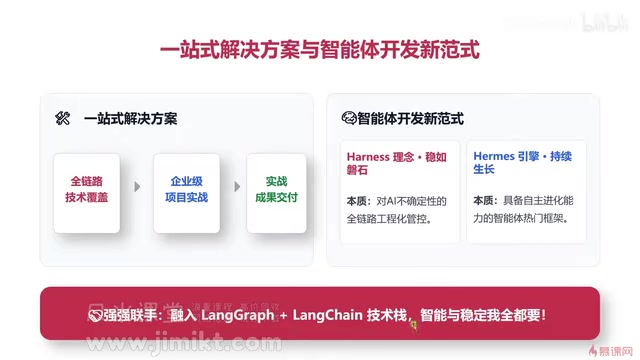
The first is Mastery Engineering — essentially a full-stack engineering management methodology for handling AI unpredictability. AI is powerful but prone to going off the rails. The goal of mastery engineering is to manage agent systems to ensure stable operation, directly addressing the core enterprise pain point of "lack of controllability."
The second is an agent framework with self-evolution capabilities. Traditional agents suffer from a "learned and forgotten" problem. Through secondary development of an evolutionary framework, the system continuously accumulates past experience and optimizes workflows, giving agents the ability to keep improving over time.
On the technology stack side, the tutorial emphasizes integrating mainstream agent development frameworks like LangGraph and LangChain, with the goal of striking a balance between "autonomous evolution" and "system stability" — both intelligent and stable. This tension is precisely the key engineering challenge in deploying agents at enterprise scale.
LangGraph and LangChain are the two most mainstream open-source frameworks in agent development today, both maintained by LangChain, Inc. LangChain provides a rich set of encapsulated components (model calls, vector retrieval, tool invocation) to help developers quickly prototype agents; LangGraph builds on top of it by introducing the concept of a "graph," expressing agent workflows as directed graphs of nodes and edges, allowing developers to explicitly define state transition logic, branching, and cyclical execution paths. This design makes complex multi-agent collaboration scenarios — such as one agent's output triggering another agent's execution — far more controllable and debuggable. Compared to traditional chain-based invocation, LangGraph is better suited for enterprise scenarios requiring conditional logic, parallel processing, or human-in-the-loop interaction, making it one of the most-watched technical solutions for production-ready multi-agent deployment.
One Enterprise-Grade Project Running Throughout the Course
The entire curriculum is built around a single enterprise-level project — a multimodal, self-evolving product focused on two core scenarios: learning improvement and interview preparation.
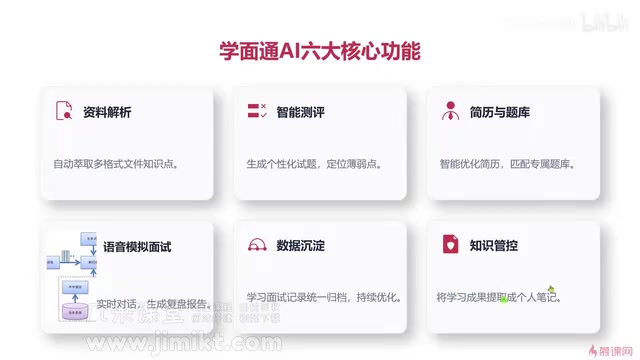
The project is designed around a complete business loop: the system automatically tracks a user's learning gaps and syncs them into interview training; weaknesses exposed during interviews then feed back into the learning plan, creating a bidirectional flow between learning and interview data. The entire system is operated by multiple collaborating agents and includes six core features:
- Document Parsing: Automatically extracts key concepts from uploaded documents, eliminating manual organization
- Intelligent Assessment: Generates personalized test questions, scores responses, and creates learning plans targeting weak areas
- Résumé & Question Bank: Analyzes résumés and suggests improvements, then matches interview question banks by target role
- Voice Mock Interviews: Integrates speech recognition and synthesis for one-on-one simulated interviews with debriefing reports
- Data Consolidation: Archives all learning and interview records, automatically syncing identified weaknesses
- Knowledge Management: Extracts learning outcomes into personal notes that support secondary editing and review
On the technology stack side, the project spans five major modules: backend using Python, FastAPI, MySQL, Redis, and vector databases; frontend using TypeScript, Vite, and Pinia; engineering infrastructure covering Docker, MCP protocol, and multi-agent communication; AI capabilities including LangChain, LangGraph, RAG retrieval, and multimodal models; and cutting-edge extensions involving Qwen3 model deployment, large model fine-tuning, and AI-assisted programming tools. This combination broadly aligns with enterprise-grade full-stack development standards.
RAG (Retrieval-Augmented Generation) is one of the core AI capabilities in the project tech stack and the most widely used engineering approach for deploying large models in enterprise settings. The core idea: rather than relying on knowledge stored in the model's weights, every inference first retrieves the most relevant text fragments from an external knowledge base (such as user-uploaded documents or internal company databases), then passes those fragments as context to the model to generate an answer. The benefits are twofold: the model can handle private information outside its training data, and hallucinations are effectively suppressed because answers can be traced back to specific retrieved documents. Vector databases (such as Milvus, Chroma, and Pinecone) are the critical infrastructure of any RAG system — they convert text into high-dimensional vectors and support semantic similarity search, which is the key technical differentiator from traditional keyword search. In this project's "Document Parsing" and "Intelligent Assessment" features, RAG is the underlying engine powering knowledge extraction and personalized question generation.
Learning Philosophy: Type the Basics by Hand, Use AI for Complexity
The tutorial's learning philosophy can be summed up as: solid foundations, maximum efficiency.
For foundational Python syntax and core agent implementations, the instructor walks students through writing code by hand to build solid programming fundamentals. For complex features, AI tools are used to accelerate the work — let AI generate the code, analyze the core logic within it, and then distill the approach into reusable prompts.
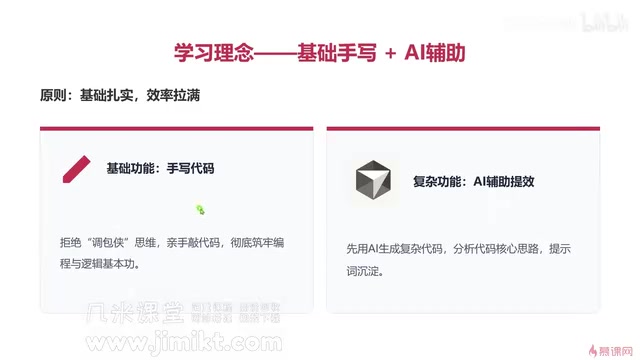
This layered strategy of "write the basics yourself, use AI for the complex parts" prevents beginners from over-relying on AI at the expense of foundational skills, while also boosting development efficiency in hands-on work. It's an approach worth borrowing.
Target Audience and a Realistic Perspective
The tutorial targets four groups: working developers looking to transition into AI, web beginners or new graduates aiming to advance into full-stack development, job seekers who need strong projects to round out their résumés, and product managers or indie developers who want to validate product ideas quickly.
A word of caution: this is course-introduction content with a clear marketing and enrollment angle (including phrases like "double your salary" and "get in before the opportunity closes"). Multi-agent development is genuinely a worthwhile technical direction to invest in — but claims like "finish the course and double your salary" deserve a healthy dose of skepticism. The parts with real value are the sections on multi-agent architectural advantages, engineering deployment methodology, and the learning framework — all of which offer useful reference points for anyone looking to get started in agent development.
Related articles
$20/Month vs. $5M/Year: The Fundamental Difference Between Cursor and Blitzy
Cursor at $20/month vs. Blitzy at up to $5M/year: a Grafana 3M-line codebase test reveals how these AI coding tools differ in context, work unit, and production readiness.
Factoriax: A GPU-Parallelized Factory-Building Reinforcement Learning Research Environment
Factoriax is a GPU-parallelized RL research environment inspired by Factorio, focused on long-horizon planning and high-throughput sampling for complex factory-building simulations.
Matt Pocock Skills Deep Dive: Turning AI Coding from Chat into Engineering
Matt Pocock Skills transforms AI coding into an engineering workflow: requirements discussion, SPEC generation, task breakdown, TDD implementation, and code review — solving vague requirements and repeated bugs.