Why Short Chain-of-Thought Hurts Spatial VQA: New Study Reveals the Perception-Transcription Bottleneck in VLMs

Short CoT makes VLMs answer from their own written text rather than the image, hurting spatial reasoning.
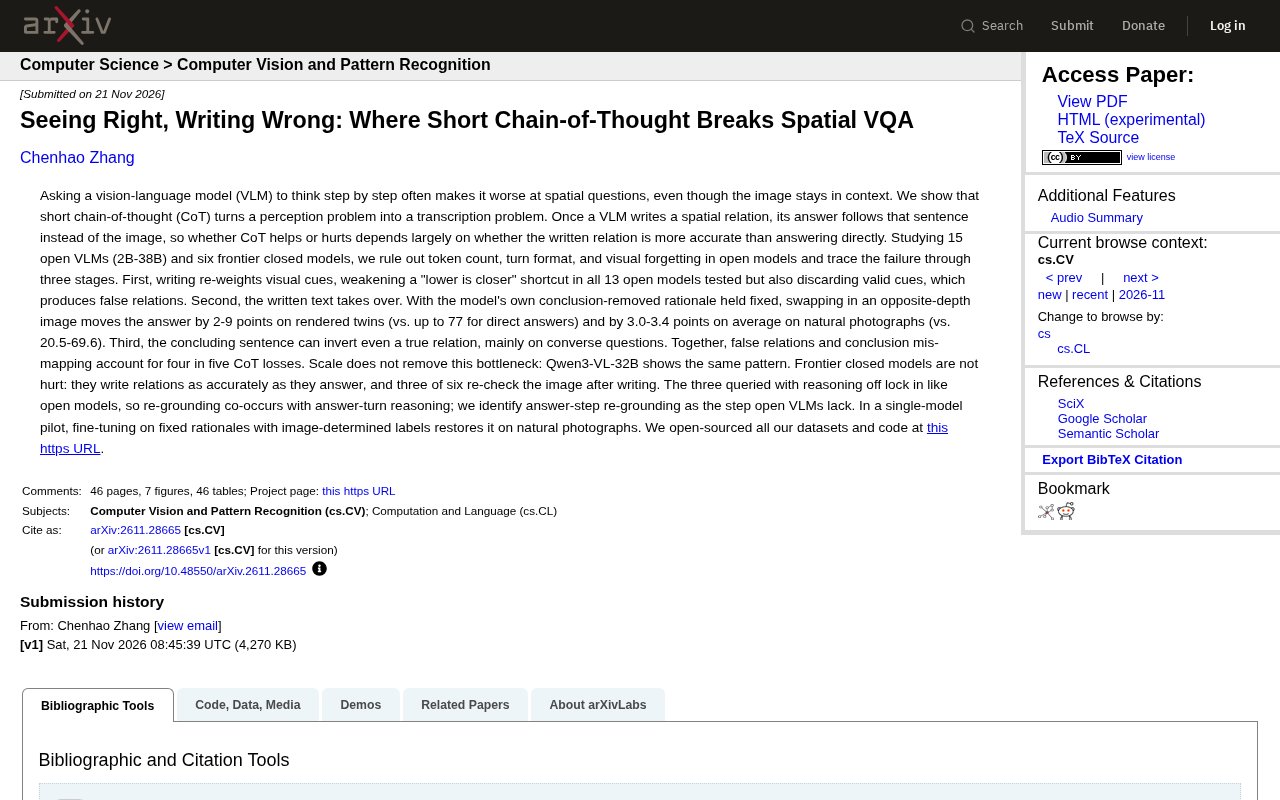
A study covering 15 open-source VLMs and 6 frontier closed-source models finds that short chain-of-thought turns spatial perception into transcription: once the model writes a spatial relationship, its answer follows that sentence rather than the image. The failure unfolds in three stages — writing reweights visual cues and produces wrong relationships, written text takes over the answer, and the conclusion sentence reverses the true relationship. Wrong relationships and conclusion mis-mapping together explain four-fifths of the CoT loss, and scaling up does not eliminate the bottleneck. Frontier closed-source models are unaffected because they write accurate relationships and some re-check the image afterward; the key is "answer-step re-grounding." A single-model pilot shows targeted fine-tuning can restore this ability on natural photographs.
Key Finding: Short Chain-of-Thought Turns a Perception Problem into a Transcription Problem
Asking a vision-language model (VLM) to think step by step may actually hurt its spatial reasoning — even when the image is still in context. A new study shows that short chain-of-thought (CoT) converts a perception problem into a transcription problem: once a VLM writes down a spatial relationship, its answer follows that sentence rather than the image. So whether CoT helps depends largely on whether the written relationship is more accurate than a direct answer.
The study covers 15 open-source VLMs (2B–38B) and 6 frontier closed-source models, rules out factors such as token count, turn format, and visual forgetting, and traces the failure process across three stages.
Vision-language models (VLMs) are multimodal large models that process both image and text inputs; representative examples include GPT-4V, Qwen-VL, and LLaVA. Unlike text-only LLMs, a VLM maps an image into a feature sequence through a vision encoder, then feeds it into the language model along with text tokens. Its spatial reasoning ability refers to judging object distance, depth order, left-right relationships, and so on — foundational capabilities for robot navigation, autonomous driving, and visual question answering. The key to this study is distinguishing "perception" from "transcription": perception requires the model to make judgments directly from image pixels, whereas transcription means the model answers based on the text description it generated itself. Once CoT turns a perception task into transcription of its own words, the image degrades into decorative context, and the accuracy of the model's output depends on that text rather than on the original visual evidence.
The Three-Stage Failure Mechanism: From Reweighting to Conclusion Reversal
Stage One: Writing Reweights Visual Cues
Writing out relationships reweights visual cues. Across all 13 open-source models tested, writing weakened the "lower is closer" shortcut but also discarded valid cues, thereby producing incorrect relationships.
"Lower is closer" is a common depth cue in images: in natural photographs, objects located lower in the frame are usually closer to the camera. VLMs acquire this statistical shortcut during pretraining and often rely on it when answering depth questions directly. Chain-of-thought requires the model to explicitly write out spatial relationships, which changes the model's internal attention weights over various visual cues — the writing process suppresses shortcuts like "lower is closer" on the one hand, but may also discard other valid cues (such as occlusion, texture gradients, and perspective convergence) on the other, causing the written relationship itself to be wrong. This "reweighting" is not an active optimization by the model; rather, it is the result of attention allocation being reshaped by serialized output during autoregressive text generation.
Stage Two: Written Text Takes Over
When the model's own conclusion is removed and the rationale is fixed, swapping in an image with the opposite depth relationship moves the answer by only 2–9 points on rendered twin images (versus up to 77 points for direct answering), and by an average of 3.0–3.4 points on natural photographs (versus 20.5–69.6 points for direct answering). This shows that the written text dominates the answer.
Rendered twin images refer to two images rendered from the same 3D scene with only the depth relationships deliberately reversed, while keeping the rest of the pixel-level appearance as consistent as possible. This experimental design cleanly separates the contributions of "image content" and "written text" to the answer: if the model truly answers based on the image, the answer should flip substantially after the image is swapped; if the answer barely moves, it means the model is following the sentence it wrote earlier. In the study, open-source models moved by only 2–9 points on twin images, versus up to 77 points when answering directly — direct evidence that written text takes over. Answer-turn reasoning refers to the model's ability to actively look back at the image and re-verify spatial relationships at the step where it generates the final answer; this is a key dividing line between frontier closed-source models and open-source models.
Stage Three: The Conclusion Sentence Reverses the True Relationship
The conclusion sentence may even reverse a true relationship, mainly on inverse questions. Incorrect relationships and conclusion mis-mapping together explain four-fifths of the CoT loss.
Scaling up does not eliminate this bottleneck: Qwen3-VL-32B exhibits the same pattern.
Why Are Frontier Closed-Source Models Not Affected?
Frontier closed-source models are not impaired: their accuracy in writing relationships is comparable to their answering accuracy, and three out of six re-check the image after writing. When reasoning is disabled at query time, these models lock in their answers just like open-source models, indicating that re-grounding and answer-turn reasoning occur simultaneously. The researchers identify "answer-step re-grounding" as the missing link in open-source VLMs.
In a single-model pilot, fine-tuning with fixed rationales and image-determined labels restored this ability on natural photographs. All datasets and code are open-sourced: https://ming-zch.github.io/seeing-right-writing-wrong
Re-grounding refers to the mechanism by which a model re-anchors its linguistic representations to the visual input during reasoning. In human cognition, this is akin to checking back against the scene while reasoning, rather than drawing conclusions solely from a remembered description. For a VLM, re-grounding means re-invoking visual features at the turn where it generates the answer, correcting relationship statements in the preceding text that may be wrong. Open-source models lack this step: once they write down an incorrect relationship, they carry it all the way to the answer; closed-source models, by contrast, partially re-check the image after writing, allowing textual errors to be corrected before the final output. The fact that fine-tuning with fixed rationales plus image-determined labels in the single-model pilot restores this ability suggests that re-grounding is a trainable, transferable behavioral pattern rather than something determined solely by model scale.
Implications for VLM Applications
For applications that rely on spatial reasoning (such as robot navigation, autonomous driving, and image question answering), blindly adding CoT may backfire. Developers should pay attention to whether the model can re-ground at the answer step, or consider targeted fine-tuning. This study offers a new perspective for understanding the reasoning limitations of VLMs and points out directions for improvement.
Related articles

GLM-5.4 vs. Opus and Neon: How Far From the Top?
No official benchmarks for GLM-5.4. Based on a YouTube deep test and developer trials, we analyze its gap vs. Claude Opus 5.5 and Gemini Neon, the speed bottleneck from marathon-style thinking, and its real position in enterprise agent scenarios.

From Gobbler to Sloppy Joe: The Hit-Making Playbook of a New Jersey Deli Institution
NYT Cooking visits Milburn Deli in New Jersey to break down the hit logic behind the Gobbler turkey sandwich and the local Sloppy Joe: bread sliced to order, house-made sauces, a group shout culture, and customer co-creation behind six locations.
In the Age of AI Programming, When Do You Still Need to Write Code by Hand?
Is handwritten code still valuable once AI programming agents are widespread? This article outlines three scenarios where handwriting is essential—learning, style development, and prototype validation—and provides a division-of-labor framework between AI and humans to help developers balance efficiency and skill growth.