Why Silicon Valley's Prophets All Missed the Midterms
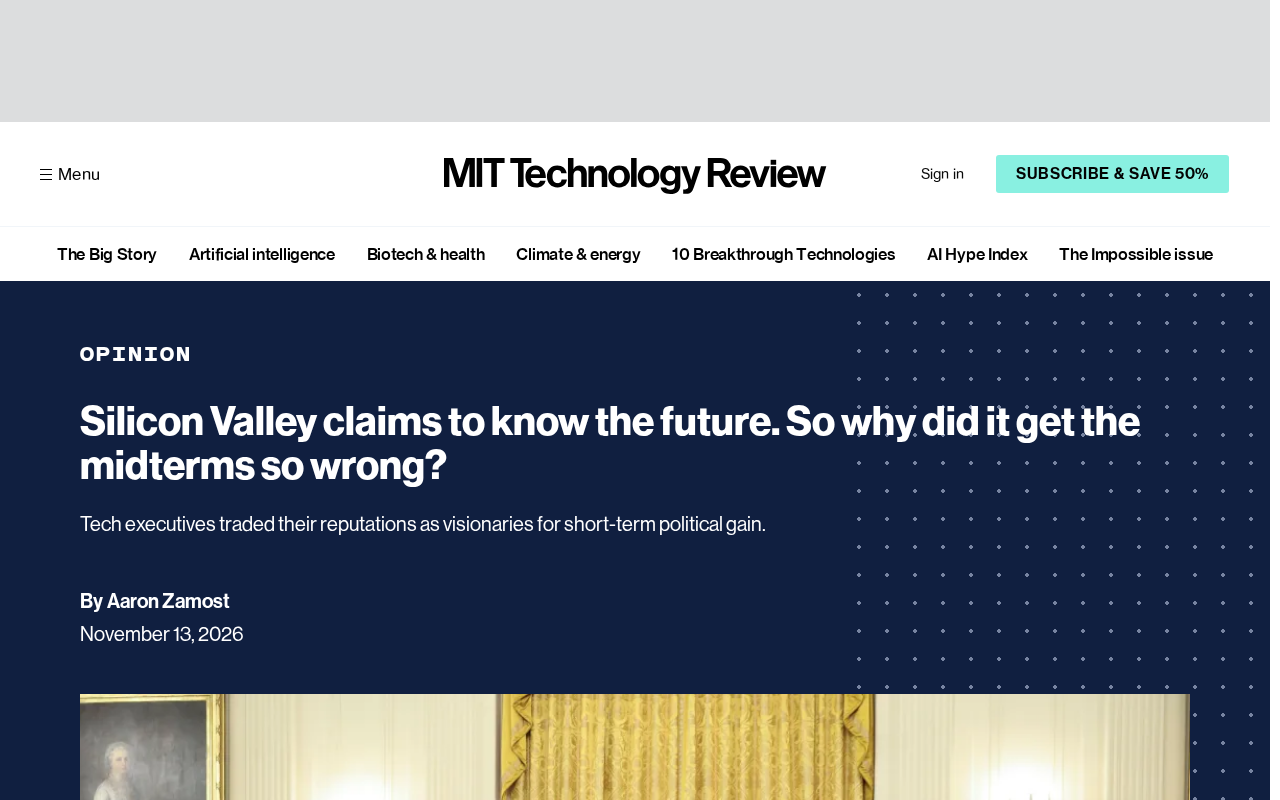
Silicon Valley's engineering mindset repeatedly misjudges politics, exposing its cognitive bias toward complex social systems.
The article explores why Silicon Valley tech leaders repeatedly miss the mark on political forecasts, especially midterms. Tech companies excel at linear, quantifiable "future narratives," but political systems are reflexive, biased in data sources, and complex—rendering engineering thinking ineffective. Reliant on social media sentiment and search trends, Silicon Valley systematically underestimates suburban, rural, and minority voters. Cross-source analysis shows directional errors in 2016 Brexit, the 2016 U.S. election, and the 2022 midterms. The article attributes this to data elites' blind spots, echo chambers, and the disconnect between grand visions and voters' real concerns. The lesson for AI practitioners: acknowledge data limits, combine qualitative research, and trade engineering arrogance for humility.
Title
Why Silicon Valley's Prophets All Missed the Midterms
Silicon Valley's leaders are accustomed to positioning themselves as people who "see the future." OpenAI CEO Sam Altman and SpaceX chief Elon Musk have built their careers on claiming the ability to see what's coming. Long-range vision is hard currency here: Mark Zuckerberg once laid out a ten-year roadmap for Facebook in 2016, and before its IPO, Google famously told investors it didn't care about short-term fluctuations.
Yet when political reality—especially midterm elections—arrives, these self-styled prophets repeatedly misjudge it. This isn't just about forecast models failing; it exposes tech elites' cognitive biases toward complex social systems.
How Silicon Valley's "Future Narrative" Is Constructed
Tech companies excel at telling linear, technology-driven, quantifiable stories about the future. From "ten-year roadmaps" to "Mars timelines," these visions are typically grounded in engineering thinking: set a goal, break it into steps, commit resources, iterate and optimize. This approach works brilliantly in product development, but once applied to political elections, it ignores human fickleness, informational chaos, and the dispersion of power.
Take midterm elections: Silicon Valley's forecasts often rely on social media sentiment analysis, search trends, and fundraising data. These signals look precise at the technical level, but they struggle to capture subtle shifts in grassroots mobilization, candidates' on-the-spot performances, and voters' last-minute wavering inside the voting booth. According to analyses by multiple tech media outlets, ahead of the 2022 U.S. midterms, Silicon Valley internally widely expected a "red wave" to sweep Congress—yet control of the Senate remained deadlocked, and the House majority was far smaller than expected. This misjudgment is no isolated case.
Why Political Forecasting Is Harder Than Technology Forecasting
The Reflexivity of Social Systems
Technology forecasting can rest on physical laws or user behavioral inertia, but political forecasting faces "reflexivity": the prediction itself affects the object being predicted. When a Silicon Valley big shot publicly disparages a candidate, it may provoke backlash voting among that candidate's supporters; when polling data is widely circulated, it may suppress some voters' willingness to participate. This kind of feedback loop is rare in engineering systems but routine in politics.
The concept of reflexivity was first proposed by sociologist William Thomas, later developed by Robert Merton into the "self-fulfilling prophecy," and systematically articulated by financier George Soros in The Alchemy of Finance. Its core idea: there is two-way feedback between observer and observed—predictions change behavior, and behavior changes outcomes. In financial markets, Soros used this to explain the formation and bursting of bubbles: price signals influence fundamentals, and fundamentals in turn reinforce prices. Political elections work the same way: after polls are published, supporters may slacken off believing victory is assured, while opponents turn out enthusiastically feeling they have nothing to lose—and the final result diverges from the initial forecast. This is fundamentally different from engineering systems—physical laws don't change because they're observed, but social systems do. If Silicon Valley's forecasting models ignore reflexivity, they will mistake dynamic feedback for static trends, producing directional errors.
The Blind Spots of Data Elites
The data sources Silicon Valley relies on—political discussion on Twitter (now X), Google search heat, Facebook ad performance—are themselves subject to sampling bias. Users of these platforms skew younger, more urban, and more tech-savvy, whereas midterm outcomes often hinge on turnout among suburban moderates, rural conservatives, and minority communities. According to reviews of election data by Bilibili creators and YouTube channels, Silicon Valley's internal models systematically underestimated the "silent majority," causing forecasts to diverge from actual results.
Sampling bias is a classic problem in statistics: when a sample fails to represent the population, inferences based on that sample systematically deviate from the true value. In political forecasting, social media data is especially prone to "non-probability sampling" bias—politically active people, young people, and urban residents are overrepresented on Twitter, while election outcomes are often decided by groups with lower turnout. Moreover, the "silent majority" phenomenon means voters who don't speak out are nearly invisible in the data, and models mistakenly assume they don't exist or don't matter. More insidious still is "selection bias": platform algorithms tend to amplify emotional content, causing models to overestimate the influence of extreme positions. Correcting these biases requires combining probability sample surveys, demographic weighting, and qualitative field research—not relying solely on platform behavioral data.
The Disconnect Between Vision and Reality
Musk once predicted "full self-driving before 2024," while Altman talks expansively about "AGI reshaping everything." These grand narratives ignite passion within tech circles, but in a political context, voters care more about gas prices, inflation, jobs, and community safety. When tech leaders try to influence elections with "future visions," they often answer questions nobody asked.
The fundamental difference between technology forecasting and political forecasting lies in the compressibility of the system. Technical systems typically follow clear causal chains with controllable variables and measurable feedback, so engineers can approach goals through "decomposition and iteration." Social systems, by contrast, are complex adaptive systems composed of large numbers of heterogeneous agents engaged in nonlinear interaction, and highly sensitive to initial conditions (the "butterfly effect"). This means a tiny local event—a candidate's gaffe, a sudden crisis—can cascade through chain reactions to change the global outcome. Moreover, social systems exhibit path dependence and institutional inertia; the influence of historical events accumulates continuously and cannot be "rolled back" like a software version. Applying engineering thinking directly to political forecasting is therefore essentially using a simple-system methodology to tackle complex-system problems—misjudgment is almost structural.
Multi-Source Cross-Validation: The Common Thread of Misjudgment
Multiple independent sources confirm the same pattern: Silicon Valley's election forecast errors are no accident. According to a joint analysis by tech media outlets The Information and Recode, tech companies' internal political forecasting models showed directional bias in 2016 Brexit, the 2016 U.S. election, and the 2022 midterms alike. This consistency points to systemic flaws, not insufficient data.
Where opinions diverge is on the cause: one side argues Silicon Valley relies excessively on quantitative data and neglects qualitative research (such as anthropological fieldwork); the other holds that the problem lies in tech leaders' "echo chamber effect"—surrounded by advisors from similar backgrounds, lacking direct contact with voters from different social strata. Both views have merit, but the consensus is clear: tech elites' political instincts need recalibration.
Implications for the Tech Industry
The midterm misjudgment is a mirror reflecting the boundaries of Silicon Valley's "future narrative." Technology can change how information spreads, but it cannot simplify social complexity. For AI and tech practitioners, this is a reminder: when developing forecasting models, recommendation algorithms, or public-opinion tools, we must acknowledge the limitations of data and the incompressibility of human nature.
More importantly, if Silicon Valley truly wants to "see the future," it needs to set aside the arrogance of engineering thinking, go into the field, and listen to different voices—rather than merely running models in Palo Alto conference rooms. The failure of political forecasting may be exactly the opportunity for the tech industry to relearn humility.
Related articles
Anthropic Goes Public: AI Bubble or Buying Opportunity?
Anthropic lists on Nasdaq, opening about a third above its IPO price. We break down the $81.3B raise, $1.5T offering valuation, and $2T market valuation, plus Claude's growth and $567M quarterly operating loss.

Why the FBI's AI Hacker Warning Hinges on a Single Word from Microsoft
FBI says AI tool Artex attacked 2,250+ organizations, but the citation trail leads to Microsoft's wording of "attempted sign-ins." The gap between attempts and breaches reveals the attack's true scale.

Fable 5.2 Powers the Creation of Getsumen Express: A Browser-Based Lunar and Martian Exploration Game
A developer used Fable 5.2 to build Getsumen Express, a browser game where players explore the Moon and Mars, scan real landmarks, shoot aliens, and ride an interstellar train. Built on Three.js and WebGPU for about $730, it showcases AI-assisted development.