Why Texas Is Making Data Centers Wait: AI Compute Hits the Grid's Limits

Texas's independent ERCOT grid is forcing data centers to queue as AI power demand outpaces grid infrastructure.
As generative AI drives data center power demand sharply higher, Texas's independent ERCOT grid faces a mounting backlog of interconnection requests. Grid infrastructure takes years to build — far slower than data centers that come online in months — forcing operators to queue hyperscale loads. Texas's history of extreme-weather grid failures reinforces regulatory caution, and some regions now require interruptible load capability as a condition of connection. This is a global structural tension, not a Texas anomaly, and electricity is fast becoming a core competitive dimension in the AI race alongside chips and algorithms.
When AI Compute Meets Grid Capacity
As generative AI adoption explodes, data center power demand is climbing at an unprecedented pace. Texas — a state renowned for its energy industry and home to the independent ERCOT grid — has become a prime case study for this growing tension. The question at the heart of the issue, "Why is Texas making data centers wait?", cuts to one of the most concrete bottlenecks in AI infrastructure expansion: can power supply keep pace with compute demand?
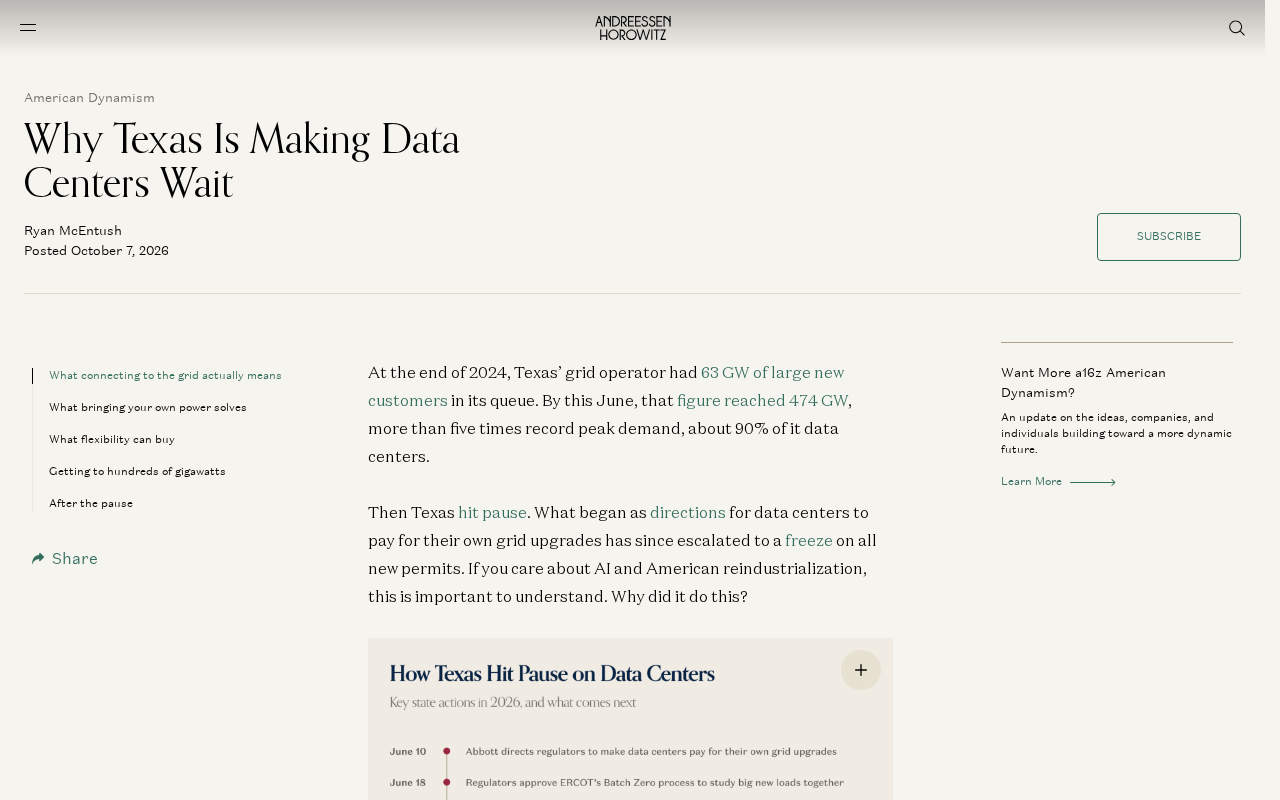
Since the original source material provides only a headline and discussion link, this article analyzes the broader industry trends the issue reflects, rather than parsing specific policy provisions line by line.
Data Centers' Insatiable Appetite for Power
Training and running large AI models requires enormous computational resources — and behind those resources lies staggering power consumption. A single hyperscale data center can draw as much electricity as a mid-sized city. As tech companies race to establish AI data centers in regions like Texas — where electricity prices are relatively low and land is plentiful — regional grids quickly find themselves overwhelmed with connection requests.
Texas's independently operated grid (ERCOT operates outside the direct jurisdiction of federal regulators) means it has both flexibility and vulnerability when absorbing sudden, large-scale load additions. Texas has historically suffered widespread grid failures during extreme weather events, which has made grid operators considerably more cautious about approving new hyperscale load connections.
ERCOT (Electric Reliability Council of Texas) is the independent system operator managing roughly 90% of Texas's electricity load, serving approximately 26 million customers. Unlike most U.S. states, the Texas grid does not cross state lines, which means it falls outside direct Federal Energy Regulatory Commission (FERC) oversight. This grants Texas greater autonomy in electricity market design — including a fully competitive real-time spot pricing mechanism. That system can deliver extremely low prices when supply is ample, making it highly attractive for data center siting. But during supply crunches, prices can spike to hundreds of times normal levels within minutes. During Winter Storm Uri in 2021, ERCOT narrowly avoided a complete collapse, leaving roughly 4.5 million households without power for days — a history that profoundly shapes how grid operators now assess the risk of adding hyperscale loads.
Why the "Queue" Exists
Making data centers wait in line is, at its core, a risk management tool that grid operators use when supply and demand fall out of balance. Allowing massive new loads to connect rapidly and without coordination could threaten overall grid stability and trigger cascading failures.
The queuing mechanism typically involves several layers of consideration:
Grid Infrastructure Upgrades Lag Behind
Building transmission lines and substations takes years — far outpacing the months it takes to construct and commission a data center. This time mismatch forces operators to sequence and prioritize connection requests.
Interconnection queue backlogs are a nationwide problem in the U.S., not unique to Texas. According to research from Lawrence Berkeley National Laboratory, the total capacity of pending grid interconnection applications nationwide exceeded 2,700 GW by the end of 2023, with a large share coming from data centers and renewable energy projects. A typical large-load interconnection application — from submission through grid impact studies and execution of an interconnection agreement — takes an average of three to five years. The root cause is that planning, permitting, and building transmission and substation infrastructure involves multiple regulatory layers and land ownership complexities, far exceeding the complexity of constructing the data center building itself. This structural time mismatch makes queuing a necessary tool for managing interconnection risk, not simply a symptom of administrative inefficiency.
Demand Flexibility Requirements
Some regions have begun requiring large data centers to demonstrate "interruptible" capability — the ability to actively reduce consumption or switch to backup power during periods of grid stress. This flexibility is increasingly becoming a prerequisite for obtaining a connection permit.
Interruptible Load or Demand Response is a grid management mechanism that allows system operators to request temporary reductions or interruptions from large users during supply crunches, in exchange for lower base electricity rates or priority connection status. For data centers, achieving this capability typically requires deploying local energy storage (such as large-scale UPS battery banks) or backup diesel/natural gas generators to keep critical operations running during curtailment events. Some AI training workloads are inherently schedulable — unlike financial trading systems, they don't require real-time execution and can be paused for minutes or even hours during grid stress events. This gives data center operators a potential bargaining chip with grid operators, potentially accelerating interconnection approvals by offering load flexibility in exchange.
Supply-Demand Balance and Rate Impacts
A concentrated wave of data center connections can push up local electricity prices, affecting ordinary residents and other industrial users. Regulators and operators must find a balance between attracting investment and protecting the public interest.
What This Means for the AI Industry
Power constraints are moving from backstage to center stage as a critical variable shaping AI's trajectory. In the past, discussions about the AI race focused on chips, algorithms, and data. Today, "can you secure sufficient, stable power" is emerging as a new competitive dimension.
This trend is likely to trigger several ripple effects: tech companies are beginning to incorporate self-owned generation capacity — including nuclear, natural gas, and renewables — into their data center planning; compute infrastructure will increasingly gravitate toward regions with more abundant power resources; and AI training job scheduling may begin to account for grid load patterns, enabling "off-peak training" strategies.
A Structural Contradiction Without a Quick Fix
Texas's data center queue is not an isolated phenomenon — it is a concentrated manifestation of the structural tension between global AI infrastructure expansion and existing energy systems. In the near term, the lag in grid upgrades means this "waiting" cannot be quickly resolved. Over the longer term, the deepening entanglement between the AI industry and the energy sector may catalyze new business models and technical solutions.
For practitioners and investors tracking AI's development, the power factor can no longer be treated as a peripheral variable. It deserves a central place in any serious framework for evaluating AI industry prospects.
Related articles

Gaussian Process Bandit Optimization: Exploration Strategies and Inference Regret Guarantees
Cumulative regret guarantees in Bayesian optimization fail to reflect final recommendation quality. This article examines a new study that provides inference regret guarantees for Gaussian process bandit optimization through exploration query strategies and fill distance analysis, validated on hyperparameter optimization and control tasks.

The Most Detailed Codex Guide on Bilibili: From Installation to Real-World Practice
The most detailed Codex guide on Bilibili: from app store installation to daily work mode configuration, with a real coffee shop project demonstrating file organization, data extraction, dashboard creation, and other practical tasks. Learn to use Plan Mode and desktop pets to leverage Codex efficiently.

Appearance Compensation in Volume Rendering: Why RGB Accuracy Cannot Guarantee Density Correctness
Volume rendering research reveals that volumetric data perfectly reproducing external RGB views may still contain density errors: appearance compensation can double central density and keep external rays unchanged even when L2 error exceeds 14.52%. Density recovery depends on appearance capacity, spatial resolution, and measurement design.