Why Unit-Level Aggregation of Causal Foundation Models Breaks Confidence Interval Coverage

Group-level credible intervals from causal foundation models are severely undercovered due to ignored unit error correlation; joint prediction fixes it.
Causal foundation models perform well in unit-level treatment effect estimation, but new research finds their credible intervals for group-level average effects are severely miscalibrated. On benchmarks like ACIC 2016, 95% interval coverage drops rapidly with group size, and full-sample average intervals contain the true value only 20% of the time. The root cause is simple variance combination at inference, which incorrectly assumes independent unit errors, while posterior uncertainty induces positive correlation, making combined variance too small. The underestimation factor grows with group size and predicts coverage failure. Jointly predictive neural process models endogenously account for error correlation and significantly improve coverage on synthetic tasks and six benchmarks. Practitioners should be wary of aggregated intervals from unit-level models and prioritize calibration or joint prediction.
Causal foundation models (CFMs) perform impressively in individual treatment effect estimation, but recent research reveals a critical flaw: when decisions rely on group-level average effects, the credible intervals produced by these models are severely miscalibrated. This article provides an in-depth analysis of the root causes and improvement strategies.
The False Sense of Security in Unit-Level Estimation
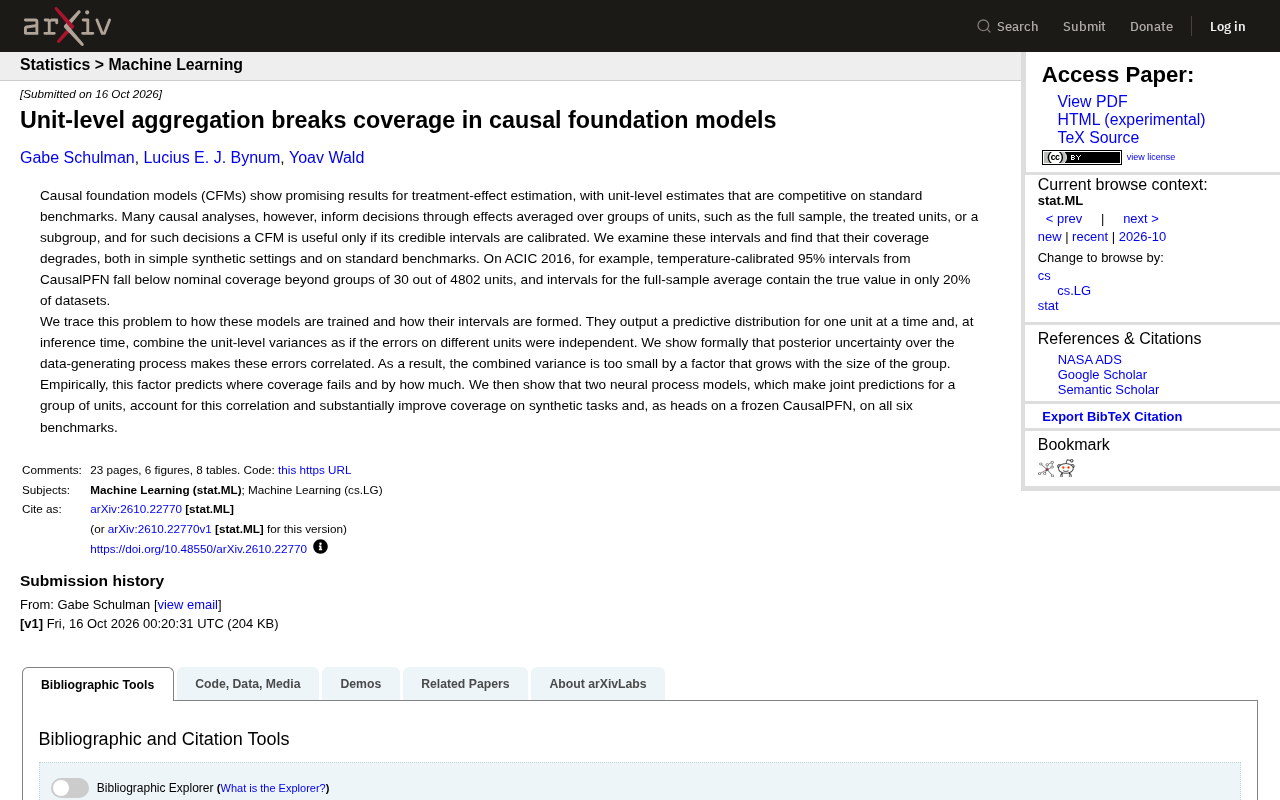
Causal Foundation Models (CFMs) demonstrate competitive unit-level treatment effect estimation capabilities on benchmarks. However, many practical causal analyses do not focus on individual units but require group-level average effects—such as full-sample averages, treatment group averages, or subgroup averages. For such decision-making scenarios, the usefulness of CFMs depends entirely on whether their credible intervals are calibrated.
The research team systematically examined these intervals and found that coverage degradation is pervasive, whether in simple synthetic data settings or on standard benchmarks. Taking the ACIC 2016 dataset as an example, the temperature-calibrated CausalPFN 95% intervals fall below nominal coverage once the group size exceeds 30 units (out of 4,802 total units); more seriously, the intervals for the full-sample average effect contain the true value in only 20% of datasets—far below the expected 95%.
This collapse in coverage is not random error but a systematic problem. It means that decisions based on these intervals may face much higher risk than anticipated.
Credible Interval Calibration and Coverage: In frequentist statistics, a 95% credible interval (or confidence interval) being "calibrated" means that if sampling were repeated and intervals reconstructed, approximately 95% of the intervals would contain the true parameter value. This proportion is called "coverage." Coverage below the nominal level (e.g., 95%) is called "undercoverage," indicating that intervals are too narrow and decision risk is underestimated. In causal inference, interval calibration for group-level average effects (such as the ATE) is particularly important because policy-making and resource allocation often depend on whether the interval contains zero or some threshold. If the predictive distributions output by unit-level models are simply averaged, the interval width may not reflect the true uncertainty of group-level estimates, so coverage must be specifically tested rather than merely looking at point estimation error.
Root Cause: Independence Assumptions and Correlated Errors
Researchers trace the problem back to the model's training approach and interval formation mechanism. CFMs output a predictive distribution for one unit at a time, and at inference they simply combine unit-level variances as if errors across different units were independent of each other.
However, the research formally proves that these unit-level errors are actually correlated due to posterior uncertainty about the data-generating process. When combining variances, if this correlation is ignored, the resulting combined variance is too small, and the factor by which it is too small grows with group size. Empirically, this factor accurately predicts where coverage fails and by how much.
This finding explains why unit-level estimates appear accurate yet problems abound after aggregation: the model captures uncertainty at the individual level but fails to propagate it to the group level.
Posterior Uncertainty and Error Correlation: Posterior uncertainty of a Bayesian model about the data-generating process refers to the distribution of model parameters that remains after conditioning on observed data. When a CFM outputs a predictive distribution for each unit, these distributions share the same posterior, so prediction errors across different units are not independent but are correlated through posterior parameters. For example, if the model underestimates the overall mean of the treatment effect, the errors of all units shift in the same direction. This positive correlation causes underestimation of the uncertainty of the group mean when variances are simply combined: the variance of the group mean includes not only the sum of individual variances but also pairwise covariance terms. Ignoring covariances makes the combined variance too small, and the degree of underestimation worsens with group size, because the number of covariance terms grows quadratically with group size.
Improvement Approach: Jointly Predictive Neural Process Models
To address these deficiencies, the research team tested two neural process models. Unlike independent unit-level predictions, these models make joint predictions over a set of units, thereby endogenously accounting for error correlation.
Experimental results show that on synthetic tasks, the joint prediction models significantly improve coverage; on all six benchmarks, as head models on top of a frozen CausalPFN, they likewise substantially improve coverage performance. This indicates that by modeling the dependence structure among units, the interval miscalibration caused by unit-level aggregation can be effectively repaired.
Neural Processes and Joint Prediction: A Neural Process is a class of meta-learning models that can infer predictive distributions from context data and output predictions for arbitrary query points. Unlike independent per-unit prediction, jointly predictive neural processes simultaneously model the joint distribution of a set of query points, thereby explicitly capturing correlations among units. In causal inference, this means that the group-level average effect intervals output by the model endogenously account for the covariance structure of unit errors, avoiding variance underestimation. Using a joint prediction model as a "head" on top of a frozen CausalPFN is a modular repair strategy: it retains the original unit-level point estimation capability and only replaces the interval construction method, improving group-level calibration at low cost.
Implications for Causal Inference Practice
This research issues an important warning for the deployment of causal foundation models: when making decisions that rely on group-level average effects, one should not blindly trust aggregated intervals from unit-level model outputs. Practitioners should pay attention to interval calibration issues and consider adopting joint prediction models or performing post-hoc calibration.
At the same time, this work points to a direction for foundation model design: training objectives and inference aggregation methods need to be consistent; otherwise, high unit-level performance may evaporate in group-level decisions. For the field of causal inference, this reminds us that coverage calibration is as important as the accuracy of point estimates.
One-line Summary
Credible intervals for group-level average effects from causal foundation models are severely undercovered because they ignore unit error correlation; joint prediction can fix this.
Paragraph Summary
Causal foundation models perform well in unit-level treatment effect estimation, but new research finds that their credible intervals for group-level average effects are severely miscalibrated. On benchmarks such as ACIC 2016, 95% interval coverage drops rapidly as group size increases, and full-sample average intervals contain the true value only 20% of the time. The root cause is that inference simply combines unit-level variances, incorrectly assuming unit errors are independent, whereas posterior uncertainty actually induces positive correlation among errors, making the combined variance too small. The research proves that the underestimation factor grows with group size and can predict the degree of coverage failure. Jointly predictive neural process models endogenously account for error correlation and significantly improve coverage on synthetic tasks and six benchmarks. Practitioners must be wary of aggregated intervals from unit-level models and should prioritize calibration or switch to joint prediction approaches.
Related articles

Automate Job Search with AI Agents and Residential Proxies for Precise Matching
Build an AI Agent with MCP and residential proxies to bypass recruitment site anti-scraping and geo-restrictions, scrape thousands of DevOps jobs, then have Claude score and rank each against your resume. Includes proxy comparison experiments, project structure, and cost analysis—filtering only, no auto-submission.

The AI Task Assistant That Knows When to Back Off: A Cure for Activation Struggles
One Small Step is an AI assistant for task initiation struggles, using agentic decisions for guilt-free reminders, timely retreat, and cross-platform task management. The developer shares real test results on 13 tasks and architectural trade-offs.

FastAPI: A High-Performance Python Framework and a Production-Ready API Development Powerhouse
FastAPI is a high-performance web framework based on Python type hints, supporting async and automatic OpenAPI docs. With over 100k GitHub stars, this article analyzes its core strengths, production readiness, and selection advice.