Widgeteer: Generate Website Widgets from a Single Sentence

Widgeteer generates embeddable website widgets from natural language descriptions and supports data routing.
Widgeteer is a product on Product Hunt that generates working website widgets from natural language descriptions (e.g., cleaning service quote calculator, table reservation form). It supports manual editing and conversational adjustments, lowering the barrier for non-technical users. Collected data can be sent to email, Zapier, n8n, or custom Webhook for integration into existing workflows; it claims compatibility with WordPress, Shopify, and any website. Focused on the "widget" granularity — lighter than full-site generation, more flexible than a form plugin. It received 64 votes, 1 comment, and ranked 17th for the day on Product Hunt — moderate traction, with generation quality and stability still to be validated.
From Description to a Working Website Widget
Adding a quote calculator or booking form to a website usually requires writing code or installing a plugin. Widgeteer, a new product on Product Hunt, aims to change that process: users simply enter a natural language description — such as "a cleaning service quote calculator" or "a restaurant table reservation form" — and it generates a working website widget.
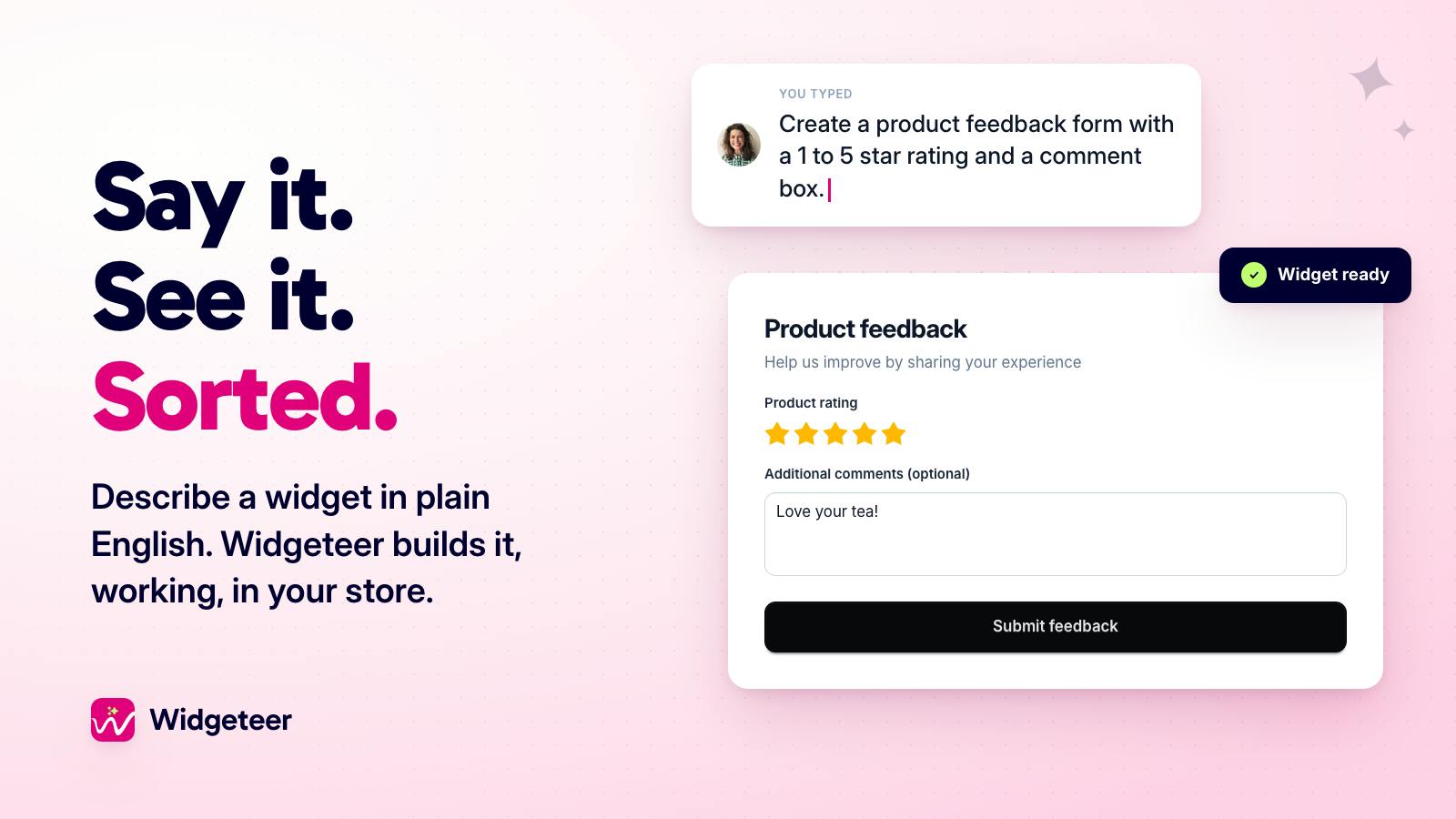
The core idea behind Widgeteer is "describe to build." Instead of designing the interface or writing the logic from scratch, AI generates an initial version of the widget based on the description. According to the official documentation, users can then edit the widget manually or continue refining it through natural language instructions. This approach lowers the barrier for non-technical users to create interactive website components.
Submission Routing and Platform Compatibility
The generated widgets aren't just static display elements. Widgeteer supports sending user-submitted data to multiple destinations: email, Zapier, n8n, or a custom Webhook. This means widgets can be embedded into existing workflows — for example, automatically routing collected quote requests to a customer service inbox or triggering an automation flow.
For deployment, Widgeteer claims compatibility with WordPress, Shopify, and any website. This broad compatibility makes it appealing to users across different site-building platforms, especially small business owners or independent creators without development resources.
How Webhook, Zapier, and n8n Differ
A Webhook is a callback mechanism where an application actively sends an HTTP request to a specified URL. It's the most low-level, universal integration method, but requires developers to write the receiving-end logic themselves. Zapier and n8n are visual automation platforms built on top of Webhooks: Zapier is a commercial SaaS connecting thousands of apps, billed by task volume; n8n is an open-source solution that can be self-hosted, suited for users sensitive to data privacy and cost. Widgeteer supporting all three means users can either pipe data directly into their own systems or leverage ready-made automation platforms to connect form submissions to CRMs, email marketing, or ticketing systems — without maintaining their own servers.
AI Website-Building Trends and Reality
Widgeteer emerges within a broader trend: AI is pushing website building from "drag-and-drop components" toward "describe your requirements." Similar product logic is appearing in form generation, landing page building, and other areas. Widgeteer's differentiation lies in focusing on the "widget" granularity — lighter than full-site generation, more flexible than a single form plugin.
Based on Product Hunt data, Widgeteer received 64 votes and 1 comment, ranking 17th for the day. This result shows it has attracted interest from some early users, but discussion volume isn't particularly high. As a product launched by Muhammad Usman, Widgeteer is still in an early stage, and its actual generation quality, editing experience, and long-term stability remain to be validated by more users.
The Technical Path of Natural Language Interface Generation
Products like this that "build from description" typically rely on large language models to parse natural language requirements into structured interface descriptions (such as component trees, field definitions, and validation rules), then render them into embeddable HTML/JS code. The quality bottleneck often isn't in the generation phase but in subsequent state management and edge-case handling — for example, field dependencies in multi-step forms, conditional display, input validation, and data persistence. This is why most tools retain a manual editing channel: pure generation struggles to cover complex branches in real-world business scenarios, and human-in-the-loop adjustments remain key to ensuring usability.
Use Cases and Potential Limitations
Widgeteer's most direct use cases include service quotes, booking appointments, contact forms, and event registration. For users who need to quickly launch an interactive component without investing development time, it offers a low-friction starting point.
However, AI generation tools like this typically face several common challenges: whether the output is professional enough, whether it can handle complex business logic, and whether there's sufficient editing freedom. Widgeteer offers both manual editing and natural language editing paths, which to some extent alleviates concerns about "not being able to adjust after AI generation," but the actual experience still depends on the product's implementation maturity.
For users looking for a lightweight website interaction component solution, Widgeteer is worth watching. It's advisable to start with simple form or calculator scenarios, evaluate its generation quality and integration results, and then decide whether to use it for more critical business processes.
One-line Summary
Widgeteer generates embeddable website widgets from natural language descriptions and supports data routing.
Paragraph Summary
Widgeteer is a product launched on Product Hunt where users simply enter a natural language description (such as a cleaning service quote calculator or a restaurant table reservation form) to generate a working website widget. After generation, it supports manual editing and conversational adjustments, lowering the barrier for non-technical users to create interactive components. Data collected by widgets can be sent to email, Zapier, n8n, or a custom Webhook for easy integration into existing workflows; for deployment, it claims compatibility with WordPress, Shopify, and any website. The product focuses on the "widget" granularity — lighter than full-site generation, more flexible than a single form plugin. It received 64 votes and 1 comment on Product Hunt, ranking 17th for the day — moderate traction, with actual generation quality and stability still to be validated.
Related articles

AI SDK Workflow 2.0.95 Update: Stream Transform API Removed
AI SDK Workflow 2.0.95 removes the experimental_transform option from WorkflowAgent.stream() and the StreamTextTransform type export, as stream transforms cannot reliably cross workflow step boundaries. This article covers the reasons, migration points, and upgrade advice.

AI SDK Vue 4.0.163 Patch Released: Full Dependency Chain Update
AI SDK Vue releases patch 4.0.163, synchronously upgrading dependencies including ai@7.0.163 and @ai-sdk/provider-utils@5.0.75. This article analyzes the practical impact of this dependency chain update.

AI SDK Voyage 2.0.75 Patch Release: What the Dependency Chain Update Means
AI SDK's Voyage Provider releases patch version 2.0.75, syncing only @ai-sdk/provider and provider-utils deps. We analyze the impact and upgrade guidance.