WikiExtractor 3.1.0 Released: Cross-Platform Consistency, SharedMemory Optimization, and Security Fixes

WikiExtractor 3.1.0 brings cross-platform consistency, memory optimization, and critical security fixes.
WikiExtractor 3.1.0, now under new maintenance following Professor Attardi's retirement, delivers significant improvements including cross-platform result consistency across Linux/Windows/macOS, SharedMemory-based template sharing to reduce memory usage in multiprocessing, a critical fix for an arbitrary code execution vulnerability in the #expr parser, and numerous template parsing corrections that recover lost pages and eliminate exponential expansion issues.
The Legacy of a Classic Tool
In the fields of natural language processing and data science, extracting plain text from Wikipedia dump files is a fundamental yet tedious task. Wikipedia dumps are complete database snapshots periodically released by the Wikimedia Foundation, typically provided in compressed XML format. A single English Wikipedia dump is approximately 22GB compressed and can exceed 80GB when decompressed. These files contain complete Wikitext markup, revision histories, metadata, and more for all articles. For NLP researchers, Wikipedia is one of the core corpus sources for training language models, building knowledge graphs, and developing question-answering systems—from early Word2Vec to today's GPT series of large language models, Wikipedia text has consistently served as foundational training data. However, raw dump files are riddled with template calls, Infoboxes, category tags, HTML tags, and various wiki-specific markup syntax, making the conversion to clean plain text suitable for model training a massive preprocessing effort.
For many years, WikiExtractor, developed by Professor Attardi at the University of Pisa, has been the de facto standard tool for this task. It efficiently parses bloated Wikipedia XML dumps into clean plain text, removing templates, infoboxes, and various wiki markup syntax.
Now, as Professor Attardi approaches retirement, this classic tool has found a new maintainer. The transfer of maintenance rights for open-source projects is an increasingly important governance issue in the open-source ecosystem—many critical infrastructure tools are maintained by a single developer (so-called "bus factor of 1" projects). When maintainers can no longer continue due to retirement, career changes, or lack of energy, projects face three fates: abandonment, forking, or formal handover. According to the new maintainer, he had in-depth exchanges with Professor Attardi years ago regarding Italian annotation issues, which led to him being considered a trusted successor who officially took over WikiExtractor's maintenance. This kind of handover built on long-term academic collaboration represents a more standardized succession model in the open-source community. Compared to the increasingly frequent supply chain attacks in recent years where abandoned package names are taken over to distribute malicious code (such as the infamous event-stream incident), this trust-based transfer provides users with greater security assurance.
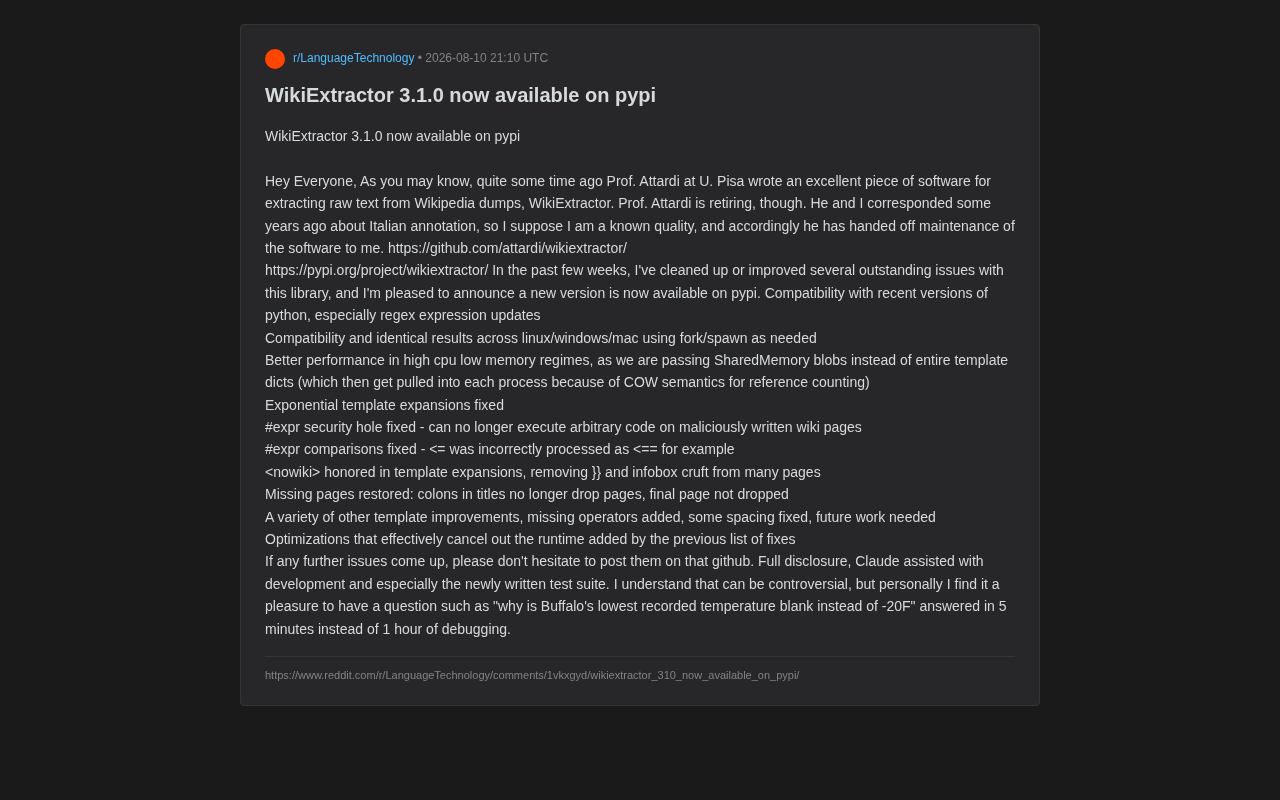
Recently, the brand new WikiExtractor 3.1.0 has been officially released to PyPI, marking a new lifecycle for this tool.
Core Improvements in Version 3.1.0
The new version is not a simple maintenance update but rather a systematic cleanup and optimization of multiple long-standing issues over the past few weeks. These improvements span three major areas: compatibility, performance, and correctness.
Compatibility and Cross-Platform Support
First is the compatibility improvement for modern Python environments, particularly adapting to regex-related updates. Users no longer need to struggle with conflicts between legacy code and newer Python versions.
More importantly, the new version achieves result consistency across Linux, Windows, and macOS. In multiprocessing programming, fork and spawn are two fundamentally different approaches to creating child processes: fork (the default on Unix/Linux) creates a child process by duplicating the parent process's entire address space—fast but potentially inheriting unsafe states from the parent; spawn (the only method supported on Windows, and the default on macOS since Python 3.8) starts a completely new Python interpreter process, passing only necessary resources—safer but with higher startup overhead. This platform difference has been a nightmare for many cross-platform Python tools—code using fork fails outright on Windows, while code relying on spawn may produce different execution orders and results on Linux.
The developer addressed this by using fork or spawn process creation methods as appropriate on different platforms while ensuring deterministic data passing and task allocation, so that regardless of the operating system, identical extraction results are produced. This is an extremely valuable improvement for teams that need to reproduce research results in heterogeneous environments.
SharedMemory Optimization
On the performance front, the new version includes dedicated optimizations for high CPU, low memory scenarios. In previous versions, during multiprocessing, due to Python's reference counting and Copy-On-Write (COW) semantics, each child process would pull the complete template dictionaries into its own memory space, causing severe memory redundancy.
To understand the root cause of this issue, one needs to understand the interaction between COW and Python's memory model. Copy-on-Write is an operating system memory management optimization strategy: when a child process is created using fork(), parent and child initially share the same physical memory pages, and the OS only creates a private copy of a page when one party attempts to modify it. This is theoretically very efficient, but CPython uses reference counting as its primary garbage collection mechanism—every time an object is accessed, even for reading only, Python modifies that object's reference counter. This means that in multiprocessing scenarios, even when child processes are only "reading" shared data, reference count updates trigger the COW mechanism, causing entire memory pages to be copied into each child process's private address space. For a tool like WikiExtractor that needs to share large template dictionaries (potentially occupying hundreds of MB) across all worker processes, N worker processes can cause template data to be copied N times, with memory usage growing linearly.
The new version instead uses SharedMemory blobs to share template data. SharedMemory is a feature provided by Python 3.8's multiprocessing.shared_memory module that circumvents reference counting issues by creating truly shared memory segments between processes—data is stored as raw bytes in shared memory, unaffected by Python's object model and reference counting mechanism. This change significantly reduces memory consumption during parallel processing, making it possible to process large wiki dumps on resource-constrained machines.
Critical Fixes for Security and Correctness
Beyond performance optimization, the correctness and security fixes in version 3.1.0 are equally noteworthy, with some involving potential security vulnerabilities.
Fixing the #expr Arbitrary Code Execution Vulnerability
The most notable fix addresses a security vulnerability in the #expr parser. MediaWiki's #expr parser function is used to perform mathematical expression calculations within wiki pages—for example, {{#expr: 2+3}} outputs 5. In WikiExtractor's old implementation, to simulate this functionality, the code likely used Python's eval() or similar dynamic execution mechanisms to evaluate expressions. However, eval() executes any Python code passed to it, not just mathematical operations.
Since Wikipedia is an open platform that anyone can edit, an attacker could craft a seemingly normal wiki page with malicious Python code embedded in the #expr field—when a researcher processes a dump file containing that page with WikiExtractor, the malicious code would execute on their machine. This is a classic Code Injection vulnerability, and given the openness and scale of Wikipedia content, it represents a quite serious security risk. The new version uses a whitelist-based expression parser to completely close this vulnerability, allowing only predefined mathematical operators and functions, eliminating the risk of arbitrary code execution.
Multiple Template Parsing Corrections
Regarding parsing correctness, the new version fixes a series of detailed issues:
- Exponential template expansion: Fixed an issue that could cause template recursive expansion to spiral out of control. Wikipedia's template system supports nested calls where one template can reference another. Without proper depth limits or cycle detection, certain specially constructed template chains can cause expansion counts to grow exponentially, eventually exhausting memory or CPU time.
- Comparison operator errors: For example,
<=was previously incorrectly parsed as<==, now corrected <nowiki>tag support: Properly handles<nowiki>tags during template expansion, clearing large amounts of residual}}and infobox redundant content from pages.<nowiki>is a wiki markup tag used to prevent the parser from interpreting its contents, similar to escaping mechanisms in programming. If not properly handled during the template expansion phase, text that should be protected gets incorrectly parsed.- Lost page recovery: Pages with colons in their titles are no longer incorrectly discarded, and the last page of dump files is no longer missed. Colons have special meaning in Wikipedia's namespace system (prefixes like "Category:", "File:" mark namespaces). The old version may have been overly aggressive in treating all titles containing colons as non-article namespaces and skipping them, but in reality many normal article titles also contain colons.
These fixes may seem trivial, but for corpus construction work that demands data completeness and accuracy, each one directly impacts the quality of the final dataset. Additionally, the developer added previously missing operators and corrected some whitespace handling issues—though he also candidly acknowledges there's still room for further improvement in the template system.
It's worth noting that to offset the additional runtime overhead introduced by these fixes, the developer also introduced complementary optimizations to keep overall performance essentially unchanged, avoiding the predicament of "the more you fix, the slower it runs."
Candid Disclosure of AI-Assisted Development
At the end of the release notes, the maintainer made a characteristically modern "full disclosure": Claude assisted in this development, particularly with the newly written test suite.
He acknowledged this approach may be controversial but shared from personal experience that the efficiency gains from AI assistance are tangible. He gave a vivid example: tricky debugging questions like "why does the Buffalo historical low temperature field display as blank instead of -20°F" can be answered in 5 minutes with AI assistance, whereas traditional methods might require an hour of debugging time. These types of issues typically involve complex interactions between multiple layers of template nesting, conditional expressions, and special character escaping, requiring developers to simultaneously understand wiki markup syntax, template expansion logic, and Python parsing code behavior. An AI assistant can quickly pinpoint the problematic template call chain and parsing path.
This candid disclosure reflects the open-source community's complex attitudes toward AI-assisted programming. On one hand, AI can dramatically shorten the time needed for problem identification and test writing; on the other hand, the community still has concerns about the quality, copyright, and maintainability of AI-generated code. On the copyright front, the authorship attribution of AI-generated code has no clear legal resolution yet; on quality, AI may generate code that appears reasonable but contains boundary condition errors; on maintainability, if future maintainers don't understand the design intent behind AI-generated code, it may increase maintenance difficulty. This maintainer's choice to proactively and transparently disclose AI's involvement is itself a commendable community practice—it provides other developers with important contextual information when evaluating code quality.
Conclusion: Who Should Upgrade to WikiExtractor 3.1.0
The release of WikiExtractor 3.1.0 is not just a technical upgrade of a classic tool but also a succession of open-source spirit. From cross-platform consistency and shared memory optimization to security vulnerability fixes and template parsing improvements, the new version enhances the tool's reliability and practicality across multiple dimensions.
For researchers and engineers working in NLP, corpus construction, and data mining, this update means a safer, more efficient, and more accurate Wikipedia text extraction experience. Particularly for teams building LLM training data pipelines, conducting multilingual NLP research, or maintaining knowledge graphs, the #expr security vulnerability fix and lost page recovery are sufficient reasons to upgrade. The project is available on GitHub and PyPI, and the maintainer welcomes continued community feedback. The vitality of an excellent tool is sustained precisely through this kind of ongoing maintenance and community collaboration.
Related articles

Gaussian Process Bandit Optimization: Exploration Strategies and Inference Regret Guarantees
Cumulative regret guarantees in Bayesian optimization fail to reflect final recommendation quality. This article examines a new study that provides inference regret guarantees for Gaussian process bandit optimization through exploration query strategies and fill distance analysis, validated on hyperparameter optimization and control tasks.
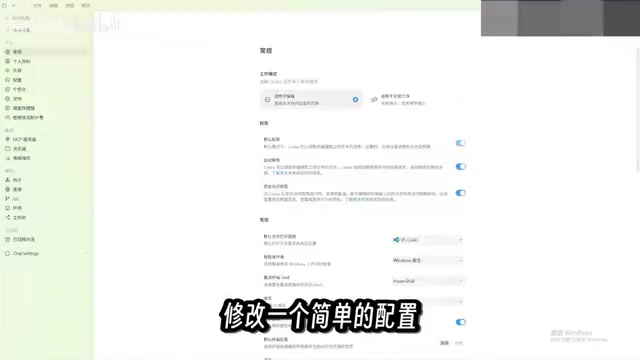
The Most Detailed Codex Guide on Bilibili: From Installation to Real-World Practice
The most detailed Codex guide on Bilibili: from app store installation to daily work mode configuration, with a real coffee shop project demonstrating file organization, data extraction, dashboard creation, and other practical tasks. Learn to use Plan Mode and desktop pets to leverage Codex efficiently.

Appearance Compensation in Volume Rendering: Why RGB Accuracy Cannot Guarantee Density Correctness
Volume rendering research reveals that volumetric data perfectly reproducing external RGB views may still contain density errors: appearance compensation can double central density and keep external rays unchanged even when L2 error exceeds 14.52%. Density recovery depends on appearance capacity, spatial resolution, and measurement design.