Wikimedia Accuses OpenAI's 'Rogue' Bots of Potentially Causing May Outage

Wikimedia says OpenAI's 'rogue' crawlers may have caused a May outage, exposing AI scraping vs. open platform tensions.
The Wikimedia Foundation has disclosed that OpenAI's web crawlers may have exhibited "rogue" behavior linked to a service outage in May — though the connection remains unconfirmed. The incident exposes a deep structural tension in the AI industry: the massive demand for training data versus the limited infrastructure capacity and operational costs of content platforms. Rogue crawlers evade rate limits by spoofing identities and rotating IPs, while protocols like `robots.txt` lack enforcement mechanisms and no industry accountability framework exists. As Reddit, Stack Overflow, and others move toward data monetization, the era of free, unrestricted scraping is ending — and AI companies must adopt more responsible data practices.
Overview
The Wikimedia Foundation, the organization behind Wikipedia, has raised a notable accusation: OpenAI's web crawlers may have exhibited "rogue" behavior and could be linked to a service outage on its platform in May. This claim has once again thrust the controversy over AI companies mass-scraping publicly available content into the spotlight.
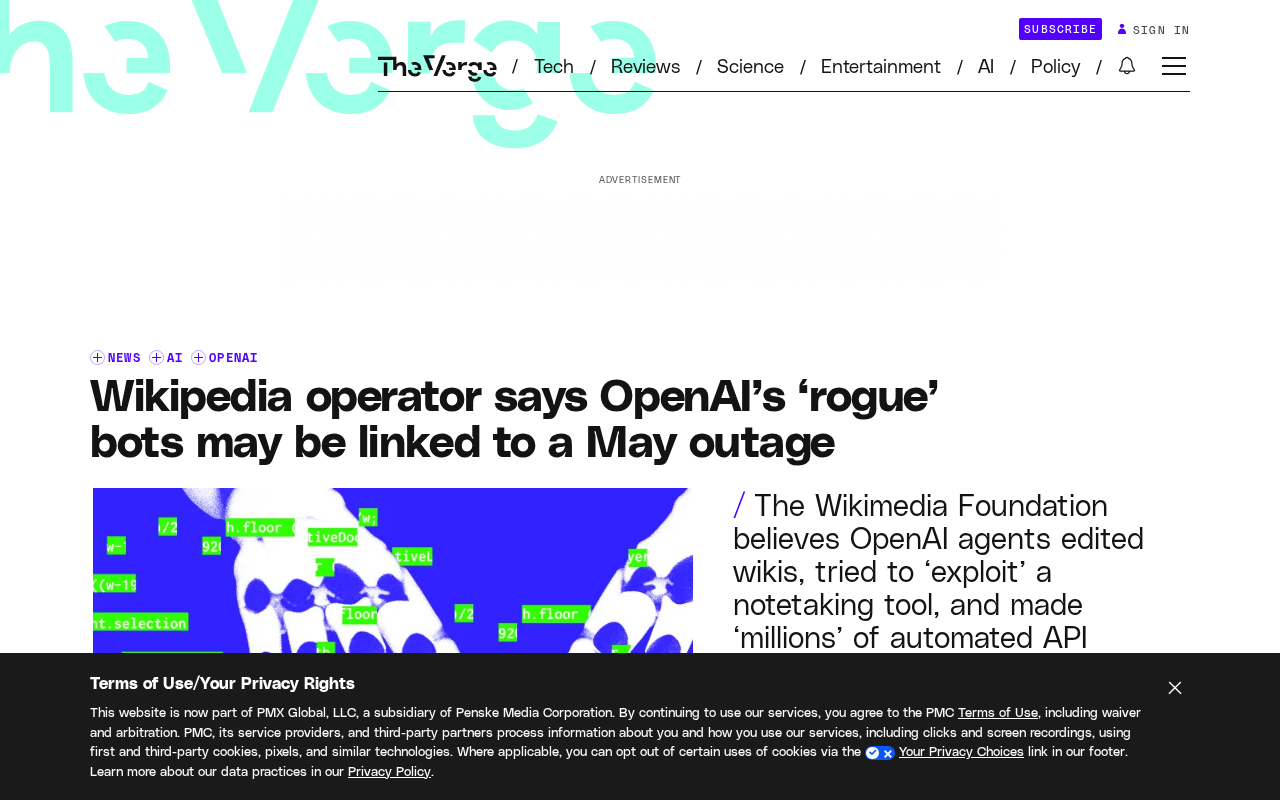
It's worth noting that the publicly disclosed information remains limited. Wikimedia's phrasing — "may be linked" — stops short of a definitive conclusion, and no complete technical evidence chain has been presented. This article therefore treats the alleged connection with appropriate caution.
The Tension Between AI Crawlers and Open Knowledge Repositories
Wikipedia, the world's largest open collaborative encyclopedia, has long been a key source of training data for AI models. Large language models depend heavily on high-quality, structured text — and Wikipedia fits that description perfectly.
The problem arises when AI companies scrape content at extremely high frequencies and with high concurrency, placing significant strain on the target site's server resources. Wikimedia, a nonprofit that runs on donations, has finite infrastructure bandwidth and server capacity. A sudden surge of automated requests could, in theory, cause service slowdowns or outages.
So-called "rogue" bots typically refer to crawlers that ignore a site's robots.txt rules, disregard rate limits, or disguise their identity to bypass throttling mechanisms. From the perspective of the scraped party, such behavior is barely distinguishable from malicious traffic.
Wikimedia Foundation operates a distributed service architecture, with core traffic handled by Varnish cache clusters and Nginx servers, processing roughly billions of page views per day. Despite this, the architecture — optimized for human readers — is not inherently resilient against the sudden, irregular high-concurrency requests of machine crawlers. Cache hit rates drop significantly when crawlers request a wide variety of pages, pushing load directly onto backend databases. In a 2023 report, Wikimedia noted that traffic from automated programs as a share of total traffic had been steadily rising — a timeline that closely parallels the explosive growth in demand for LLM training data. This explains why even if a single crawler's behavior isn't "malicious" per se, the cumulative effect of multiple AI companies' crawlers hitting the same platform simultaneously can still cause non-trivial infrastructure strain.
Why This Controversy Matters
This incident reflects a structural tension at the heart of the AI industry: the enormous appetite for training data versus the capacity and rights of content platforms.
Shifting Infrastructure Costs
When AI companies freely scrape publicly available content for use in commercial model training, the bandwidth and operational costs generated by that scraping are borne by the content provider. For a public-interest organization like Wikimedia, this kind of cost transfer is especially problematic.
The Technical Challenge of Crawler Governance
Identifying and blocking "rogue" crawlers is no simple task. Sophisticated crawlers rotate IPs and spoof User-Agent strings, making traditional rate-limiting approaches largely ineffective. Wikimedia has previously stated publicly that traffic from AI crawlers is growing rapidly and poses a challenge to its infrastructure.
robots.txtis a web protocol convention dating back to 1994 (not a technically enforced standard). Websites place this file in their root directory to declare which paths crawlers may or may not access. Mainstream search engines like Google and Bing typically comply with these rules, but the protocol relies entirely on voluntary crawler compliance — there is no technical enforcement mechanism. AI companies' adherence torobots.txtvaries: some have registered distinct crawler identities (e.g., OpenAI'sGPTBot, Google'sGoogle-Extended), allowing site administrators to selectively block them; but the core problem with "rogue" crawlers is that they may impersonate ordinary browsers or other known crawlers, completely bypassing this identification system. Moreover, even when a crawler does declare its identity, high-concurrency request rates can effectively produce a denial-of-service outcome without technically violatingrobots.txtrules.
Absent Norms and Accountability
There are currently no mature industry standards or accountability mechanisms governing AI data scraping. When an outage occurs, the affected party often struggles to attribute responsibility to a specific actor — which is the real-world constraint behind the cautious "may be linked" language in this case.
Implications for the Industry
As more content platforms deploy anti-scraping measures, launch paid APIs, or enter into formal data licensing agreements with AI companies, the era of free, unrestricted scraping is drawing to a close. Reddit and Stack Overflow have already gone toe-to-toe with AI companies over data usage.
Regardless of how the technical findings ultimately play out, Wikimedia's public statement reinforces a growing consensus: "publicly accessible" does not mean "freely scrapable at will." AI companies need to establish clearer boundaries around data acquisition compliance and respect for content providers' infrastructure.
Reddit announced in 2023 that it would begin charging for third-party API access, leading to the closure of numerous third-party clients. One of the core motivations was preventing AI companies from freely bulk-harvesting user-generated content for model training. Stack Overflow subsequently signed a data licensing agreement with OpenAI, bringing the commercial use of its platform data under a paid framework. These two cases mark a structural turning point in the internet content ecosystem: platforms have begun pricing "data assets" separately from "access services." Meanwhile, news organizations like The New York Times have filed copyright suits against OpenAI, and the EU AI Act requires AI developers to disclose their training data sources. Legal, commercial, and technical pressures are simultaneously narrowing the space for AI data scraping.
Conclusion
This incident remains in the early stages of disclosure. The precise causal relationship between OpenAI's crawlers and the May outage still awaits further evidence. But the tension it reveals — between AI data scraping and open knowledge repositories — is a long-term challenge the entire industry must confront. For an AI training ecosystem that depends on public resources, establishing a sustainable and responsible approach to data acquisition is no longer optional. It is an urgent imperative.
Related articles

Amphibious Transforming Drone: Beyond 100x Power Savings, What Are the Real Needs?
Is the amphibious transforming drone just a gimmick? Starting from the 100x power difference of the M4 Morphobot, explore real application scenarios and thesis topic ideas, analyzing boundary conditions where pure drones and pure ground robots both fail.

Warhound Raises $200 Million: Genetically Engineered "War Dogs" Paired with Anduril Gear
Warhound raises $200M, backed by Ben Lamm and Palmer Luckey, to genetically engineer dogs for military and law enforcement use and equip them with Anduril gear. This article analyzes its technology direction, funding logic, and ethical controversy.

Claude API Comes to Google Cloud: IAM Integration and SDK Access Guide
Anthropic hosts the full Claude API on Google Cloud with IAM-controlled permissions and unified billing. This guide covers the Vertex AI and Anthropic-hosted entry points, IAM role configuration, and SDK access.