Will Jensen Huang's Departure Shake NVIDIA's Open-Source Commitment?
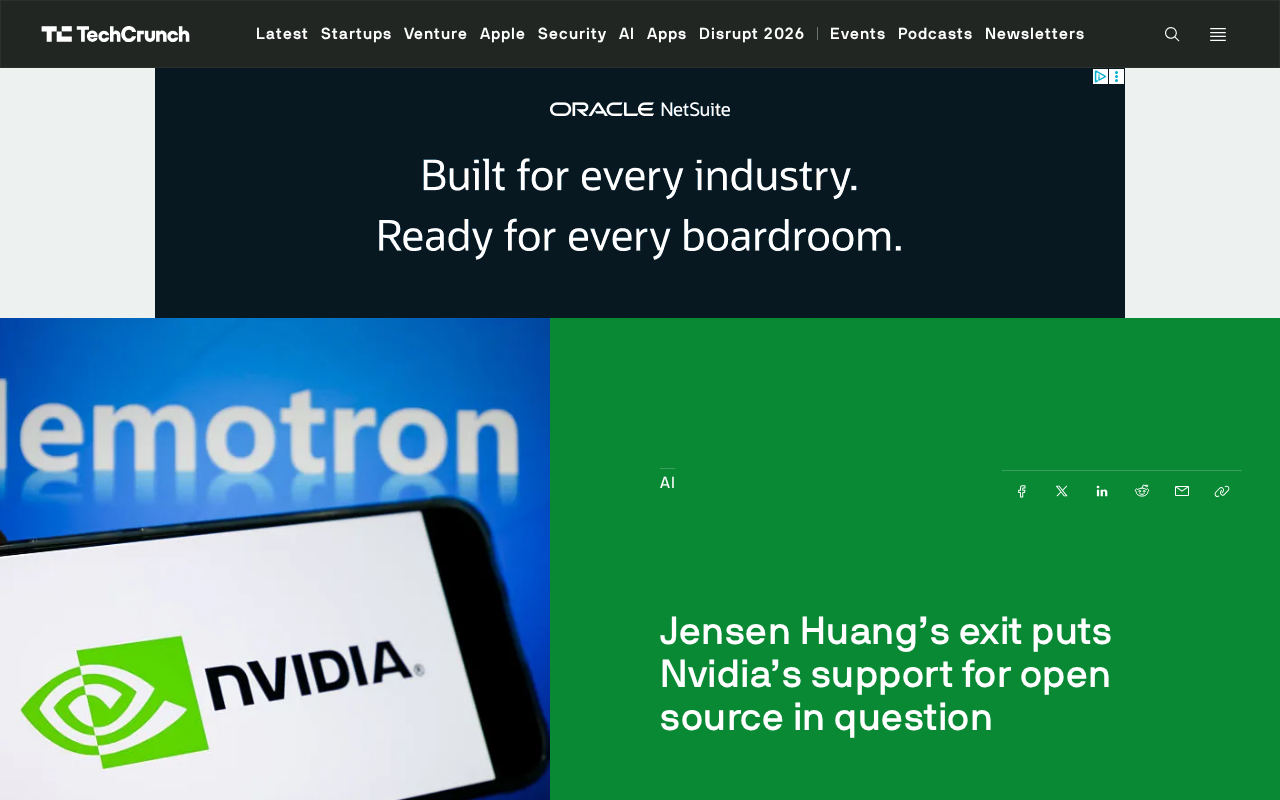
Jensen Huang's exit sparks concerns over NVIDIA's open-source strategy, though organizational inertia may preserve its commitments.
Jensen Huang's departure has developers questioning whether NVIDIA will maintain its open-source AI strategy. Its investments—acquiring Hugging Face, releasing open-weight models, and opposing restrictive AI regulation—are driven by the logic that open source lowers barriers and drives GPU demand. Leadership change could slow Hugging Face integration, open-model releases, and policy advocacy, but open source remains core to NVIDIA's CUDA ecosystem lock-in.
NVIDIA CEO Jensen Huang's departure has sent shockwaves through the AI community. More than who will succeed him, developers care about a more practical question: will this company—which has invested heavily in open-source AI—shift its open-source strategy now that its visionary leader is gone?
Open-Source Footprint: More Than Just Selling Chips
Over the past few years, NVIDIA's open-source investments have been plain to see. From acquiring Hugging Face (a move once seen as a strong vote of confidence in the open-source ecosystem), to releasing multiple open-weight models, to publicly opposing regulatory proposals that would restrict open-source AI, NVIDIA has gradually evolved from "hardware supplier" into a key player in the open-source ecosystem.
This shift has a clear business logic: open-source models lower the barrier to AI development, and developers' experimentation and deployment ultimately translate into demand for GPU compute. Huang himself has repeatedly championed open source in public, framing it as part of NVIDIA's "accelerated computing" vision. Now that vision has lost its most visible advocate.
Hugging Face is the world's largest hosting platform for open-source AI models and datasets, dubbed "the GitHub of AI" by developers. It offers model sharing, version management, inference APIs, and other services, hosting hundreds of thousands of pre-trained models—making it the de facto infrastructure of the open-source AI community. For NVIDIA, acquiring Hugging Face meant direct access to its vast developer user base—developers who experiment, fine-tune, and deploy models on the platform, all of which ultimately translates into demand for GPU compute. Hugging Face is therefore not only the gateway to the open-source ecosystem but also a key springboard for NVIDIA to extend from the hardware layer into software and community.
Open-weight models refer to models whose parameters (weights) are made public after training for others to download, use, and fine-tune—distinct from fully open-source models (which also release training code and data). NVIDIA's models of this kind (such as the Nemotron series) typically come with permissive licenses, aimed at lowering the barrier for developers to build AI applications while promoting its GPU ecosystem. The iteration frequency and degree of openness of open-weight models often reflect a company's genuine willingness to invest in the open-source community, making them an important indicator of its strategic direction.
The Chain of Uncertainty Unleashed by the Departure
The impact of leadership change on open-source commitments can be observed on three levels.
Hugging Face integration direction. After the acquisition, Hugging Face maintained relatively independent operations, but strategic priorities are defined by the parent company. Whether the new management is willing to maintain this "loosely coupled" relationship, or prefers to deeply bind Hugging Face's capabilities to NVIDIA's own software stack, will directly affect the open-source community's experience.
Investment pace in open-weight models. NVIDIA's previously released open models carried clear ecosystem-building intent, and their iteration speed and degree of openness were closely tied to senior-level push. Once internal support weakens, resource allocation for such projects may be reassessed.
Continuity of policy advocacy. Huang's speaking out against restrictive AI regulations relied heavily on his personal influence. After the leadership change, whether NVIDIA's activity on regulatory issues will decline remains unclear.
Open Source Is a Strategic Asset, Not a Personal Preference
It should be noted that attributing NVIDIA's open-source support entirely to Jensen Huang may underestimate organizational inertia. Open source has become a core tool for NVIDIA to lock in its developer ecosystem—CUDA's moat is built precisely on a broad community, and open-source models and toolchains are a natural extension of that logic. The board and core management are not divided on this point.
But short-term fluctuations are hard to avoid. Strategic ambiguity during the transition period may slow the pace of some open-source projects, and the community will watch to see the new leadership's true attitude toward Hugging Face and open models. For researchers and startups relying on NVIDIA's open-source tools, this window period deserves close attention.
CUDA (Compute Unified Device Architecture) is NVIDIA's parallel computing platform and programming model, allowing developers to use GPUs for general-purpose computing. Since its release in 2006, CUDA has accumulated a large number of libraries, tools, and community tutorials, becoming the industry standard for AI training and inference. Its moat lies not only in technical performance but also in the lock-in effect of the developer ecosystem: researchers are accustomed to writing code in CUDA, enterprises build toolchains around CUDA, and migrating to other platforms is costly. Open-source models and toolchains (such as TensorRT and Triton) are a natural extension of the CUDA ecosystem—they lower the barrier for developers to deploy models on NVIDIA platforms, further reinforcing hardware stickiness. Open-source support is therefore a strategic investment for NVIDIA to strengthen the CUDA ecosystem, not a purely philanthropic act.
What Developers Should Watch
Rather than speculating about the direction of personnel changes, a more pragmatic approach is to keep an eye on several observable signals: whether Hugging Face's roadmap adjusts, the release frequency of NVIDIA's open-weight models, and the company's public statements on AI regulation. These are the hard indicators that measure the substance of its open-source commitment.
One-line Summary
Jensen Huang's departure raises concerns about the direction of NVIDIA's open-source strategy, but organizational inertia may keep its open-source commitments on course.
Paragraph Summary
Jensen Huang's departure has developers focused on the continuity of NVIDIA's open-source strategy. In recent years, NVIDIA has been deeply involved in the open-source ecosystem by acquiring Hugging Face, releasing open-weight models, and opposing regulatory proposals that restrict open-source AI—driven by the business logic that open source lowers development barriers and drives GPU compute demand. Leadership change could affect the direction of Hugging Face integration, the pace of investment in open models, and the strength of policy advocacy, creating short-term strategic ambiguity. But open source has become a core tool for NVIDIA to lock in its CUDA developer ecosystem, and organizational inertia makes a strategic pivot unlikely. Developers should watch observable signals such as Hugging Face's roadmap, open-model release frequency, and regulatory statements.
Related articles

Astrophysicist Pokes Fun at Supermoons: The Difference Between a 16-Inch and a 15-Inch Pizza
Astrophysicist Neil deGrasse Tyson criticizes the terms supermoon and micromoon, using a 16-inch vs. 15-inch pizza analogy to show the visual difference is negligible, and calls out exaggerated labels in science communication.
Bypassing the iOS Safari 60fps Limit: Building a Native-Like Web App Experience
A deep dive into bypassing iOS Safari's 60fps limit through compositor animations, frame rate decoupling, and interaction detail optimization to give web apps a near-native feel on iPhone.

Allstate's Multi-Day Technical Outage Before Thanksgiving
Insurance giant Allstate suffered a multi-day technical outage before the Thanksgiving travel peak. This article analyzes the impact of the timing, implications for insurtech, and the importance of system stability for financial institutions.