Will Wright's New Game MyMems: Turning Your Memories into a Game World with AI

Will Wright's new game MyMems uses AI to turn personal memories into an explorable game world.
Will Wright, who defined systems simulation games with SimCity and The Sims, is now developing an AI-driven title called MyMems centered on players' personal memories. The article notes this marks a shift from simulating the external world to simulating the internal world: AI likely handles understanding unstructured memory material and organizing it into interactive virtual spaces. This moves games from preset content consumption toward authorship-driven creation while amplifying privacy and trust risks. Public information remains at the conceptual level—specific interactions, platform, and release date are undisclosed—but the project reflects the industry trend of AI pushing games toward content co-creation.
From SimCity to Simulated Memory
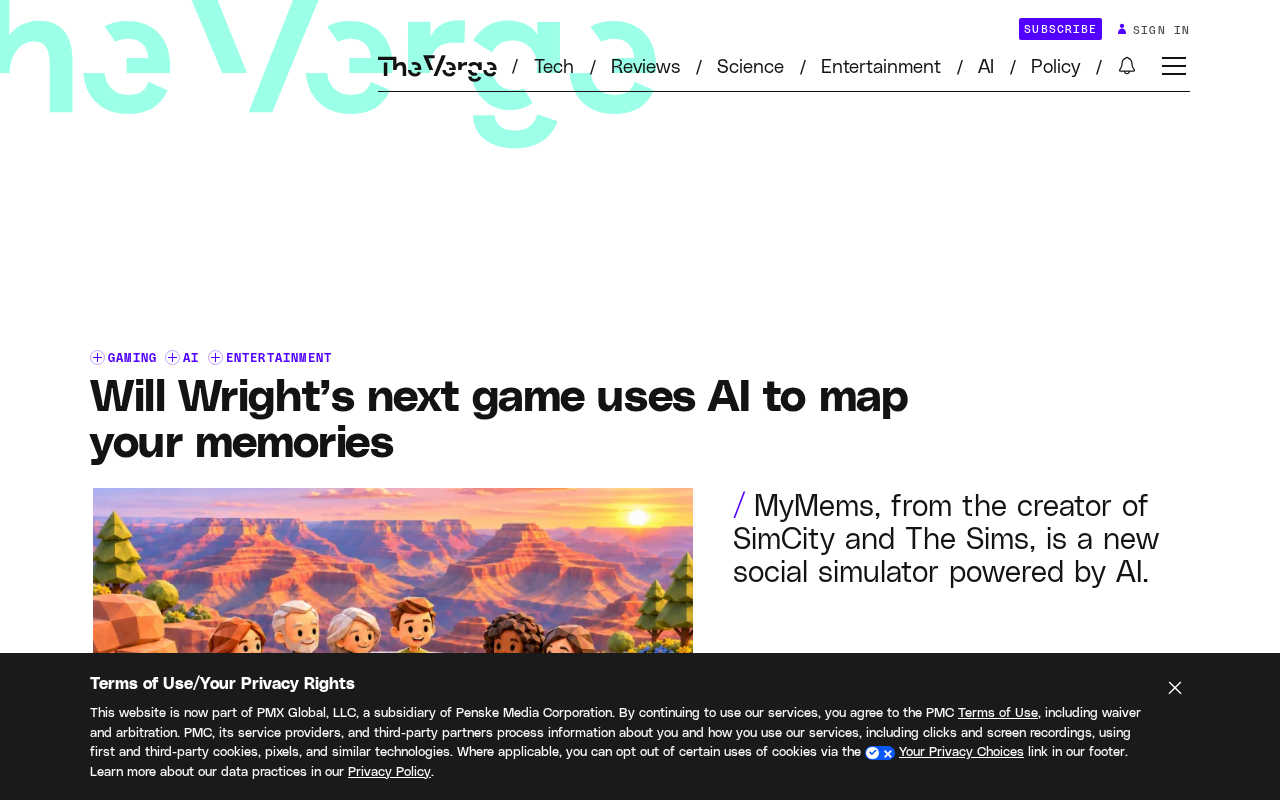
Will Wright, the creator of SimCity and The Sims, is developing a new AI-driven game called MyMems. The project revolves around "your memories" and continues Wright's signature ambition: letting players create and explore worlds of their own making.
The name Will Wright is practically synonymous with the "systems simulation" genre. From SimCity, which had players plan how a city runs, to The Sims, which turned everyday life into a playable system, his strength has always been breaking complex reality down into rules that players can tinker with. MyMems turns this methodology toward a more personal domain—memory.
According to the original report, the core of MyMems is to let players explore a world they have created in an entirely new way. In other words, the input is no longer a map or a character but the user's own memories. The role AI plays here is most likely to transform scattered, unstructured personal memories into an interactive game space.
This shift is worth noting: Wright's past works simulated the "external world," while MyMems simulates the "internal world." The former relies on public rules, the latter on private data—which amplifies both the game's imaginative potential and its privacy concerns.
Will Wright's most famous contribution to game design is the concept of the "software toy." Unlike traditional games that emphasize goals, winning and losing, and levels, he tends to build simulation systems with no fixed endpoint, letting players experiment freely within a framework of rules and observe emergent outcomes. SimCity originally had no concept of "beating the game" at all—players were more like tinkering with a dynamic model. This design philosophy later influenced a large number of sandbox and management simulation games. Understanding this helps clarify MyMems' positioning: it may likewise not be a quest-driven product at its core, but an open system for players to explore, edit, and reinterpret their own memories.
How AI "Maps" Memory
The source material does not disclose the technical details of MyMems, but from the description "using AI to map your memories," we can infer that the game needs to accomplish at least two steps: understand the memory material the user provides, then organize it into an explorable virtual world. This aligns with the direction of current generative AI capabilities in content generation and spatial construction.
For players, this means the game is no longer just consumption of preset content but an act of creation with authorship. Wright has consistently emphasized player expression in interviews, and MyMems pushes that expression from "building a city" to "building scenes of memory."
It should be noted that the currently public information is limited to the conceptual level; the specific interaction format, platform, and release date are all unclear, and this article makes no speculation about undisclosed details.
"Unstructured data" refers to information without a predefined model or fixed format—for example, free text, voice recordings, photos, handwritten notes, and so on. Personal memory material is usually exactly this form: scattered, subjective, and lacking uniform tags. To turn such data into an interactive game space, steps such as extracting entities, identifying relationships, and generating scene descriptions or spatial layouts are typically required—precisely the areas where current large language models and multimodal models excel. However, the controllability and consistency of generated results remain challenging, because the same memory may be mapped into very different scenes under different prompts, which directly affects players' sense of recognition that "this is my memory."
The Imagination and Risks of Memory as Game Material
Handing memories to AI to process opens up vast imaginative possibilities: players can revisit a childhood street corner, reconstruct a journey, or even turn family stories into roamable spaces. The emotional appeal of such experiences far exceeds the geographical exploration of traditional sandbox games.
The risks are equally obvious. Memory is highly private data, and how AI stores, processes, and presents this content directly relates to user trust. Wright's project has not published any information about its privacy architecture, which is a question it will have to answer in the future.
From an industry perspective, MyMems represents a trend: AI is pushing games from "content consumption" toward "content co-creation." Wright's past works defined the simulation genre; this time he has chosen to redo it with AI, and the results are worth following closely.
On the privacy and data governance front, personal memories constitute sensitive personal information, involving highly private content such as emotions, family, and location. If an AI system needs to upload this data to the cloud for processing, it raises compliance issues around data retention periods, access permissions, whether the data is used for model training, and cross-border transfers. Regulations such as the EU's General Data Protection Regulation (GDPR) impose high requirements on the handling of sensitive data, and users typically need to give explicit informed consent. For a product like MyMems, whether it can offer localized processing, deletion mechanisms, and transparent data usage statements will directly affect whether users are willing to entrust it with their real memories.
FAQ
What kind of game is MyMems?
Currently public information indicates it is an AI-driven game centered on personal memories; specific gameplay has not been disclosed.
Who is Will Wright?
He is the creator of the SimCity and The Sims series, known for systems simulation games.
When will MyMems be released?
The original report did not mention a release date or platform; we will have to wait for official announcements.
One-line Summary
Will Wright's new game MyMems uses AI to turn personal memories into an explorable game world.
Related articles

ChatGPT Plus Subscription Pitfall Guide: Go/Plus/Pro Tier Comparison and Quick Activation
A complete ChatGPT Plus subscription guide based on a Bilibili tutorial: from registering an account, comparing Go/Plus/Pro tiers, to the practical steps for quickly completing your subscription.

GPT-6.2 Sol/Astra Released! A Step-by-Step ChatGPT Plus Subscription Guide and Tier Comparison
GPT-6.2 Sol/Astra is out—here's a ChatGPT Plus subscription guide: register an account, compare Go/Plus/Pro tiers, and subscribe in a minute.

Comparing Three Channels for Subscribing to GPT Plus in China: Is Website Top-Up the Easiest?
How to subscribe to GPT Plus in China? This article compares website top-up, credit card, and mobile top-up channels—process, cost, and risk—with steps and tips to help you choose wisely.