Will You Regret Not Working at a Big Tech Company? A Deep Dive into Career Choices for Programmers

A deep dive into whether programmers should regret not joining big tech, and how to think about career trade-offs.
A Reddit post asking whether not joining FAANG is a regret sparked wide discussion among tech professionals. This article examines the real pay gap, hidden costs like PIP culture and burnout, and why career satisfaction is deeply personal. It advises distinguishing social comparison from genuine needs, exploring options at low risk, and building transferable skills — because having choices is the ultimate antidote to career anxiety.
A Career Dilemma That Resonates Widely
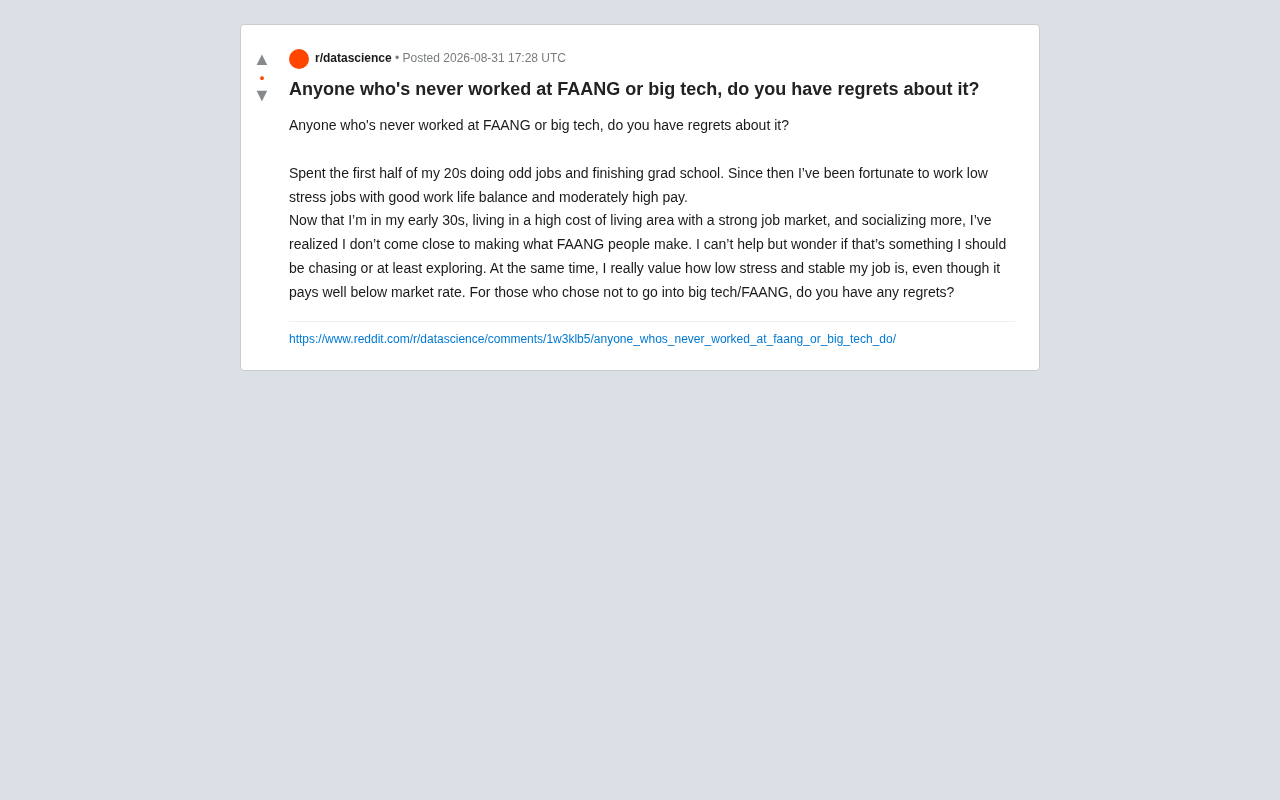
Recently, a programmer's post on Reddit sparked extensive discussion across the tech community. The poster's experience is remarkably relatable: they spent their early 20s working odd jobs and completing graduate school, then settled into a low-stress job with good work-life balance and above-average (but not exceptional) pay.
Now in their early 30s, living in a high cost-of-living area with a thriving job market, their social circle has expanded — and they've suddenly realized that their income pales in comparison to peers working at FAANG companies (Facebook, Amazon, Apple, Netflix, Google, and similar tech giants).
"I can't help but wonder if this is something I should pursue, or at least explore. But on the other hand, I really value my current low-stress, stable job — even though the pay is well below market rate."
The reason this post resonated so deeply is that it touches on a core question every tech professional inevitably faces: What exactly are we trading our careers for?
The Real Ledger Behind the Big Tech Halo
The Pay Gap Is Real
There's no denying it — compensation at FAANG and top-tier tech companies is significantly higher than the industry average. It's worth understanding how big tech compensation is structured: it typically consists of Base Salary, Restricted Stock Units (RSU), and annual performance Bonuses, collectively referred to as Total Compensation (TC). For a senior software engineer (L5/E5 level), TC in the Bay Area typically ranges from $350,000 to $550,000, while an engineer at the same level at an average tech company might earn $150,000 to $250,000. Notably, RSU value is directly tied to stock price, meaning actual take-home pay can shrink substantially during market downturns — a risk factor often overlooked in big tech compensation discussions.
A senior engineer at these companies can easily earn 2-3x the TC of their counterparts at regular companies. The poster's anxiety isn't unfounded — when your friends are making several times your salary, anyone would start second-guessing their choices.
This income gap is further amplified in high cost-of-living areas. Long-term financial goals like homeownership, raising children, and retirement savings can follow dramatically different trajectories depending on where your salary ceiling sits.
The Hidden Costs Behind High Pay
However, high pay is never free. The intense work pace, performance review pressure, frequent reorganizations, and layoff risks common at big tech companies are all "hidden costs" lurking behind those impressive compensation numbers.
Perhaps the most emblematic example is PIP (Performance Improvement Plan) culture. On paper, PIPs are designed to help underperforming employees improve, but in practice, they're widely regarded as a prelude to a "graceful termination" — industry estimates suggest fewer than 10% of employees placed on a PIP successfully pass it. Amazon's PIP culture is particularly well-known, with its implicit "Up or Out" rule and Stack Ranking system that requires managers to rate a certain percentage of team members as low performers each year. While this system theoretically drives organizational efficiency, it also breeds a highly competitive and even toxic work environment. During the 2022-2024 mass layoffs, Meta, Google, and other companies were also reported to have used PIP mechanisms to accelerate headcount reductions, leaving employees under constant evaluation pressure and contributing to rising mental health concerns.
What the poster currently has — "low stress, stability, and work-life balance" — is precisely the scarce resource that many big tech employees find impossible to buy back, even with their high salaries. When someone already enjoys health, free time, and peace of mind, is trading all of that for bigger numbers truly worth it? That requires very clear-eyed self-awareness.
Whether You'll Regret It Depends on Your Values
There's No Standard Answer — Only Personal Trade-offs
In these discussions, community responses tend to be polarized, which actually reveals the essence of the issue: career satisfaction is deeply personal.
Some people say they have no regrets. They believe health, family time, and mental well-being can't be measured in dollars, and that "enough" income combined with high quality of life is itself a form of success. These individuals typically have a clear hierarchy of values — they know what they want and aren't easily swayed by external benchmarks.
Others honestly admit to some regret, mainly around two points: first, the timeline to financial freedom gets pushed back — higher pay could have helped them buy a home or retire early sooner; second, the brand value on their résumé — big tech experience genuinely serves as a powerful credential for future job changes and promotions.
The Key Is "Exploring," Not "Chasing"
The poster's word choice is telling — they said "exploring," not blindly "chasing." That's a remarkably mature starting point.
For someone who already has a stable life, the most rational approach may not be to upend everything immediately, but to validate their curiosity in a low-risk way: apply to a few big tech positions, go through interviews, and learn about the real working environment and compensation ranges. This process alone delivers two possible outcomes — either you discover big tech isn't as glamorous as imagined and gain a deeper appreciation for what you have, or you walk away with a real offer that gives you negotiating leverage or a genuine option to switch.
The cost of exploring is far lower than the cost of regret. A failed interview costs you a few weekends at most, but the nagging question of "what if I had tried" can haunt you for years.
Practical Advice for Tech Professionals
Distinguish Between "Social Comparison" and "Genuine Needs"
The poster's anxiety largely stems from lateral comparisons that emerged after "socializing more." This is a psychological trap worth being vigilant about.
From a psychological perspective, there's a classic framework for this phenomenon — Social Comparison Theory. Proposed by psychologist Leon Festinger in 1954, it posits that humans have an innate drive to evaluate their own abilities and opinions by comparing themselves to others. Social comparison comes in two forms: "upward comparison" (comparing yourself to those better off) and "downward comparison" (comparing yourself to those worse off). When tech professionals enter social circles dense with high earners, frequent upward comparisons significantly reduce subjective well-being — even when their objective quality of life hasn't declined at all. Research in behavioral economics also shows that income satisfaction is highly relative — a person earning $120,000 where all their colleagues make $100,000 feels more satisfied than someone earning $150,000 where all their colleagues make $200,000.
Social comparison is endless — even after joining FAANG, you'll find people with higher offers, people who've already achieved financial independence, and people who've built successful startups. The real question isn't "how much do others earn," but "how much do I need to live the life I want?" When you shift the focus from others back to yourself, much of the anxiety naturally dissolves.
View Your Choices Through the Lens of a Long Career
A tech career can span thirty to forty years. Unlike the stereotype of a "programmer's age-35 crisis" from two decades ago, modern tech career paths have become significantly more diverse. Beyond the traditional management track (IC → Tech Lead → Engineering Manager → Director → VP), more and more companies have established senior Individual Contributor tracks — such as Google's Distinguished Engineer or Meta's E9 level — allowing experienced engineers to continue advancing without transitioning into management. Additionally, emerging paths like technical consulting, Developer Relations (DevRel), technical writing, and indie development offer flexible options for tech professionals at different life stages.
Over such a long time horizon, one or two career path decisions are not irreversible. Choosing the low-stress route today doesn't prevent you from pursuing big tech a few years later — and vice versa.
More importantly, focus on continuously building your core competencies — technical depth, system design skills, and industry influence. These "transferable skills" hold long-term value in any organizational context. When your abilities are strong enough, whether or not you've worked at a big tech company, you'll have abundant options — and having options is the ultimate weapon against career anxiety.
Conclusion
The question "will I regret not working at a big tech company" is fundamentally asking "how should I define a successful life?" This Reddit user's dilemma mirrors the inner conflict of countless tech professionals.
The answer may be this: If you already have health, stability, and sufficient income, then big tech isn't a mountain you must climb — it's simply one of many landscapes to choose from. Rather than exhausting yourself in cycles of anxiety, approach it with an open mind, explore, and let real information guide your decision.
No matter which path you ultimately choose, as long as it's made with clear-eyed self-awareness, there's no need for regret. Because the greatest regret is usually not choosing the wrong path — it's never having seriously thought about what you truly want.
Key Takeaways
Related articles

Trump's Request to Rename the Atlantic Rejected by Google; 1Password Lets AI Agents Log In Securely
The Vergecast roundup: Trump's request to rename the Atlantic the 'Trump Ocean' was politely declined by Google's CEO; 1Password's new feature lets AI agents log into accounts without touching passwords; OPPO launches the world's first 200-megapixel phone, the Find X10 Pro Max. All three point to the boundaries of tech authorization and trust.

The Truth About American College Party Culture: The Risks Schools Won't Admit
Behind American college party culture, the administration's "don't ask, don't tell" attitude is amplifying freshman risks. This article analyzes how the pandemic strengthened Greek dominance, freshmen's difficulty accessing safety information, and the chain reactions caused by a culture of denial.

OpenAI Reportedly Raising $30B at $1.25T Valuation Ahead of IPO
OpenAI is planning a $30B funding round at a possible $1.25T valuation, paving the way for an IPO. If completed, it would set a private company valuation record. This article analyzes the funding size, pre-IPO logic, and industry signals.