Withings Charges New Users $99/Year to Sync with Apple Health

Withings charges new users $99/year to sync data to Apple Health, sparking debate over the fairness of paid data export.
Withings recently adjusted its service strategy, requiring new users to pay a $99 annual subscription to sync device data to Apple Health. This change has sparked controversy in tech communities, as data export should be a basic hardware capability that doesn't consume extra server costs. The article analyzes the reasonable boundaries of subscriptions, noting that charging for cross-platform data interoperability may dilute hardware buyout value, and reminds users about data sovereignty and platform lock-in risks. For potential buyers, long-term costs rise significantly; for existing users, while rights may be preserved, the strategic shift warrants caution. Users can evaluate alternatives, confirm their exposure, and follow community responses.
Health Data Now Requires a Subscription?
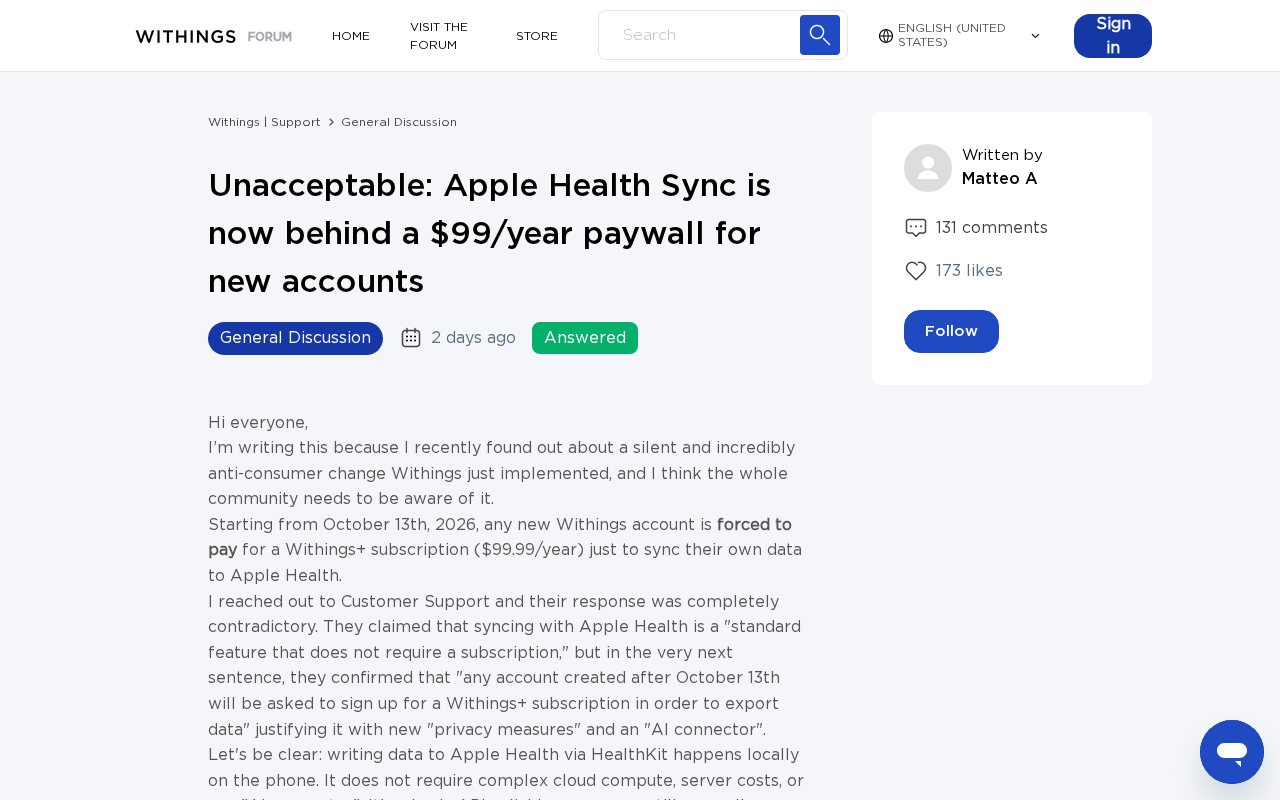
Smart health device maker Withings recently adjusted its service strategy: new users who want to sync their device data to Apple Health must pay an annual subscription fee of $99. This change has sparked considerable discussion in tech communities like Hacker News—when the hardware is already paid for in full, yet data export becomes a paid feature, the business logic and user impact behind this deserve a closer look.
What Exactly Changed
According to the discussion thread on Hacker News, Withings' charging policy for the Apple Health sync feature primarily targets new users. This means: new users who purchase Withings hardware devices and wish to write health data such as weight, blood pressure, and sleep into the Apple Health ecosystem need to unlock this capability through a paid subscription.
For existing users who are already using Withings products, current information suggests their existing rights may not be affected, but this "cutoff between old and new users" approach itself hints that the manufacturer is testing user acceptance of charging for data export.
Why This Matters
Data Export Should Be a Basic Capability
The value of health data lies precisely in its flow. When users buy a smart scale or blood pressure monitor, one of the core demands is to aggregate this data into a unified health management platform—for iPhone users, Apple Health is the most natural choice.
Setting "syncing data to the user's own health account" as a paid feature is logically delicate: the data collected by the device belongs to the user, and exporting it to a third-party platform does not consume the manufacturer's ongoing service costs. This is fundamentally different from subscription features like cloud storage or advanced analytics that genuinely require server resources.
Apple Health is a health data aggregation framework launched by Apple in iOS 8. It does not produce data itself, but serves as a centralized platform that receives health and fitness data from iPhone, Apple Watch, and numerous third-party apps and Bluetooth devices. Third-party hardware manufacturers who want to write data to Apple Health typically do so through the HealthKit API. The server cost of this process is extremely low: data synchronization mainly occurs between the user's device and the manufacturer's app, which then calls the system interface to write to Apple Health—the manufacturer does not need to maintain additional cloud services for this. Therefore, Withings including this feature in its subscription is more of a business strategy consideration rather than reasonable pricing based on ongoing service costs. This also explains why the tech community reacted so strongly—the technical overhead of the feature itself clearly does not match the subscription price.
Where Is the Boundary of Subscription Models
Hardware manufacturers shifting to subscription models is nothing new. The problem is that there is no unified industry standard for which features are suitable for subscription and which should be provided as a one-time purchase with the hardware.
Withings' adjustment has drawn a rather controversial line: cross-platform data interoperability has become a paid item. If this model is imitated by more manufacturers, users may face a situation where "you buy the device but still need to keep paying to use its full functionality," further diluting the value of one-time hardware purchases.
In the smart hardware space, common reasonable subscription scenarios include: cloud storage and data backup (manufacturers bear server and bandwidth costs), advanced data analytics and personalized recommendations (involving algorithms and ongoing computation), multi-user family account management, and value-added services such as extended warranties or dedicated customer support. What these features have in common is that manufacturers still need to invest resources continuously after the hardware is sold. Conversely, data export, basic device control, and local data viewing are typically regarded as basic hardware capabilities whose costs are already included in the purchase price. The controversy in the industry centers on the fact that some manufacturers are trying to package "data portability"—a basic user right—as a subscription feature, thereby opening up recurring revenue beyond hardware profits. If this trend spreads, it could undermine consumer confidence in the hardware buyout model.
Real Impact on Users
For users currently considering purchasing Withings devices, the math needs to be recalculated: beyond the device price, an annual $99 subscription fee significantly raises the long-term cost of use. Over three years, the subscription alone would approach $300, which could directly influence purchase decisions for price-sensitive users.
For users who already rely on the Withings + Apple Health workflow, although their rights may be preserved in the short term, the manufacturer's strategic shift also reminds everyone: the portability of health data and platform lock-in risks should be factored into the consideration when choosing smart health devices.
Platform lock-in refers to users' data and workflows being bound to a specific manufacturer's ecosystem, resulting in high switching costs when migrating to other platforms. In the smart health device field, platform lock-in is particularly insidious: if long-accumulated data such as weight, blood pressure, and sleep cannot be easily exported, it becomes difficult to switch brands, because the continuity of historical data is crucial for health trend analysis. Withings' move to make Apple Health sync a paid feature actually reinforces this lock-in—users must either keep paying to maintain data flow or give up cross-platform integration and remain trapped within Withings' own app. For users who already deeply rely on the Withings + Apple Health workflow, even if short-term rights remain unchanged, the uncertainty of future policies also constitutes a risk. Therefore, when choosing smart health devices, in addition to hardware accuracy and price, data export capability, API openness, and the manufacturer's subscription strategy should all become key evaluation dimensions.
Possible Responses for Users
Faced with such strategic adjustments, users can focus on several directions: first, confirm whether they fall within the affected new user scope; second, evaluate whether there are alternatives, such as similar devices that support direct data export or open APIs; third, follow the manufacturer's subsequent responses in the community to see if there will be policy adjustments.
Data sovereignty and platform openness are becoming increasingly important dimensions in smart hardware purchasing. Withings' adjustment may just be the beginning of this round of discussion.
One-line Summary
Withings charges new users $99 per year to sync data to Apple Health, sparking debate over the reasonableness of charging for data export.
Paragraph Summary
Withings recently adjusted its service strategy, requiring new users to pay an annual $99 subscription fee to sync device data to Apple Health. This change has sparked controversy in tech communities, as data export should be a basic hardware capability that does not consume additional server costs for the manufacturer. The article analyzes the reasonable boundaries of subscription models, pointing out that classifying cross-platform data interoperability as a paid item may dilute the value of hardware buyouts, and reminds users to pay attention to data sovereignty and platform lock-in risks. For those considering a purchase, long-term costs rise significantly; for existing users, while rights may be preserved, the manufacturer's strategic shift is worth vigilance. Users can evaluate alternatives, confirm the scope of impact on themselves, and follow subsequent community responses.
Related articles

Amphibious Transforming Drone: Beyond 100x Power Savings, What Are the Real Needs?
Is the amphibious transforming drone just a gimmick? Starting from the 100x power difference of the M4 Morphobot, explore real application scenarios and thesis topic ideas, analyzing boundary conditions where pure drones and pure ground robots both fail.

Warhound Raises $200 Million: Genetically Engineered "War Dogs" Paired with Anduril Gear
Warhound raises $200M, backed by Ben Lamm and Palmer Luckey, to genetically engineer dogs for military and law enforcement use and equip them with Anduril gear. This article analyzes its technology direction, funding logic, and ethical controversy.

Claude API Comes to Google Cloud: IAM Integration and SDK Access Guide
Anthropic hosts the full Claude API on Google Cloud with IAM-controlled permissions and unified billing. This guide covers the Vertex AI and Anthropic-hosted entry points, IAM role configuration, and SDK access.