Woman Rescues Injured Crow, Keeps Receiving "Thank-You Gifts" from Birds

A woman keeps receiving "gifts" after rescuing an injured crow, sparking discussion on crow cognition and human-wildlife interaction.
A video documents a woman who, after rescuing an injured crow, continues to receive shiny small objects left by the crow. The article explains crows' tool use, face recognition, and long-term memory, and presents two animal behavior explanations for "gift-giving": reciprocal instinct and collecting habits. It also reminds readers that wildlife rescue should involve professional organizations. Similar cases worldwide show corvids can form long-term memories and selective interactions with specific individuals. The story's value lies in showing that human kindness may be perceived and reciprocated by animals.
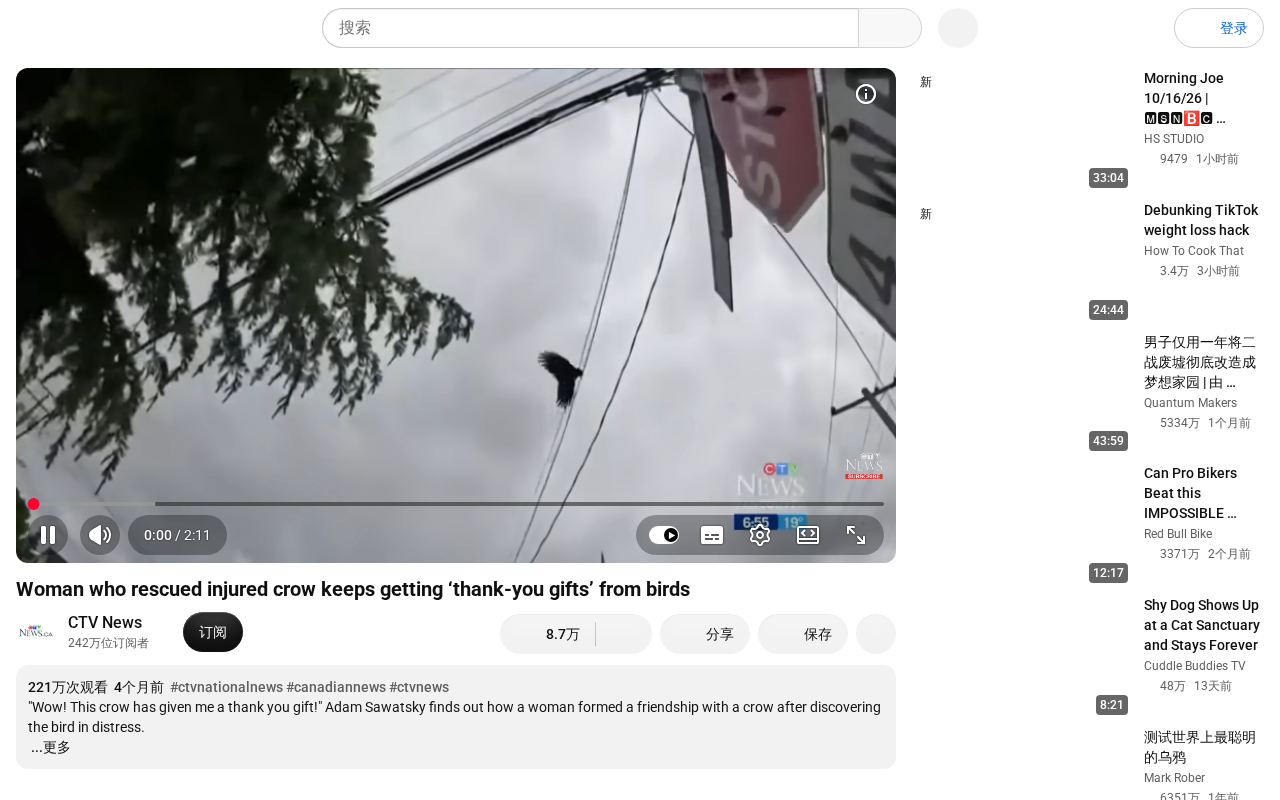
A video about human-wildlife interaction has sparked widespread discussion online. After a woman rescued an injured crow, she has continued to receive "thank-you gifts" from the bird. This heartwarming story has not only moved many viewers but also prompted people to rethink the relationship between humans and the natural world.
What Happened: A Rescue That Led to Ongoing Interaction
According to the video, the woman found an injured crow and took it in for rescue and care. After the crow recovered and returned to the wild, the story did not end there — the crow (or its companions) began appearing frequently near her home, leaving various small objects as "gifts."
These items include shiny trinkets, metal objects, colorful fragments, and other things crows are typically drawn to. The woman recorded and shared this experience online, attracting a great deal of attention and discussion from netizens.
Why Do Crows "Give Gifts"?
Crows' Cognitive Abilities and Memory
Crows belong to the corvid family and are considered among the most intelligent birds in animal behavior research. They are capable of using tools, recognizing faces, and remembering specific humans. Studies have shown that crows can remember the faces of individuals who have been kind to them or posed a threat, and retain this memory for a considerable amount of time.
New Caledonian Crows and Tool-Use Experiments: In corvid cognition research, the New Caledonian crow (Corvus moneduloides) is one of the most frequently cited species. Teams from Oxford University and elsewhere designed "meta-tool use" experiments: crows needed to use a short stick to extract a longer stick, then use the longer stick to reach food. The results showed they could plan multi-step operations. Additionally, experiments at Cambridge University showed that scrub jays can remember whether they were seen by other birds while caching food, and adjust their behavior accordingly — regarded as a precursor to "theory of mind." These abilities, together with "face recognition," form the foundation for understanding crows' social interactions.
Face Recognition Experiments: Researchers at the University of Washington once wore specific masks to capture and tag crows, and later found that these crows could recognize the mask wearers, even emitting alarm calls years later. Moreover, this vigilance spread through social learning to flock members that had not directly experienced the capture. This shows that crows' memory is not only individual but can also spread within a group.
Possible Explanations for Reciprocal Behavior
Regarding the phenomenon of crows "giving gifts," animal behavior researchers have offered several possible explanations. One view holds that this is related to crows' reciprocal instinct — they may regard humans who once provided help as "collaborators" and maintain this relationship by sharing items they have collected.
Another explanation is more pragmatic: crows naturally have a habit of collecting and storing items. When they develop a sense of closeness to a particular human, they may treat that person's home as their own "storage spot" or social venue. Regardless of which explanation applies, this behavior demonstrates that crows have clear individual recognition and memory of their rescuer.
Reciprocal Altruism and Kin Selection: In animal behavior studies, "reciprocal altruism" refers to an individual paying a cost to help a non-kin individual in expectation of future return. Crow "gift-giving" is often discussed within this framework, but strictly speaking, there is currently a lack of experimental evidence proving that crows have the intention to "calculate returns." Another explanation is "by-product mutualism": crows frequently approach humans due to food rewards, occasionally leave items behind, and humans interpret this as gifts.
Anthropomorphism in Animals: Attributing human motivations (such as "gratitude" or "repaying kindness") to animal behavior is a common form of anthropomorphism in public narratives. Behaviorists caution that while anthropomorphism helps spread goodwill, it may blur understanding of animals' true motivations. A more rigorous statement would be: crows form conditional closeness to their rescuers and may carry items to safe locations associated with food.
The Boundaries of Human-Wildlife Interaction
Part of the reason this story resonates so widely is that it touches on deep human emotions toward the natural world. Against the backdrop of ongoing urbanization, contact between humans and wildlife is becoming increasingly rare, and such a kind interaction with ongoing reciprocation seems to remind people that nature is not cold and indifferent.
However, wildlife experts also caution that rescuing injured animals should ideally involve contacting professional wildlife rescue organizations. Although individual rescue is well-intentioned, it may cause secondary harm to the animal due to a lack of professional knowledge, or make it difficult to successfully release the animal after recovery.
Professional Principles of Wildlife Rescue: Professional rescue organizations typically follow an "assessment—treatment—rehabilitation—release" process, emphasizing the reduction of habituation and avoiding animals becoming overly dependent on humans. If individual rescue involves long-term captivity or frequent contact, it may result in the animal being unable to forage after release or approaching dangerous sources.
Legal and Ethical Boundaries: In China, most wild birds are classified as "three-have" protected animals or nationally key protected animals, and unauthorized capture or keeping by individuals may involve legal risks. The correct approach is to contact local forestry departments or wildlife rescue centers, and let professionals determine whether intervention is needed. Even with good intentions, feeding human-processed foods may lead to malnutrition or disease transmission.
Similar Cases Online Are Not Uncommon
In fact, stories about crows "repaying kindness" are not isolated incidents globally. There have been multiple reports documenting cases of crows bringing small gifts to specific humans. The common thread in these stories is that the individuals involved usually had provided food or help to the crows, and the crows subsequently showed clear closeness and "reciprocal" behavior.
Although these cases carry a certain anthropomorphic flavor, they also reflect the complex social cognitive abilities of corvids. They are not simply attracted by food, but can form long-term memories and selective interactions with specific individuals.
What This Story Really Makes Us Think About
Setting aside the anthropomorphic narrative framework of "repaying kindness," perhaps the most valuable aspect of this video is that it demonstrates a possibility: when humans treat wildlife with kindness, animals can perceive it and respond in their own way. This cross-species interaction is both a subject of animal behavior research and a small but vivid footnote to harmonious coexistence between humans and nature.
One-line Summary
A woman keeps receiving "gifts" after rescuing an injured crow, sparking discussion about crow cognition and the boundaries of human-wildlife interaction.
Paragraph Summary
A video documents a woman who, after rescuing an injured crow, continues to receive shiny small objects left by the crow. Starting from the events, the article explains crows' cognitive abilities — tool use, face recognition, and long-term memory — and introduces two animal behavior explanations for "gift-giving": reciprocal instinct and collecting habits. It also reminds readers that individual wildlife rescue should involve professional organizations to avoid secondary harm or release difficulties. Similar cases worldwide show that corvids can form long-term memories and selective interactions with specific individuals. The story's true value lies in showing that human kindness may be perceived and reciprocated by animals, serving as a vivid footnote to cross-species interaction.
Related articles

Claude Pro Doesn't Include API Access? Max and Team Plans Now Add API Credits Explained
Claude Pro has no API access; API is billed separately. But Max and Team plans now include monthly API credits: Max 5x $100, Max 20x $200, Team up to $500 per seat. This article details each tier's credits, how to claim them, and the impact on developers.

Testing the 350K-Star REA in an Isolated Environment: 4-Second Install, but Watch Out for Two Pitfalls
Isolated lab test of the 350K-star open-source reverse-engineering tool REA: 4-second install, 15 seconds to list a screenshot tool's outbound addresses, 565 communication channels mapped, while exposing two pitfalls—user-level settings writes and 31 high-risk tool permissions—plus three safety rules.
Reverse Engineering + AI Agents: The T…
Reverse Engineering + AI Agents: The Technical Truth Behind Cloning Adobe Apps in Weeks
A developer used AI Coding Agents for reverse engineering to build 7 open-source Adobe alternatives in weeks. We explore how it works, the MCP Server that hit 100K stars in 6 days, and the real technical and legal limits.