Wonder Dev View: Run Claude Code and Codex Agents in Parallel

Wonder Dev View lets multiple Claude Code and Codex agents work in parallel, review each other's code, and target changes in the preview.
Wonder Dev View is a developer tool that placed 3rd on Product Hunt. It lets multiple Claude Code and Codex agents work simultaneously in parallel worktrees and review each other's code, while developers can select elements in the preview to instruct changes. It suits tasks with clear boundaries, but merging costs and conflict coordination remain unresolved.
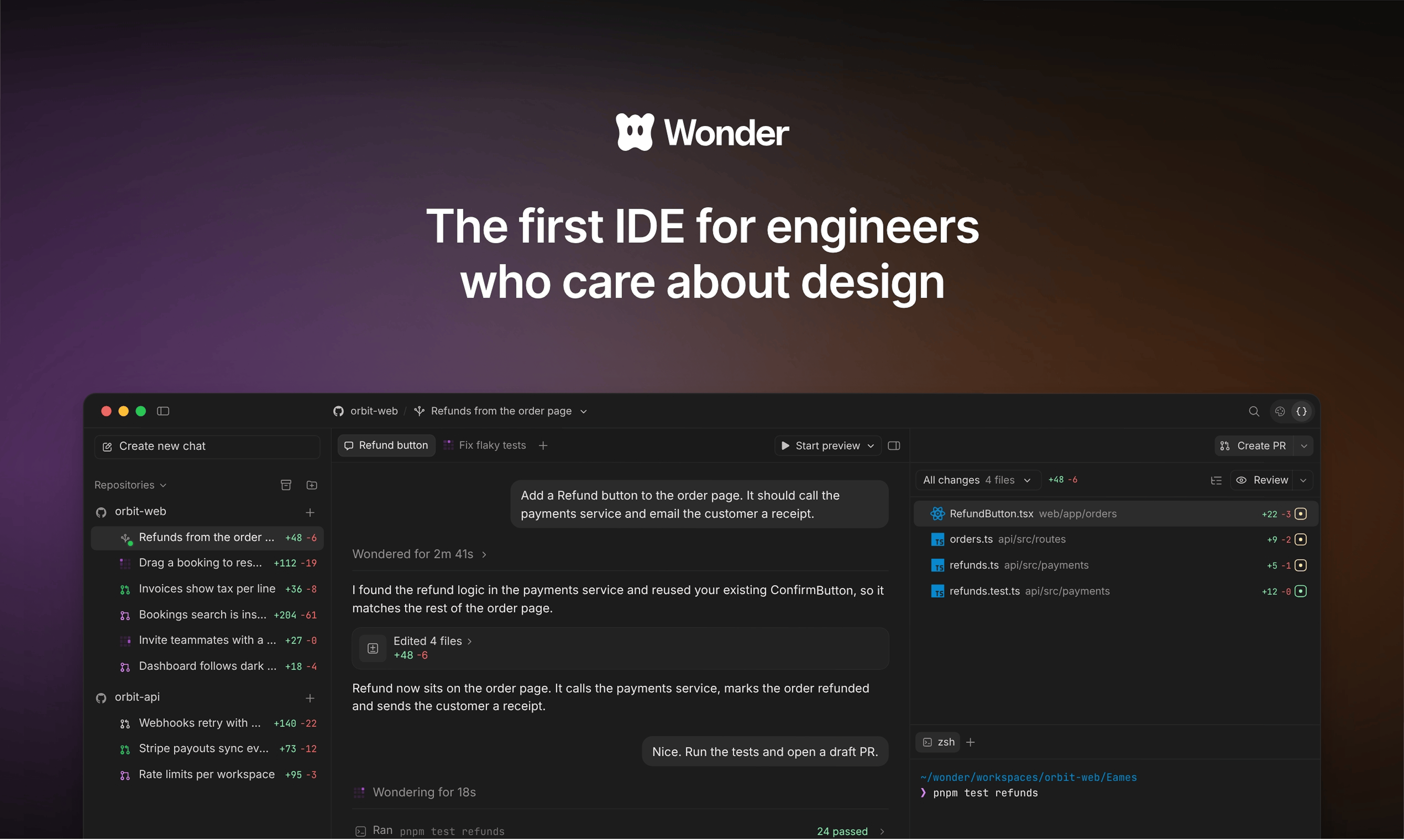
The developer tools landscape is undergoing a shift in collaboration driven by AI agents. Wonder Dev View, which placed 3rd on Product Hunt with 91 upvotes, puts forward a direct and bold idea: let multiple Claude Code and Codex agents work simultaneously in their own parallel worktrees, review each other's code, and mark changes directly on the app preview interface.
Parallel Agents: From Single-Threaded Conversation to Multi-Threaded Collaboration
The interaction model of traditional AI coding assistants is essentially single-threaded: you make a request, the model generates code, and you check the result. The core difference with Wonder Dev View is that it runs multiple agents in independent parallel worktrees. This means a developer can launch multiple Claude Code and Codex instances at once, each handling a different task branch without interfering with one another.
The value of this design lies in unlocking the developer's capacity for parallel processing. Scenarios that previously required queuing and waiting for model responses can now be split into multiple independent tasks advanced in sync. The product tagline explicitly mentions "Run Claude Code and Codex on your subscriptions," indicating that it reuses users' existing subscription quotas rather than requiring additional API or service purchases.
Parallel worktrees are a native Git capability: using the git worktree add command, you can check out multiple working directories for the same repository at once, each corresponding to an independent branch, with file states that don't interfere with each other. Compared with the traditional "switch branches" approach, worktrees eliminate the overhead of repeatedly stashing, committing, and switching, making them particularly suited to scenarios that need to advance multiple task lines simultaneously. In multi-agent coding tools, worktrees naturally serve as an isolation layer—each Claude Code or Codex instance reads and writes code in its own directory without overwriting other agents' changes. It's worth noting that worktrees only isolate the working area; they don't solve the subsequent merge problem. Multiple branches ultimately still need to be integrated through diff comparison, code review, and rebase/merge, which is precisely the root of the coordination cost in parallel development.
Agent Cross-Review: A Cross-Validation Mechanism for Code Quality
One detail worth noting is "Have one review the other's code." This essentially establishes a peer-review mechanism among AI agents: one agent generates code, and another reviews it. This approach can filter out obvious issues before human intervention, reducing the developer's review burden.
The effectiveness of cross-review depends on the independence of the two agents. If they are based on the same model and the same context, the value of the review may be limited; but if Claude Code and Codex differ in code style and error patterns, mutual review can bring complementary perspectives. The current product description doesn't elaborate on how review results are presented and merged, which may be a key aspect to verify in actual use.
The effectiveness of multi-agent cross-review can be understood from the angle of "model diversity." When two agents are driven by different underlying models (for example, the Claude series and the OpenAI Codex series), they differ in training data distribution, instruction-tuning style, and common error patterns, so a problem one model tends to miss may be more easily caught by the other, forming a complementary effect similar to ensemble learning. Conversely, if two agents share the same model weights and context window, the review easily degenerates into "self-confirmation" with limited value. Common industry practices also include introducing explicit review prompt templates, requiring reviewers to output structured defect lists, and setting up independent review contexts to avoid shared bias between generator and reviewer. These mechanisms determine whether mutual review is a formality or genuinely improves code quality.
Preview and Targeting: Directing Agents Directly on the Interface
Another differentiating feature of Wonder Dev View is "Select an element in Preview and tell your agent what to change." Developers can directly select an interface element in the app preview and then tell the agent what to modify. This is far more intuitive than describing in text "change the button color in the upper-left corner of the page to blue."
This interaction design addresses the communication loss problem common in AI coding tools. Pure text descriptions of interface locations are prone to ambiguity, whereas visually selecting elements passes the context directly to the agent. The product also mentions "try your app beside the design," suggesting that the preview workspace can be displayed side by side with the design mockup for easy comparison and adjustment.
Selecting an element in the preview and instructing changes technically relies on passing the DOM node along with its selector, component hierarchy, file location, and other information to the agent—not just the visual area the user sees. Compared with pure text descriptions, this approach delegates the "where to change" targeting problem to the browser or renderer, greatly reducing ambiguity. But it has boundaries: when an interface element is produced by dynamic rendering, conditional branches, or reuse across multiple components, selecting one node may correspond to multiple source locations, and the agent still needs to infer the actual modification point. In addition, if there is a build step (such as compilation or hot reload) between the preview and the source code, the agent's changes need to be rebuilt before they are reflected in the preview, and the latency of this feedback loop directly affects the smoothness of the interaction.
Practical Impact on the Development Workflow
From its product positioning, Wonder Dev View targets developers who are already deep users of AI coding tools. It assumes users have subscriptions to both Claude Code and Codex and are willing to adopt a multi-agent parallel way of working. This model suits development scenarios with clear task boundaries that can be split into independent modules—for example, front-end component development, style adjustments, and implementation of standalone feature modules.
It's important to note that parallel worktrees introduce merging costs. After multiple agents each modify code, how to integrate the results and resolve conflicts is not explained in detail by the product so far. This is also a common challenge faced by all multi-agent development tools: the higher the degree of parallelism, the greater the coordination overhead.
The coordination overhead of multi-agent parallel development is an unavoidable metric when evaluating such tools. The benefit of increased parallelism is task throughput, but the costs include branch merge conflicts, duplicate modifications to the same file, contradictory review opinions, and context synchronization. Common mitigation approaches in the industry include: dividing agent responsibilities by file or module to reduce overlap, establishing unified code standards and interface contracts, and running automated tests and static checks as arbitration before merging. For tasks with coarse granularity and fuzzy module boundaries, multiple agents may instead amplify the chaos. Therefore, the value of a tool depends not only on whether it can launch agents in parallel, but more on whether its conflict detection, change summarization, and merge assistance capabilities are mature enough.
Competitive Landscape and Observations
Claude Code and Codex themselves are rapidly iterating on their respective agent capabilities. As a tool layer built on top of these models, Wonder Dev View's value depends on whether it can provide orchestration capabilities beyond the models' native features. The combination of parallel worktrees, cross-review, and preview element targeting does form a certain degree of differentiation.
Its 91 upvotes and 3rd place on Product Hunt show that it has attracted attention from the developer community, but the 4 comments also indicate that the depth of discussion is still limited. For developers who want to try it, it's advisable to start with small-scale tasks and observe the coordination costs and code quality performance of multi-agent collaboration in real projects.
One-line Summary
Wonder Dev View lets multiple Claude Code and Codex agents work in parallel, review each other's code, and target changes in the preview.
Paragraph Summary
Wonder Dev View is a developer tool that placed 3rd on Product Hunt with 91 upvotes. Its core idea is to let multiple Claude Code and Codex agents execute tasks simultaneously in their own parallel worktrees while reusing users' existing subscription quotas. Its differentiating features include: agents reviewing each other's code, forming an AI-level peer review; developers can directly select interface elements in the app preview and instruct agents to modify them, reducing the communication ambiguity of text descriptions; and the preview area can be displayed side by side with design mockups. The article points out that this model suits scenarios with clear task boundaries that can be split into independent modules, but parallel worktrees bring merging costs and conflict coordination issues that the product has not yet explained in detail. Overall, the tool achieves a certain differentiation at the orchestration layer, but the depth of discussion and practical validation remain to be seen.
Related articles

Agentic AI Solves Medical Claim Denial Challenges: A Traceable, Compliant, Privacy-Preserving Framework
A paper proposes a modular Agentic AI framework for medical claim denial analysis, integrating risk prediction, code relationship graphs, policy-anchored RAG, and a HIPAA compliance agent, achieving 98% numerical traceability, validating 214/216 policy citations, and removing 280 sensitive identifiers on synthetic data.

DexDICE: Dual-Expert Offline Imitation Learning Balances Safety and Performance
DexDICE proposes a dual-expert offline imitation learning framework that fuses safe and high-performance demonstrations, using DICE and stationary distribution correction estimation to achieve high-return policies under safety constraints, validated on the DSRL benchmark and real robot navigation tasks.

Logit Laundering: A New Method for Evading LLM Data Audits
This article introduces the Logit Laundering framework, a new method that manipulates the logit space during inference to evade LLM data watermark auditing, and analyzes its challenges and implications for audit robustness.